


















Lesson 1 of 47 · Getting Started
Course map: Introduction to Law
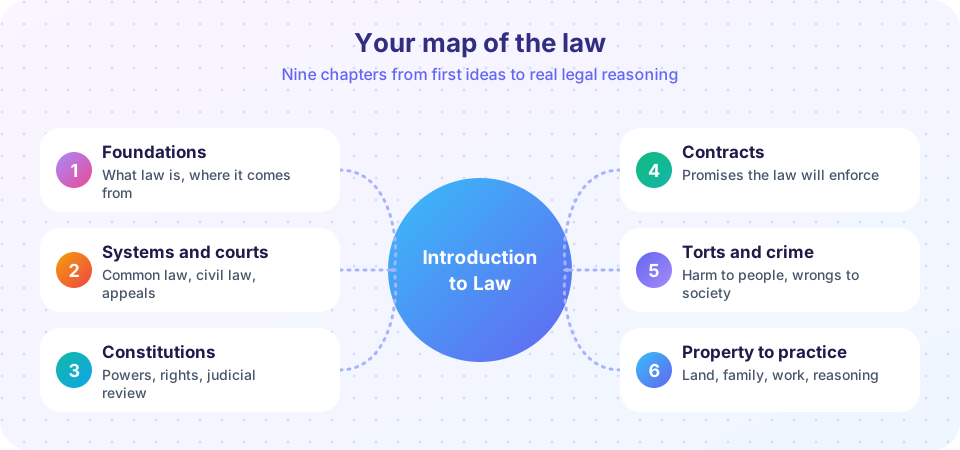
A friendly map of this introduction to law: who it is for, how the nine chapters fit together, and how to study legal ideas across different legal systems.
Law is the set of rules that a society recognizes as binding and is prepared to enforce. You meet it every day without noticing: when you buy a train ticket, rent a flat, sign up for a phone plan, take a job or cross a road. This course gives you the vocabulary, the big ideas and the reasoning habits you need to understand what law is, how it works and how lawyers think about problems.
Educational information only. This course explains how law works in general. It is not legal advice, and nothing here tells you what to do in a real situation. Laws differ by country, state and date, and they change. If you face a real legal problem, speak to a qualified lawyer or a legal aid service in your own jurisdiction.
What you will learn
- Who this course is written for and what you need before you start.
- How the nine chapters build on each other.
- Which legal systems the examples come from, and why we always say which one we mean.
- A simple routine for studying law: read, summarize, apply, test.
Who this course is for
The course is written for curious people aged about 14 and up, for students thinking about studying law, for people who work alongside lawyers (managers, engineers, journalists, founders) and for anyone who simply wants to understand the rules that shape their lives. You do not need any legal background. You do need two things: patience with careful wording, and willingness to argue both sides of a question.
Law uses ordinary words in precise ways. "Reasonable", "liable", "consideration" and "title" all have specific meanings that differ from everyday speech. Part of learning law is learning to slow down on words you thought you knew. We define every technical term the first time it appears and collect the main ones in a glossary later in the course.
A note on jurisdictions
There is no single "law of the world". Each country (and in federal countries, each state or province) has its own legal system. International law and regional systems such as the law of the European Union add further layers. So a statement like "a contract needs consideration" is true in England and most other common law countries, but it is not part of the law of France or Germany.
To keep you from mixing systems up, this course follows one rule: whenever we give a detailed rule, we say which system it comes from. Where we show examples, we use the legal tradition they come from, mostly:
- the common law tradition (England and Wales, the United States, Canada, Australia, India and many other countries), built on judicial decisions as well as statutes;
- the civil law tradition (France, Germany, Brazil, Japan, much of continental Europe, Latin America and parts of Asia), built on comprehensive written codes;
- public international law, the rules between states.
Real legal systems also mix traditions. Scotland, South Africa, Louisiana, Quebec and many Asian countries combine common law and civil law elements. Islamic, customary and religious law operate alongside state law in some places. Chapter 3 maps this variety.
The nine chapters
| Chapter | Question it answers |
|---|---|
| 1. Getting Started | What is law for, how is it divided, how do I study it? |
| 2. What Law Is and Where It Comes From | How does law differ from morality? What are its sources? |
| 3. Legal Systems and Courts | How do common and civil law differ? How do courts and appeals work? |
| 4. Constitutional and Public Law | Who holds power, and what limits it? |
| 5. Contracts | When will the law enforce a promise? |
| 6. Torts and Criminal Law | When must I pay for harm I cause, and when does the state punish? |
| 7. Property, Family and Employment Law | Who owns what, who is responsible for whom, what do workers and employers owe each other? |
| 8. Legal Reasoning and Practice | How do lawyers argue, read cases and write answers? |
| 9. Projects and Practice | Putting it together with case studies. |
Part 1: Foundations
Part 2: The machinery
Part 3: Private rights
Part 4: Skills
Chapters 1 to 4 give you the map and the machinery. Chapters 5 to 7 cover the three big areas of private life that everyone meets: agreements, harm and everyday relationships. Chapter 8 teaches the skill that makes lawyers lawyers, and chapter 9 lets you practice it.
How to study law
Law rewards active reading. A routine that works for most learners:
- Read slowly, once. Underline defined terms. Write a one-line summary of every section in your own words.
- Separate rule from example. Every legal passage has a general rule and specific facts. Ask: "What would change if the facts changed?"
- Apply before you check. Try each exercise before you read the explanation. An honest wrong answer teaches more than a lucky right one.
- Argue both sides. For any question, write the strongest argument for each party. Courts only hear disputes where both sides have an argument.
- Revisit. Come back to earlier chapters. Law is a web, and later ideas make earlier ones clearer.
A word about memorization. You will meet case names and statute names, and they matter, but understanding the principle behind a case is worth much more than remembering a date. When we name a case, we describe what it decided and why; check the exact citation in a proper law library before you rely on it.
Try it
The first demonstration is a small planner. Set how many hours you have per week and it shows how many weeks the course would take at a steady pace. It is a planning aid, not a prediction.
Press Run (or Ctrl + Enter) to see the console output here.
No output.
The second demonstration is a self-check flashcard drill. It shuffles the main questions of this chapter so you can test yourself.
Press Run (or Ctrl + Enter) to see the console output here.
No output.
Check your understanding
Quick check · 4 questions
of 4 answered You scored / 4 · perfect!
-
1. Why does this course say which legal system a rule comes from?
Each jurisdiction has its own law. A rule true in one system can be false in another, so naming the system prevents errors. -
2. Which pair names two major legal traditions?
Common law and civil law are the two largest Western traditions, and many countries mix them. -
3. What is the best way to use the exercises?
Active attempts, even wrong ones, build understanding faster than passive reading. -
4. Can this course replace a lawyer for your own legal problem?
Real problems depend on the facts, the jurisdiction and the current law, which only a qualified professional can assess.
Summary
- Law is the set of rules a society treats as binding and enforces.
- The course has nine chapters moving from foundations to machinery to private law to practice.
- Rules vary by legal system, so we always name the system (common law, civil law, international law).
- Study law by reading slowly, separating rule from example, applying before checking and arguing both sides.
- This is educational material, not legal advice.
Next: Why law matters
Track your progress
Create a free account to tick off lessons and pick up where you left off on any device.
of Introduction to Law lessons completed