


















Lesson 43 of 47 · Projects and Practice
Project: brief a landmark case
A guided project: learn the four-part case brief, brief Donoghue v Stevenson step by step, then choose another case and write your own brief.
A case brief is a short, structured summary of a judgment. Law students write them to make sure they have understood why a court decided as it did, and to build a personal library of authorities. In this project you will learn the format, study a worked example and then brief a case of your own. It is the best way to turn the reading skills of the last chapter into a habit.
Educational project. Briefs are study notes, not legal advice. When you write about real cases, rely on the judgment itself and be careful to describe the court's reasoning accurately. If you cannot check a detail, say so rather than guess.
What you will learn
- The standard parts of a case brief
- How to brief a case in your own words
- How to choose and brief a case yourself
- How to check your brief for quality
Key terms
Case brief: a short structured summary of a judgment. Holding: the court's answer to the legal question. Reasoning: the steps by which the court reached its holding. Disposition: what the court ordered (for example, appeal allowed).
The format
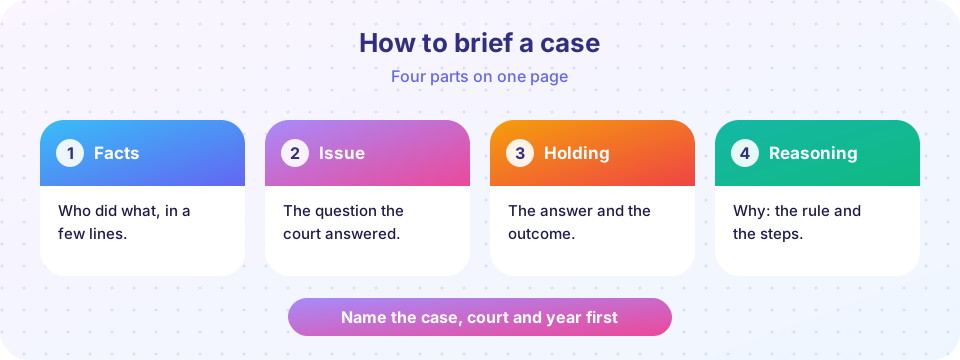
Write each brief on one page. Use these headings.
- Citation. Case name, court, year, and a reference to where it is reported.
- Facts. Only the facts that matter, in three to six sentences, in your own words.
- Procedural history. What happened in the lower courts, if relevant.
- Issue. The legal question the court answered, phrased as a question.
- Holding. The court's answer, in one or two sentences.
- Reasoning. The key steps and rules relied on, including any important statute or earlier case. Note the ratio decidendi.
- Disposition. The result: appeal allowed or dismissed, damages awarded and so on.
- Notes. Any dissent, important obiter remarks, why the case matters, and how later cases have treated it.
A worked example: Donoghue v Stevenson (1932)
Citation. Donoghue v Stevenson [1932] AC 562, House of Lords.
Facts. In August 1928, Mrs Donoghue was given a bottle of ginger beer in a cafe in Paisley, bought by a friend. She said she drank some and then saw the remains of a decomposed snail in the bottle, and later became ill. The bottle was opaque, so the snail could not have been seen beforehand. She had no contract with the cafe owner, and she sued the manufacturer.
Procedural history. The preliminary question was whether, if her facts were true, the law gave her any claim. The case reached the House of Lords on that question only. The facts were never proved at trial, and the case was reported as an appeal on the legal point.
Issue. Does a manufacturer of a product owe a duty of care to the ultimate consumer who is not a party to any contract with them?
Holding. Yes. By a majority of three to two, the House of Lords held that a manufacturer of products sold in a form that prevents reasonable inspection owes a duty to the consumer to take reasonable care that the product is free from defects likely to cause injury.
Reasoning. Lord Atkin reasoned from the idea that you must take reasonable care to avoid acts or omissions you can reasonably foresee would be likely to injure your neighbour, and that neighbours are people so closely and directly affected that you ought to have them in mind. The principle was grounded in morality and in earlier fragments of case law, and he said the absence of a contract should not prevent a claim in negligence.
Disposition. The appeal was allowed, so the claim could go forward.
Notes. Lords Buckmaster and Tomlin dissented, fearing an expansion of liability. The case created the modern tort of negligence. Its "neighbour principle" was later refined by cases such as Caparo v Dickman (1990).
Notice that the brief is concise, avoids quoting long passages and separates the broad principle (obiter and persuasive, developed later) from the narrow ratio about manufacturers.
How to do your own
- Choose a case. Pick a case from this course, such as Carlill v Carbolic Smoke Ball Co (1893), Hadley v Baxendale (1854), Bolton v Stone (1951), R v Woollin (1999) or Smith v Hughes (1960). Choose one where you can read the full judgment. Many UK judgments are free on the BAILII website, and the UK Supreme Court publishes its own decisions free; US decisions are available through the courts and public databases.
- Read it twice. First for the story, then for the reasoning.
- Draft in your own words. Do not copy long passages. Quotation marks are for the few words that matter.
- Check the ratio. Ask: if the court had decided the opposite on this point, would the outcome change?
- Add a "why it matters" note. One sentence on what later law owes to this case.
- Review. Is it one page? Is every sentence necessary? Could a classmate use it to understand the case without reading it?
Quality checklist
- Did you separate facts, issue, holding and reasoning?
- Is the issue a real legal question, not a topic?
- Is the holding an answer, not a summary?
- Did you avoid facts that do not affect the reasoning?
- Did you mention dissents or important obiter remarks?
Try it
Press Run (or Ctrl + Enter) to see the console output here.
No output.
Check your understanding
Quick check · 4 questions
of 4 answered You scored / 4 · perfect!
-
1. The holding of a case is:
It answers the issue. -
2. Which should be in your own words?
Briefs are your own summaries; quote only the few words that matter. -
3. A good issue statement is phrased as:
For example: does a manufacturer owe a duty of care to a consumer? -
4. A quick test for the ratio is:
If yes, the point is necessary to the decision.
Summary
- A case brief has citation, facts, issue, holding, reasoning, disposition and notes.
- Write it in your own words and keep it to one page.
- Test the ratio by asking what would change the outcome.
Next: Practice problems
Track your progress
Create a free account to tick off lessons and pick up where you left off on any device.
of Introduction to Law lessons completed