


















Lesson 27 of 47 · Contracts
Chapter 5 review: Contracts
Review the whole contracts chapter with a one-page picture, a recap table, a worked scenario and a ten-question mixed quiz.
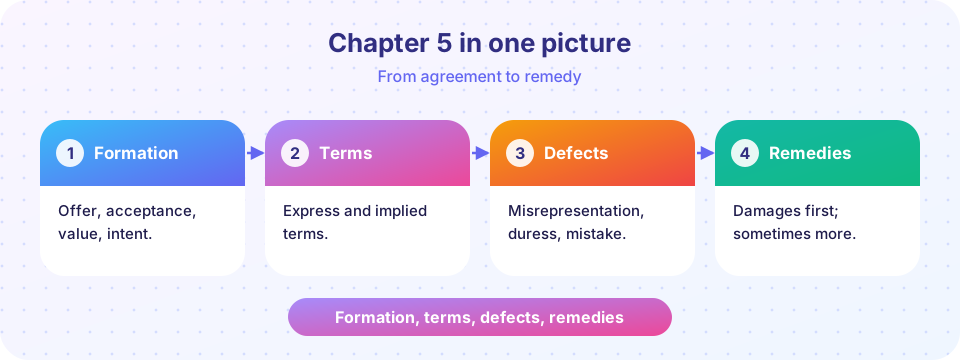
You have followed a contract from its birth to its breakdown. This review pulls the pieces together so you can see the chain: formation, terms, defects, and remedies. Use it to check whether you can explain each idea in your own words before moving on to torts and crime.
What you will learn
- How to see a contract problem as a sequence of questions
- Which lesson to revisit for each topic
- How to apply the whole chapter to one short scenario
Recap table
| Stage | Key question | Main ideas and cases |
|---|---|---|
| Formation | Was there a binding agreement? | Offer and acceptance (Carlill, Hyde v Wrench), consideration (Currie v Misa, Stilk v Myrick), intention (Balfour v Balfour), capacity |
| Terms | What did the parties promise? | Express and implied terms, conditions and warranties, exclusion clauses |
| Defects | Was consent genuine? | Misrepresentation, duress, undue influence, mistake, illegality |
| Remedies | What can the innocent party claim? | Expectation damages, Hadley v Baxendale, mitigation, specific performance |
A worked scenario
Maya runs a bakery. On 1 March she emails a supplier: "I will buy 500 kg of flour at 1.20 pounds a kilo, delivery on 10 March." The supplier replies: "Agreed, but delivery on 12 March." Maya does not respond. On 10 March no flour arrives. Maya buys 500 kg elsewhere at 1.50 pounds a kilo.
Work it through. Formation: the supplier's reply changed the delivery date, so it is a counter-offer (Hyde v Wrench). Maya's silence is not acceptance, so there may be no contract at all. If instead Maya had replied "fine", a contract would exist with delivery on 12 March, and the 10 March non-delivery would not be a breach. Suppose she accepts the original terms and the supplier agrees; then there is a contract for 10 March. Breach: failure to deliver. Remedy: damages of the extra cost, 0.30 pounds a kilo times 500 kg, which is 150 pounds, subject to mitigation (she did mitigate by buying elsewhere promptly).
Notice the habit: each answer depends on a small fact, and the reasoning is the same every time. Ask the questions in order.
Try it
Press Run (or Ctrl + Enter) to see the console output here.
No output.
Check your understanding
Quick check · 10 questions
of 10 answered You scored / 10 · perfect!
-
1. A shop price tag on a self-service shelf is usually:
Boots (1953): the customer makes the offer at the till. -
2. Which case involved an advertisement treated as a unilateral offer?
The smoke ball advertisement promised 100 pounds to anyone who met the conditions. -
3. A new term added in reply to an offer is:
It rejects the original offer and proposes a new one. -
4. Which is NOT a vitiating factor?
Mitigation is a duty to reduce loss after a breach, not a defect in consent. -
5. A term that goes to the root of a contract is a:
Breach of a condition allows termination. -
6. The test of remoteness comes from:
Losses must arise naturally or be within the parties' contemplation. -
7. Which remedy is most likely for a contract to sell a unique painting?
Damages may be inadequate for unique goods. -
8. A voidable contract is:
The innocent party chooses whether to affirm or rescind. -
9. Which of these statements about writing is correct?
Only certain contracts, such as sales of land, need writing. -
10. The duty to take reasonable steps to reduce loss is called:
You cannot recover for avoidable loss.
Summary
- Work through contract problems in order: formation, terms, defects, remedies.
- Small factual changes can reverse the outcome.
- Money damages are the normal remedy; specific performance is exceptional.
- Always state which legal system you are describing.
Track your progress
Create a free account to tick off lessons and pick up where you left off on any device.
of Introduction to Law lessons completed