


















Lesson 25 of 47 · Contracts
Terms, exclusion clauses and defects in consent
What a contract says and when it can be challenged: express and implied terms, exclusion clauses, misrepresentation, duress and mistake explained.
Once you know a contract exists, the next questions are practical. What exactly did each side promise? Can one side limit its responsibility? And what if one party agreed only because they were lied to, threatened or badly mistaken? This lesson covers the content of a contract (its terms) and the main reasons the law lets someone escape or challenge one.
Jurisdiction. The rules here are those of England and Wales, with notes on the US where useful. Educational information, not legal advice.
What you will learn
- The difference between express and implied terms
- Conditions, warranties and the effect of breaking each
- How courts control exclusion clauses
- Misrepresentation, duress, undue influence and mistake in plain terms
Key terms
Term: a promise that forms part of the contract. Representation: a statement of fact that induces a contract but is not itself a term. Condition / warranty: an essential term / a lesser term. Exclusion clause: a term that limits or removes liability. Void / voidable: treated as never existing / valid until the innocent party cancels it.
Express terms
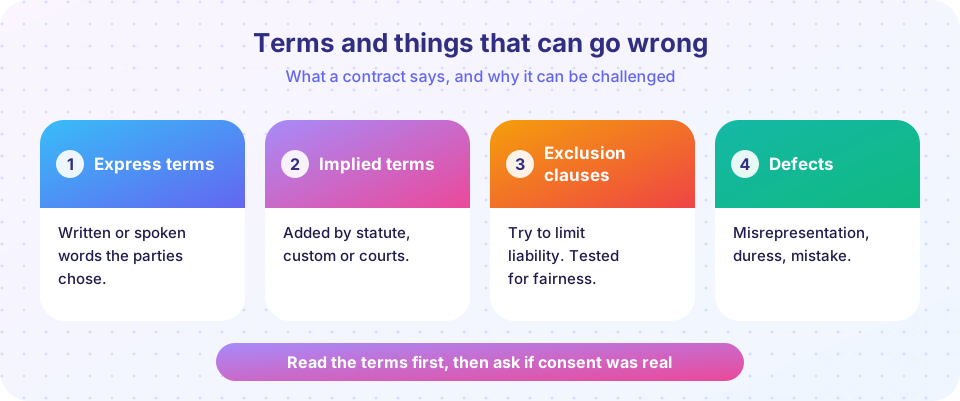
Express terms are the ones the parties actually said or wrote. In a phone contract they include the monthly price, the length of the agreement and the data allowance. Courts read them objectively, using the ordinary meaning of the words in context. If a written contract looks complete, the parol evidence rule generally stops a party from adding earlier spoken promises, though there are exceptions.
How do you tell a term from a mere sales talk? Judges look at how important the statement was, whether the speaker had special knowledge, whether it was written into the final document, and how much time passed before the deal. In Bannerman v White (1861), a buyer of hops said sulphur must not have been used; this was held to be a term because it was clearly important to him.
Implied terms
Courts and Parliament also add terms that nobody wrote down. These come from three places.
- Statute. Under the Consumer Rights Act 2015, goods sold to consumers in England must be of satisfactory quality, fit for a particular purpose the buyer made known, and as described. Services must be performed with reasonable care and skill. In the US, the UCC creates a warranty of merchantability.
- Custom and trade usage. Standard practices in a market can be implied.
- Business efficacy. A term may be implied if the contract would not work without it. The test is strict: the term must be necessary, obvious and capable of being clearly expressed.
Conditions and warranties
Not all terms are equally serious. A condition goes to the root of the contract; if it is broken, the innocent party can end the contract and claim damages. A warranty is a lesser term; breaking it gives only a right to damages. In between, some terms are innominate, and the court looks at how serious the consequences of the breach were. In Poussard v Spiers and Pond (1876), an opera singer who missed the opening nights could be replaced, because her presence was a condition. In Bettini v Gye (1876), a singer who missed a few rehearsals was held to have breached only a warranty.
Exclusion clauses
An exclusion clause tries to limit or remove liability, for example "we are not responsible for lost property." Courts have always disliked unfair surprises, so they control these clauses in three steps.
- Incorporation. Was the clause part of the contract? A notice must be given before or when the contract is made. In Olley v Marlborough Court Hotel (1949), a notice displayed in a hotel bedroom came too late, after the guest had booked and paid. In Thornton v Shoe Lane Parking (1971), onerous terms needed especially clear notice.
- Interpretation. Do the words cover what happened? Ambiguity is read against the person relying on the clause (the contra proferentem rule).
- Statutory control. Under the Unfair Contract Terms Act 1977, a business cannot exclude liability for death or personal injury caused by negligence, and other exclusions must pass a reasonableness test. The Consumer Rights Act 2015 also lets courts strike down unfair terms in consumer contracts.
When consent goes wrong
A contract may be formed but still be challengeable because one party's consent was not genuine. These are called vitiating factors.
Misrepresentation. A false statement of fact that induces the other party to contract. It may be innocent, negligent or fraudulent. In Derry v Peek (1889), fraud required knowing falsehood or recklessness. The Misrepresentation Act 1967 gives remedies, mainly rescission (undoing the contract) and, in some cases, damages. Opinions and sales puffery ("the best car in town") are not usually actionable. Silence is also generally not misrepresentation, though half-truths and changed circumstances can be.
Duress. Illegitimate pressure that leaves no practical alternative. Threats of violence are classic duress. Economic duress, such as a supplier threatening to stop delivery unless prices rise, can also qualify, but only if the pressure was illegitimate and the victim had no reasonable alternative.
Undue influence. One person abuses a relationship of trust to get the other to agree. Some relationships raise a presumption, such as parent and child or solicitor and client. The leading modern case is Royal Bank of Scotland v Etridge (No 2) (2001), which tells banks how to protect people who stand as guarantors for a partner's debts.
Mistake. If both parties share a fundamental mistake about something that goes to the root of the contract, such as the contract subject has already been destroyed, the contract may be void. Mistakes about quality or value are usually not enough. In Bell v Lever Brothers (1932), the House of Lords refused to set aside a payment where the mistake was only about the value of the deal.
Illegality. Contracts to commit a crime are unenforceable, and contracts that unreasonably restrain trade are void unless justified.
Common misconceptions
"If it is in the small print, it always applies." Not necessarily. Terms must be properly incorporated, clearly worded and, for consumers, fair.
"A false statement always lets me cancel." Only if it was a statement of fact that induced the contract. Opinions and obvious exaggeration do not usually qualify.
"Void and voidable are the same." A void contract never had legal effect. A voidable contract is valid until the innocent party chooses to cancel it.
Try it
Press Run (or Ctrl + Enter) to see the console output here.
No output.
Check your understanding
Quick check · 5 questions
of 5 answered You scored / 5 · perfect!
-
1. Which is an implied term under the Consumer Rights Act 2015?
Satisfactory quality, fit for purpose and as described are implied by statute in consumer sales. -
2. Breach of a condition typically allows the innocent party to:
Conditions go to the root of the contract; warranties give only damages. -
3. In Olley v Marlborough Court Hotel (1949), why did the exclusion notice fail?
Terms must be brought to the other party's attention before or when the contract is made. -
4. A contract made after a threat of violence is best described as made under:
Duress is illegitimate pressure that overcomes genuine consent. -
5. A voidable contract is:
The innocent party may choose to affirm it or to rescind it.
Summary
- Express terms are what the parties said; implied terms come from statute, custom or necessity.
- Conditions allow ending the contract; warranties give damages.
- Exclusion clauses must be incorporated, clearly worded and, where statutes apply, reasonable or fair.
- Misrepresentation, duress, undue influence and mistake attack genuine consent.
- Voidable contracts stay valid until cancelled.
Next: Breach and remedies
Track your progress
Create a free account to tick off lessons and pick up where you left off on any device.
of Introduction to Law lessons completed