


















Lesson 28 of 47 · Torts and Criminal Law
Chapter 6 overview: Torts and criminal law
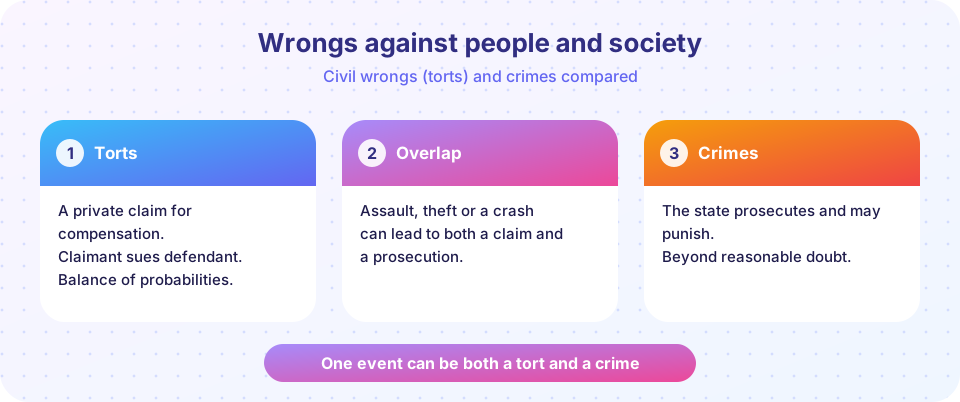
A big-picture comparison of tort law and criminal law: who brings the case, what must be proved, and what remedies or punishments follow.
Sometimes the law is not about a promise but about harm. A driver hurts a cyclist. A newspaper prints a false story. A man takes a bicycle that is not his. Two parts of the law deal with these events in different ways. Tort law lets the injured person claim compensation from the wrongdoer. Criminal law lets the state prosecute the wrongdoer and punish them. Understanding the difference is one of the first real steps toward thinking like a lawyer.
Which legal system? This chapter mainly describes England and Wales, with notes on the US where helpful. Educational information, not legal advice.
What you will learn
- The difference between a tort and a crime
- Why the burden of proof differs in each
- Where the two areas overlap
- What each lesson in this chapter covers
Key terms
Tort: a civil wrong, other than breach of contract, for which the law gives a remedy. Claimant / defendant: the person who sues / the person who is sued or prosecuted. Prosecution: the party, usually the state, that brings a criminal case. Standard of proof: how sure the court must be.
Torts and crimes side by side
| Tort (civil) | Crime (criminal) | |
|---|---|---|
| Purpose | Compensate the victim | Punish, deter, protect the public |
| Who brings the case | The injured person (claimant) | The state (prosecution) |
| Standard of proof | Balance of probabilities (more likely than not) | Beyond reasonable doubt |
| Typical outcome | Damages or an injunction | Fine, community order, imprisonment |
| Example | Negligent driving injures a cyclist | Dangerous driving |
Why is the criminal standard so high? Because the consequences are severe: loss of liberty and a public stigma. The law prefers that some guilty people go free over convicting innocent ones. In tort, the dispute is between two private parties, so the law uses an even-handed standard.
One event, two cases
A single event can lead to both. If a driver deliberately hits a pedestrian, the state may prosecute for an offense, and the pedestrian may also sue for the tort of battery or negligence. The two cases are separate, run in different courts under different rules, and a conviction can sometimes be used as evidence in the civil case. A famous US example, the O. J. Simpson matter of the 1990s, ended in an acquittal in the criminal trial and a finding of liability in the civil trial, which shows how the different burdens can produce different outcomes.
A map of this chapter
- Negligence basics explains the most important tort: duty, breach, causation and damage.
- Other torts and defences covers nuisance, trespass, defamation, and defences.
- Criminal law basics covers actus reus, mens rea, burden of proof, defences and the criminal process.
- Chapter review mixes everything in a ten-question quiz.
Try it
Press Run (or Ctrl + Enter) to see the console output here.
No output.
Check your understanding
Quick check · 4 questions
of 4 answered You scored / 4 · perfect!
-
1. Who normally brings a criminal case?
Criminal cases are public wrongs brought by the prosecution. -
2. The civil standard of proof is:
More likely than not. -
3. Can one event lead to both a tort claim and a criminal case?
They use different courts, standards and outcomes. -
4. Which outcome is typical of a tort claim?
Torts compensate the victim.
Summary
- Torts compensate; crimes are punished by the state.
- The criminal standard of proof is higher.
- One event can be both a tort and a crime.
Next: Negligence basics
Track your progress
Create a free account to tick off lessons and pick up where you left off on any device.
of Introduction to Law lessons completed