


















Lesson 45 of 47 · Projects and Practice
Glossary of legal terms
A plain-language glossary of the key terms in this introduction to law, grouped by theme, with a search box and a practice quiz.
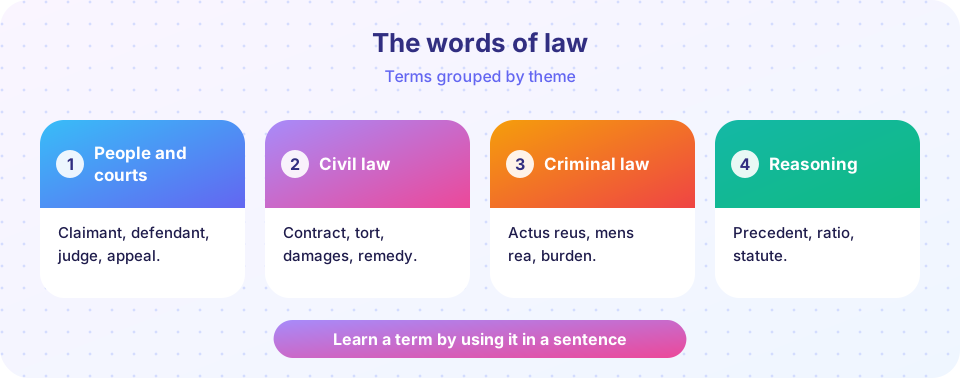
Law has its own vocabulary, and some of it is Latin. This glossary collects the main terms from the course in plain language and groups them by theme. Use the search box in the first example to find a word fast, and try to use each term in a sentence of your own. Definitions describe the usual meaning in England and Wales; terms may be used slightly differently elsewhere. This is educational information, not legal advice.
What you will learn
- The core vocabulary of this course
- How the terms group together
- How to test yourself on them
People, courts and process
| Term | Meaning |
|---|---|
| Claimant | The person who brings a civil claim (called the plaintiff in the US and in older English usage). |
| Defendant | The person sued in a civil case or prosecuted in a criminal case. |
| Prosecution | The party, usually the state, that brings a criminal case. |
| Appeal | A request that a higher court review a decision. |
| Jurisdiction | The authority of a court, or the territory whose law applies. |
| Burden of proof | The duty to prove a case. |
| Standard of proof | How sure the court must be: balance of probabilities (civil) or beyond reasonable doubt (criminal). |
Civil law: contract, tort and property
| Term | Meaning |
|---|---|
| Offer | A promise to be bound on stated terms if accepted. |
| Acceptance | Unqualified agreement to the terms of an offer. |
| Invitation to treat | An invitation to make offers, such as goods on a shelf. |
| Consideration | The value given by each side in a contract. |
| Term | A promise forming part of a contract. |
| Condition / warranty | An essential term / a lesser term. |
| Breach | Failure to perform a legal duty, such as a contract term. |
| Damages | Money awarded as compensation. |
| Specific performance | A court order to perform a contract. |
| Misrepresentation | A false statement of fact that induces a contract. |
| Void / voidable | Treated as never valid / valid until cancelled. |
| Tort | A civil wrong, other than breach of contract, giving a claim for a remedy. |
| Negligence | Failure to take reasonable care, causing harm to someone owed a duty. |
| Causation | The link between a breach and the harm. |
| Nuisance | Unreasonable interference with the use of land. |
| Trespass | Direct, unjustified interference with a person, goods or land. |
| Defamation | A false statement that harms reputation. |
| Freehold / leasehold | Ownership without a time limit / a right to occupy for a fixed term. |
| Easement | A right over another person's land. |
| Intellectual property | Rights in creations such as copyright and patents. |
| Intestacy | Dying without a valid will. |
| Parental responsibility | A parent's rights and duties toward a child. |
Criminal law
| Term | Meaning |
|---|---|
| Actus reus | The guilty act, with its circumstances and consequences. |
| Mens rea | The guilty mind, such as intention or recklessness. |
| Intention | Aim or purpose; in some cases, virtual certainty plus awareness. |
| Recklessness | Awareness of an unjustified risk and going ahead. |
| Strict liability | An offense that does not require proof of a mental element for one or more elements. |
| Automatism | Loss of voluntary control; a defence. |
| Insanity | A legal defence based on a disease of the mind; not the same as the medical idea. |
| Duress | Acting under threat of serious harm. |
Legal reasoning and sources
| Term | Meaning |
|---|---|
| Statute | A law passed by a legislature. |
| Precedent | An earlier decision that guides later cases. |
| Ratio decidendi | The legal reason necessary to a decision; it binds. |
| Obiter dictum | A remark made in passing; persuasive only. |
| Stare decisis | The doctrine that courts follow earlier decisions. |
| Distinguish | To show that a precedent does not apply because the facts differ. |
| Overrule | For a higher court to declare an earlier decision wrong. |
| Common law | Law developed through judicial decisions; also a family of legal systems. |
| Civil law | A family of legal systems based mainly on codes; also private law in general. |
| IRAC | Issue, Rule, Application, Conclusion. |
Notice that some words, such as "civil law" and "common law," have more than one meaning. Check which meaning is used in context.
Try it
Press Run (or Ctrl + Enter) to see the console output here.
No output.
Check your understanding
Quick check · 4 questions
of 4 answered You scored / 4 · perfect!
-
1. A person who brings a civil claim is the:
Plaintiff in the US. -
2. Which pair is correctly matched?
The ratio is the reason needed for the decision. -
3. A freehold is:
Contrast leasehold. -
4. Strict liability means:
It is mostly used for regulatory offenses.
Summary
- Learn terms in groups and use them in sentences.
- Some terms, such as common law and civil law, have more than one meaning.
- Definitions can vary by country, so always check the system.
Next: Cheat sheet
Track your progress
Create a free account to tick off lessons and pick up where you left off on any device.
of Introduction to Law lessons completed