


















Lesson 12 of 47 · Legal Systems and Courts
Common law and civil law: two great traditions
Compare the common law and civil law traditions: their history from Rome and medieval England, the role of codes and precedent, how trials differ, and mixed systems.
If you ask lawyers in London and Paris to describe how law works, you will hear two different stories. In London the story starts with judges deciding cases and gradually building rules. In Paris it starts with a code that sets out principles in general terms, with judges applying it. Both systems protect rights, enforce contracts and punish crimes, and in practice they have grown more alike. But their history and habits still shape how lawyers think, how they argue and how judgments are written.
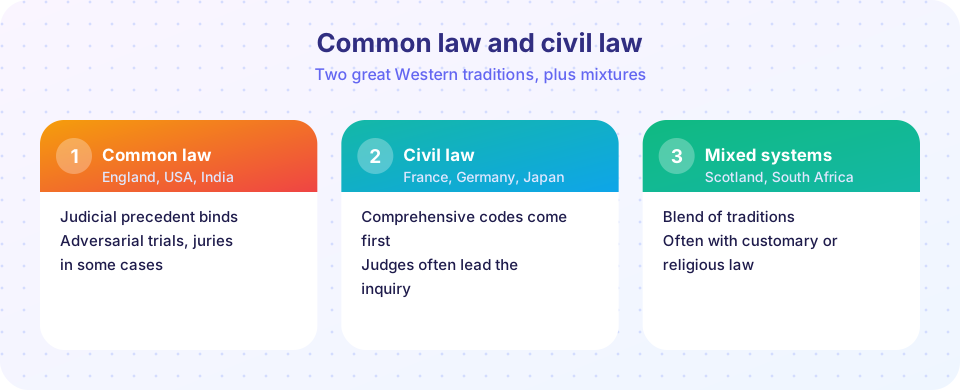
What you will learn
- How the civil law tradition grew from Roman law and the common law from medieval English courts.
- The main differences: sources, the role of precedent, the judge and the trial.
- Why the differences are narrowing.
- What mixed systems and other traditions look like.
Key terms
Common law: a tradition that began in England in which judicial decisions are a major source of law.
Civil law (tradition): a tradition rooted in Roman law in which comprehensive written codes are the primary source. Not the same as the civil branch of law.
Codification: collecting and organizing a field of law into a systematic, authoritative text.
Adversarial system: a procedure in which the parties, through their lawyers, present the case to a neutral judge or jury.
Inquisitorial system: a procedure in which the court takes an active role in investigating the facts.
Roots of the civil law tradition
The civil law tradition begins in ancient Rome. The Roman emperor Justinian had the legal writings of Roman jurists collected and organized in the sixth century, in a work later called the Corpus Juris Civilis (about 529 to 534). After the Western Roman Empire collapsed, the text was rediscovered in Italy in the eleventh century and became the core of teaching at the University of Bologna, one of the first universities. Scholars across Europe studied it, and a shared body of learning, the ius commune, developed.
The decisive step came in the nineteenth century: codification. France's Code civil of 1804, also called the Napoleonic Code, collected private law in a clear, accessible text. It was exported through conquest and imitation to many parts of Europe, Latin America and beyond. Germany completed its Civil Code (Bürgerliches Gesetzbuch, BGB) in 1896, in force from 1900; it is more technical, and it strongly influenced Japan, South Korea, and parts of Eastern Europe. The idea behind a code is that law should be written systematically by the legislature so that citizens and judges can find it.
Roots of the common law
The common law starts after the Norman conquest of England in 1066. Over the following century kings, especially Henry II (reigned 1154 to 1189), sent royal judges around the country. They applied a body of rules that became "common" to the whole kingdom, replacing the local customs that had varied from region to region. The writ system gave claimants access to royal courts for particular kinds of claim. Over time judges' decisions were recorded, and later judges cited them. The doctrine of precedent hardened in the eighteenth and nineteenth centuries.
A second court system, the Court of Chancery, developed equity, a body of remedies and principles that softened the rigidity of the common law courts. Equity gave us the trust, injunctions and specific performance. England merged the systems of law and equity procedurally in the 1870s. English colonial history spread the common law to North America, Australia, India, parts of Africa, and many other places, where it has adapted to local conditions.
Main differences
| Feature | Common law (typical) | Civil law (typical) |
|---|---|---|
| Starting point | Statutes and earlier cases | The code and statutes |
| Role of precedent | Formally binding in hierarchy | Persuasive; high court decisions are influential but not formally binding |
| Trial style | Adversarial: parties control the evidence | More inquisitorial: judge plays a bigger role in gathering evidence |
| Juries | Used in some criminal and civil trials (especially USA) | Rare; lay judges or mixed panels in some cases |
| Judgments | Long, with named individual judges and reasoning | Often shorter and more formal; collegial judgments |
| Legal scholarship | Less central; judges and practitioners dominate | Scholars (doctrine) influence interpretation |
| Legal education | Case method in the United States | Systematic study of codes and doctrine |
These are tendencies, not absolutes. Judges in civil law countries do cite earlier decisions, and in some countries the highest courts' interpretations are practically binding. Common law judges do not simply invent rules: they work within statutes, constitutions and the pressure of precedent. In the United States, much of the law is statutory or constitutional, and in England the volume of statutes has grown enormously.
The convergence story
The two traditions have been moving toward each other.
- Common law countries have codified large areas: criminal codes in many Commonwealth countries, the Uniform Commercial Code in the United States (a model law adopted by the states).
- Civil law countries give increasing weight to the case law of their high courts and constitutional courts, and some now publish more detailed reasoning.
- International and regional bodies, such as the European Court of Human Rights and the Court of Justice of the European Union, mix styles, and lawyers from both traditions work together on international arbitration and treaty law.
Mixed systems and other traditions
Many legal systems combine elements:
- Scotland has Roman-law roots in its private law but is part of a United Kingdom system in which many statutes and the House of Lords (now the UK Supreme Court) have a common law flavor.
- South Africa developed from Roman-Dutch law with English law influence, and its 1996 Constitution adds a strong rights framework. Customary law is recognized.
- Louisiana (United States) and Quebec (Canada) keep civil law traditions in private law inside common law countries.
- Japan adopted European codes in the nineteenth century, later added strong American influence after 1945, and sits in the civil law family.
- Islamic law (sharia) is a source of law, in different ways and degrees, in many states, such as Saudi Arabia and Iran, and in family law in many others. Countries combine it with codes or statutes in diverse ways.
- Customary law governs aspects of life in many parts of Africa, Asia and the Pacific, often recognized by state courts.
- China has a socialist legal system with civil law features; it adopted a Civil Code in 2020.
Remember that "mixed" is the rule, not the exception, and that each country's arrangement has its own history.
Common misconceptions
"Common law means law that is common (ordinary)." The name comes from the idea of law common to the whole kingdom, as opposed to local custom.
"Civil law countries have no judge-made law." Courts there interpret codes, and that interpretation shapes what the code means in practice.
"One system is better." Each has strengths: predictability and accessibility in codified systems, flexibility and incremental development in case-based ones. Both can deliver justice or fail to.
Try it
First, compare two systems feature by feature. Change the field names or add systems and run it again.
Press Run (or Ctrl + Enter) to see the console output here.
No output.
Second, a timeline you can step through. Use the slider to move through the key dates of the two traditions.
Check your understanding
Quick check · 5 questions
of 5 answered You scored / 5 · perfect!
-
1. Which text is the foundation of the civil law tradition's Roman roots?
Justinian's compilation, rediscovered in medieval Italy, was the core of European legal learning. -
2. Which event began the formation of the English common law?
After 1066 royal judges, especially under Henry II, built a law common to the kingdom. -
3. What is a typical difference in trial style?
Common law trials rely on the parties presenting evidence; civil law judges generally play a larger role. -
4. Which is a mixed system?
Scotland, South Africa, Louisiana and Quebec are among the systems that combine traditions. -
5. Which statement about convergence is true?
Common law countries codify and civil law countries give weight to case law.
Summary
- The civil law tradition grew from Roman law and was spread by codification, notably the 1804 French and 1900 German civil codes.
- The common law grew from medieval English royal courts, with equity added by Chancery.
- Differences include sources, precedent, trial style, juries and the style of judgments, but they are tendencies.
- The traditions are converging, and many systems are mixed or combine state law with customary or religious law.
Next: Courts and appeals
Track your progress
Create a free account to tick off lessons and pick up where you left off on any device.
of Introduction to Law lessons completed