


















Lesson 13 of 47 · Legal Systems and Courts
Courts and appeals: who decides and who reviews
Understand how courts are organized: jurisdiction, trial and appeal courts, supreme and constitutional courts, specialist tribunals, judges and juries, with examples from several countries.
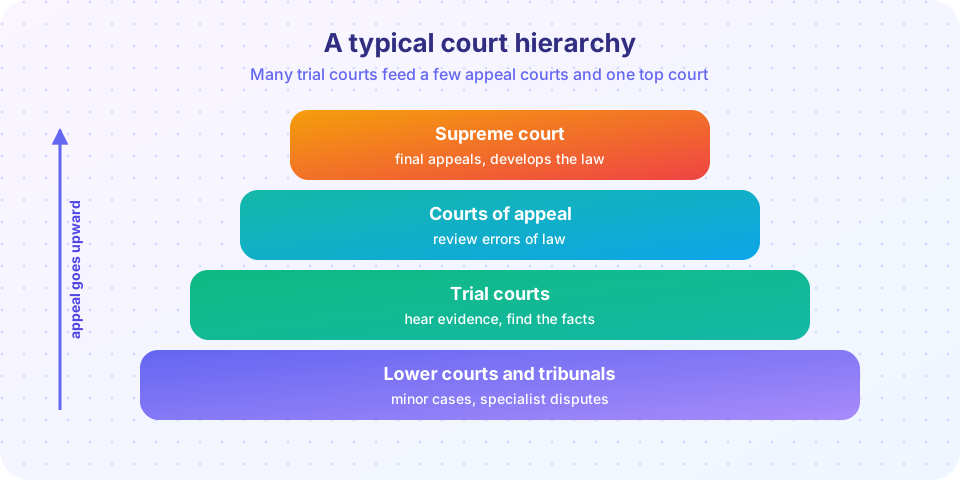
Law needs people who decide disputes. Courts are the institutions that do this: they hear the parties, find the facts, apply the law and issue binding decisions. Almost every legal system arranges its courts in tiers, so that a losing party can ask a higher court to check the result. This lesson explains how those tiers are organized, why, and what each tier does.
What you will learn
- What jurisdiction means and how it divides the work of courts.
- The difference between trial courts and appeal courts, and between errors of fact and errors of law.
- How supreme and constitutional courts differ.
- What specialist courts, judges and juries do.
Key terms
Jurisdiction: the power of a court to hear a type of case, or the territory it covers.
First instance (trial) court: the court that hears a case first and finds the facts.
Appeal: a request to a higher court to review a lower court's decision.
Appellant and respondent: the party who appeals and the party who answers the appeal.
Constitutional court: a court whose main task is to decide whether laws or acts are consistent with the constitution.
Jurisdiction: which court, which case?
Before a court can decide, it must have jurisdiction. There are several kinds:
- Subject-matter jurisdiction: a court may only hear certain kinds of case. A small claims court hears minor money disputes; a criminal court hears prosecutions; a family court hears divorces and child matters.
- Territorial jurisdiction: a court usually covers a geographic area. A local court hears disputes connected to its district.
- Original and appellate jurisdiction: a court with original jurisdiction hears a case first; one with appellate jurisdiction reviews decisions of lower courts.
- Monetary or seriousness limits: lower courts handle smaller claims or less serious crimes; serious crimes or large claims go to higher trial courts.
If a case is started in the wrong court, it may be transferred or dismissed, which is why practitioners check jurisdiction first.
Trial courts: finding the facts
A trial court, or court of first instance, is where witnesses are heard, documents examined and facts found. In a common law criminal trial, a jury of lay people may decide guilt, with a judge directing them on the law; in many civil law systems, panels of professional judges, sometimes with lay assessors, decide. The trial court applies the law to the facts it has found and produces a judgment or verdict, and in criminal cases a sentence.
Appeal courts: checking the result
A losing party can often ask a higher court to review the decision, but appeals are not a second trial in most systems. The distinction between questions of fact and questions of law is central:
- A question of fact asks what happened (who signed the contract, whether the defendant was driving). Appeal courts are reluctant to disturb findings of fact because the trial judge saw the witnesses.
- A question of law asks what the legal rule is or how it applies (what a statute means, whether evidence was wrongly admitted). Appeal courts are more willing to correct legal mistakes.
Many systems also require permission to appeal for higher levels, so that courts only hear cases that raise arguable errors or important points. An appeal court can uphold, reverse or vary the decision, or send the case back for a new hearing.
The purpose of appeals is twofold: to correct mistakes in individual cases and to give courts at the top a chance to develop and unify the law, so that similar cases are treated alike.
Supreme and constitutional courts
At the top is usually a supreme court or court of cassation, which gives the final word on questions of law. Examples:
- England and Wales: Magistrates' Courts and the Crown Court for criminal cases; the County Court and High Court for civil cases; the Court of Appeal; and the Supreme Court of the United Kingdom (created in 2009, taking over the judicial role of the House of Lords).
- United States: separate federal and state systems. Federal trial courts are called district courts; appeals go to the courts of appeals (circuits) and then to the Supreme Court of the United States, which chooses which cases to hear. Each state also has its own trial, appeal and supreme courts.
- France: ordinary courts (tribunaux judiciaires, appeal courts and the Cour de cassation at the top) hear civil and criminal cases, while a separate administrative branch, topped by the Conseil d'État, hears disputes with public authorities. A Conseil constitutionnel reviews laws for constitutionality.
- Germany: ordinary courts run from local courts (Amtsgerichte) through regional courts and higher regional courts to the Federal Court of Justice (Bundesgerichtshof); separate branches handle labor, administrative, social and tax cases; and the Federal Constitutional Court (Bundesverfassungsgericht) decides constitutional questions.
Two models of constitutional review exist. In the diffuse model, as in the United States, any court can decide constitutional questions in the cases before it, with the Supreme Court at the top. In the concentrated model, as in Germany and many European countries, one specialized court decides them. Chapter 4 returns to judicial review.
Specialist courts and tribunals
Many systems have courts or tribunals for particular subjects: employment, immigration, tax, planning, social security, family, juveniles, commercial disputes and small claims. They are often faster, cheaper and less formal than general courts, and may have judges with specialist expertise. Their decisions can usually be appealed to a higher court.
There are also non-court ways of resolving disputes: arbitration (parties agree a private decision maker will decide, widely used in international commerce), mediation (a neutral helps the parties negotiate), and ombudsmen (who investigate complaints about public bodies). These alternatives are known collectively as ADR, alternative dispute resolution.
Judges and juries
Judges are selected in very different ways. In many civil law countries they are career judges, trained and appointed through a state school or competitive exam. In common law countries they are usually chosen from experienced lawyers, by appointment (for example by a judicial commission in England and Wales) or in the United States, in some states, by election. Independence is a core value: judges must be free from pressure by government, parties and public opinion. Typical protections include security of tenure (they cannot easily be removed), fixed salaries and rules on conflict of interest.
Juries are groups of citizens who decide facts, and in some countries guilt. They are common in serious criminal trials in the United States, England and Wales and many other common law countries, and play a smaller role in civil cases, especially outside the United States. Some civil law countries use lay judges (Schöffen in Germany, mixed courts in other states) who sit with professional judges. Supporters of juries say they bring community values and check state power; critics point to cost, complexity and unpredictability.
Courts beyond the state
Some courts sit above or beside national systems. The International Court of Justice in The Hague settles disputes between states; the European Court of Human Rights in Strasbourg hears complaints from individuals against states that are parties to the European Convention on Human Rights; the Court of Justice of the European Union ensures uniform interpretation of EU law. Their powers come from treaties, and their decisions bind only those states that accepted their authority.
Common misconceptions
"An appeal is a new trial." Usually it is a review for errors, mostly legal, not a fresh hearing of all the evidence.
"The highest court hears every case." Top courts typically choose a small number of cases that raise important questions.
"All countries have juries." Many do not, or use them in only a few types of case.
"Courts make the law only when they decide appeals." Trial courts also apply and sometimes develop law, although appellate decisions have broader effect.
Try it
First, a small router that decides which court a case would normally start in, using made-up rules for a fictional country. It shows how jurisdiction narrows the choice.
Press Run (or Ctrl + Enter) to see the console output here.
No output.
Second, an appeal ladder. Choose a country and step up the ladder one level at a time.
Check your understanding
Quick check · 5 questions
of 5 answered You scored / 5 · perfect!
-
1. What is a question of law on appeal?
Appeal courts mostly review legal errors; findings of fact are usually left to the trial court. -
2. What is the main difference between diffuse and concentrated constitutional review?
The United States uses the diffuse model; Germany and many European countries use a single constitutional court. -
3. Which court was created in 2009 and took over the judicial role of the House of Lords?
The UK Supreme Court began work in 2009. -
4. Why do many systems require permission to appeal to the highest court?
Permission screening focuses top courts on cases that matter for the development of the law. -
5. Which of these is a form of alternative dispute resolution?
Arbitration and mediation resolve disputes outside the ordinary courts.
Summary
- Jurisdiction decides which court may hear a case: by subject, territory and level.
- Trial courts find facts; appeal courts mostly correct legal errors.
- Supreme courts unify the law; constitutional review may be diffuse or concentrated.
- Specialist tribunals and ADR relieve general courts.
- Judges must be independent; juries exist in some systems for some cases.
Track your progress
Create a free account to tick off lessons and pick up where you left off on any device.
of Introduction to Law lessons completed