


















Lesson 34 of 47 · Property, Family and Employment Law
Property law: land, goods and ideas
Understand property law: kinds of property, freehold and leasehold, how ownership is transferred, finders, intellectual property and inheritance.
When you say "this is mine", the law asks what you mean. Do you own the thing outright, or only have the right to use it for a while? Can you sell it? Can others be kept out? Property law answers these questions for land, for movable things and for ideas. It matters to home buyers, tenants, artists and anyone who inherits.
Jurisdiction. This lesson mainly describes England and Wales, with comparisons to the United States and other systems. Property rules vary greatly, especially for land. Educational information, not legal advice.
What you will learn
- The main kinds of property and why the distinction matters
- Freehold, leasehold and other interests in land
- How ownership of land and goods is transferred
- The basics of intellectual property and inheritance
Key terms
Real property: land and things permanently attached to it. Personal property: movable things (goods) and rights such as debts. Freehold / leasehold: ownership for an indefinite period / the right to occupy for a fixed term. Easement: a right over someone else's land, such as a right of way. Intellectual property: legal rights in creations of the mind.
Kinds of property
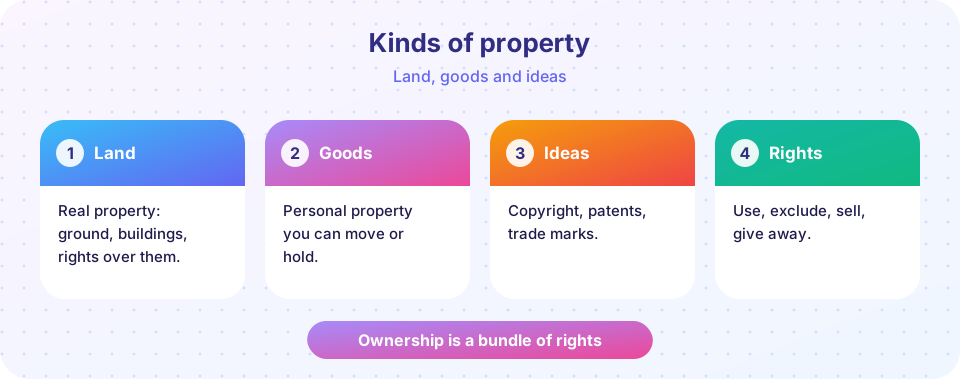
Real property is land and what is attached to it. Personal property includes goods such as cars and books, and intangible rights such as shares and debts. Intellectual property (IP) protects creations: copyright protects writing, music and art; patents protect inventions; trade marks protect brand identifiers; designs protect appearance.
Ownership is better described as a bundle of rights: the right to use the thing, to exclude others, to sell it, to give it away, to lease it and to leave it to heirs. Rights in the bundle can be split. A landlord owns the land, but the tenant has the right to occupy it for the term of the lease.
Land in England and Wales
Land law in England is old and technical. Under the Law of Property Act 1925, only two main legal estates in land remain: the freehold (called a fee simple absolute in possession), which lasts indefinitely, and the leasehold (a term of years absolute), which lasts for a fixed time such as 99 years or 6 months. Leasehold flats are common in England: the buyer owns a long lease while someone else owns the freehold.
Land ownership is recorded by the Land Registry. Under the Land Registration Act 2002, registration is central: it gives people confidence that what the register shows is what they are buying.
Other interests in land include:
- Easements: for example, a right of way across a neighbor's driveway.
- Mortgages: the lender takes security over the land, and may sell it if the loan is not repaid.
- Covenants: promises about how land may be used, for example not to build more than one house.
- Trusts: one person holds the land for the benefit of others. Two people who buy a home together often hold it on trust for each other.
In England, a contract for the sale of land must be in writing and signed (Law of Property (Miscellaneous Provisions) Act 1989, section 2). A deed is needed to transfer legal title. In practice, a buyer's solicitor carries out searches and checks the title before the sale completes.
Goods
The transfer of goods is simpler. Ownership can pass by sale, gift or inheritance. A sale of goods is governed by the Sale of Goods Act 1979 in England, and by the Uniform Commercial Code in most US states. A gift requires delivery or a deed; the law does not enforce a bare promise to give.
What happens when goods are lost and found? In Armory v Delamirie (1722), a chimney sweep's boy found a jewel and took it to a jeweler, who refused to return it. The court held that the finder had a better right than anyone except the true owner. In Parker v British Airways Board (1982), a man found a gold bracelet on the floor of an airport lounge, and the Court of Appeal held that the finder had a better claim than the airline, which had not shown any intention to control lost items. The finder also has duties to take reasonable steps to find the owner.
An older US case teaches the idea of possession. In Pierson v Post (1805), a New York court held that a hunter who merely chased a fox did not own it, because only the hunter who actually captured or mortally wounded it had possession. Possession and control remain central to property law.
A buyer may also lose out. The general rule is that you cannot give a better title than you have. But there are exceptions for innocent buyers, for instance under Sale of Goods Act rules about sellers in possession.
Intellectual property
IP rights differ in how long they last and how they are obtained.
- Copyright arises automatically when an original work is created and fixed. In the UK, it generally lasts for the life of the author plus 70 years for literary works. Many countries follow the Berne Convention, which gives automatic protection across member states.
- Patents protect new, inventive and industrially useful inventions, for a maximum of 20 years from filing, but must be applied for and examined.
- Trade marks protect signs that distinguish goods or services. They can be registered, and renewed every ten years in the UK, so they can last indefinitely if used.
- Designs protect the appearance of products.
IP is an area where national laws are linked by international treaties, but details differ.
Inheritance
When a person dies, their property passes by a will if they made a valid one. In England, the Wills Act 1837 requires a will to be in writing, signed by the maker and witnessed by two people. Without a valid will, the estate passes under the intestacy rules, which give shares to a spouse and relatives in a fixed order. England allows broad freedom to leave property as you wish, though certain family members can apply to a court if they have not been adequately provided for. Many civil-law countries, in contrast, reserve a fixed share for children.
Common misconceptions
"Owning a house means I own the land forever." If it is leasehold, ownership lasts only as long as the lease.
"Finders keepers." The finder usually has a good right against everyone except the true owner, but not against the owner.
"An idea can be copyrighted." Copyright protects the expression of an idea, not the idea itself.
Try it
Press Run (or Ctrl + Enter) to see the console output here.
No output.
Check your understanding
Quick check · 5 questions
of 5 answered You scored / 5 · perfect!
-
1. Which describes a leasehold?
A term of years, such as 99 years. -
2. In Parker v British Airways Board, the finder of a bracelet had:
The airline had not shown intent to control lost items. -
3. Copyright protects:
Not the idea itself, but how it is expressed. -
4. A will in England needs:
Wills Act 1837. -
5. An easement is:
For example, a right of way.
Summary
- Property is a bundle of rights over land, goods and ideas.
- Freehold lasts indefinitely; leasehold lasts for a term.
- Land transfers need formalities and registration; goods transfer more simply.
- IP rights protect creations; they differ in how they arise and how long they last.
- Wills and intestacy rules decide inheritance.
Next: Family law basics
Track your progress
Create a free account to tick off lessons and pick up where you left off on any device.
of Introduction to Law lessons completed