


















Lesson 46 of 47 · Projects and Practice
Cheat sheet: Introduction to Law on one page
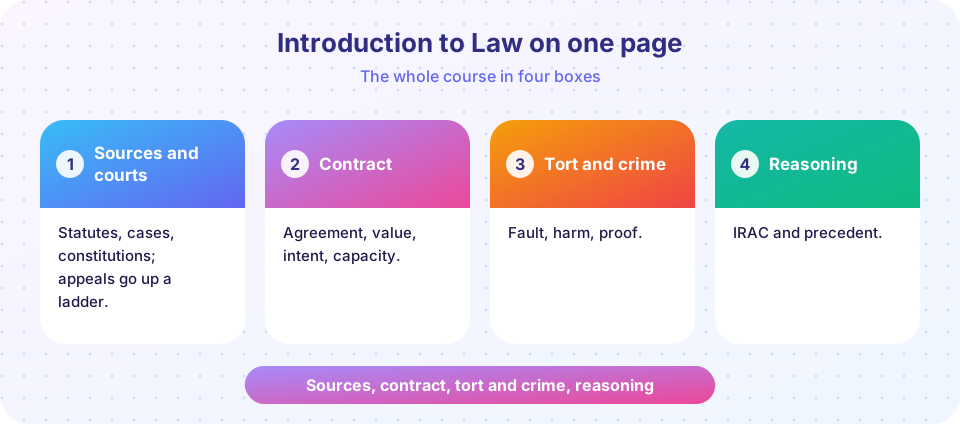
A one-page recap of the whole course: sources, courts, contract, tort, crime, property, family, employment and legal reasoning, with a summary picture.
This page is a quick recap of the second half of the course, with pointers to the first half. Use it before an exam, before a discussion or whenever you need to remember how the pieces fit together. It is a memory aid, not legal advice, and it mostly describes England and Wales, with some US comparisons.
What you will learn
- A compact map of the main ideas
- The questions to ask in each area
The big picture
| Area | The question to ask | The key test | Landmark examples |
|---|---|---|---|
| Sources and courts | Which rule applies, and which court decides? | Statutes and precedent; higher courts bind lower ones | Parliament, Supreme Court, stare decisis |
| Contract | Is there an enforceable promise? | Offer, acceptance, consideration, intention, capacity | Carlill (1893), Hyde v Wrench (1840) |
| Terms and defects | What was promised and was consent genuine? | Express and implied terms; misrepresentation, duress, mistake | Consumer Rights Act 2015 |
| Breach and remedies | What can the innocent party claim? | Expectation damages; remoteness; mitigation | Hadley v Baxendale (1854) |
| Negligence | Was a duty owed and broken, causing harm? | Duty, breach, causation, damage | Donoghue v Stevenson (1932), Caparo (1990) |
| Other torts | Which interest was invaded? | Nuisance, trespass, defamation; defences | Rylands v Fletcher (1868) |
| Criminal law | Can the state prove guilt? | Actus reus plus mens rea beyond reasonable doubt | Woolmington (1935), Woollin (1999) |
| Property | Who owns what, and with which rights? | Bundle of rights; freehold and leasehold | Armory v Delamirie (1722) |
| Family | What is best for the child; how do relationships end? | Welfare principle; no-fault divorce | Children Act 1989 |
| Employment | Employee, worker or contractor? | Control, integration, reality over label | Uber v Aslam (2021) |
| Reasoning | What is the rule and how does it fit the facts? | Ratio, interpretation approaches, IRAC | Heydon's Case (1584) |
Five habits to keep
- Name the system. Say which country's law you describe.
- Break the facts down. Separate events and parties, and list issues.
- State the rule precisely. Statute section or case principle.
- Argue both sides. Then weigh them and choose.
- Show your confidence. Law is rarely certain.
Standards at a glance
- Civil: balance of probabilities (more likely than not).
- Criminal: beyond reasonable doubt (the jury is sure).
- Binding: ratio of a higher court in the same system.
- Persuasive: obiter, equal or lower courts, foreign courts.
Try it
Press Run (or Ctrl + Enter) to see the console output here.
No output.
Check your understanding
Quick check · 4 questions
of 4 answered You scored / 4 · perfect!
-
1. Which standard of proof applies in civil cases?
More likely than not. -
2. Which landmark case is associated with the duty of care?
The snail in the bottle. -
3. Which step of IRAC contains the reasoning that links facts to the rule?
Application. -
4. Employment status is decided by:
Courts look at control, integration and substitution.
Summary
- Name the system, find the issues, state the rule, apply it, conclude with confidence.
- Civil claims compensate; crimes are prosecuted by the state.
- Courts follow precedent; statutes are interpreted by words and purpose.
Next: Further study
Track your progress
Create a free account to tick off lessons and pick up where you left off on any device.
of Introduction to Law lessons completed