


















Lesson 29 of 47 · Torts and Criminal Law
Negligence: duty, breach, causation and damage
Learn the tort of negligence: duty of care, breach, causation and remoteness, with Donoghue v Stevenson, Caparo, Bolton v Stone and the Wagon Mound.
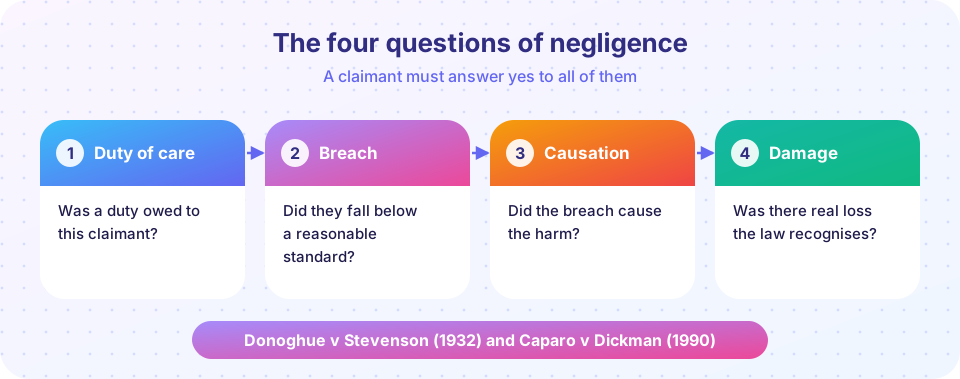
Negligence is the most important tort in modern law. It covers car accidents, medical mistakes, faulty products, unsafe workplaces and many other situations where careless behavior harms someone. If you remember one thing about negligence it should be that carelessness alone is not enough. A claimant must prove four things: a duty of care, a breach of it, that the breach caused the harm, and that the harm is of a kind the law recognizes.
Jurisdiction. This lesson describes the tort of negligence in England and Wales. US states use a very similar structure, with local differences. Educational information, not legal advice.
What you will learn
- How the duty of care idea began with a snail in a bottle
- How courts judge whether someone fell below the standard of care
- The but-for test and remoteness of damage
- Common defences and the time limit for claims
Key terms
Duty of care: a legal obligation to take reasonable care not to harm others. Reasonable person: an imagined person of ordinary prudence; the yardstick for breach. Causation: the link between breach and harm. Remoteness: harm too unforeseeable to be recoverable. Thin skull rule: you take your victim as you find them.
Element 1: Duty of care
In 1928, a woman drank ginger beer in a cafe in Paisley, Scotland. She said she later found the remains of a snail in the bottle and became ill. She had not bought the drink (a friend had), so she had no contract with anyone. In Donoghue v Stevenson (1932), the House of Lords held that the manufacturer owed her a duty of care. Lord Atkin's famous "neighbour principle" said you must take reasonable care to avoid acts or omissions you can reasonably foresee would injure your neighbours, meaning people so closely affected that you should have them in mind.
The law then needed a more precise test. In Caparo Industries v Dickman (1990), the House of Lords looked for three things: harm that was reasonably foreseeable, a relationship of proximity between the parties, and that it was fair, just and reasonable to impose a duty. Later, in Robinson v Chief Constable of West Yorkshire (2018), the Supreme Court said that for familiar situations, such as drivers and road users or doctors and patients, a duty already exists, and courts should only use Caparo-style reasoning for new situations, building step by step on past cases.
Duties are not universal. The law is cautious about omissions: you are generally not liable for failing to rescue a stranger, though there are exceptions when you create a danger or have a special relationship. It is also cautious about pure economic loss and psychiatric injury, where special limits apply.
Element 2: Breach
Once a duty exists, the question is whether the defendant fell below the standard of a reasonable person in their position. This is an objective test. In Blyth v Birmingham Waterworks (1856), negligence was described as failing to do what a reasonable person would do, or doing what a reasonable person would not.
Courts weigh several factors.
- Probability of harm. In Bolton v Stone (1951), a cricket ball was hit out of a ground and struck a woman in the street. It had happened only a handful of times in many years, so the risk was so small that the club was not negligent.
- Seriousness of harm. In Paris v Stepney Borough Council (1951), a worker with one good eye was blinded. Because the employer knew of his condition, the potential harm was much greater, so higher precautions were required.
- Cost of precautions and the social benefit of the activity. Emergency services and public benefit activities are judged with this in mind.
The standard is the same for everyone doing the activity. In Nettleship v Weston (1971), a learner driver was held to the standard of a competent driver. Professionals are judged by the standard of a reasonable member of their profession; in Bolam v Friern Hospital Management Committee (1957), a doctor is not negligent if acting in accordance with a practice accepted as proper by a responsible body of medical opinion. In England, that approach has since been refined for how patients are warned of risks (Montgomery v Lanarkshire Health Board, 2015).
Element 3: Causation and remoteness
Even if the defendant was careless, the claimant must show that the carelessness caused the harm. The first test is the but-for test: would the harm have happened but for the defendant's breach? In Barnett v Chelsea and Kensington Hospital (1969), a doctor failed to examine a man who had been poisoned with arsenic. The man would have died anyway, so the breach was not the cause.
Next comes remoteness. The damage must be of a type that was reasonably foreseeable. In The Wagon Mound (No 1) (1961), oil spilled into Sydney harbor was later ignited by molten metal from welding on a wharf. The Privy Council held that the defendant was not liable for the fire damage, because fire was not a reasonably foreseeable consequence of the oil. The exact way the harm happens need not be foreseen, but the kind of harm must be. The thin skull rule says you take your victim as you find them: in Smith v Leech Brain (1962), a minor burn led to cancer in a man who was predisposed to it, and the defendant paid for the full result.
Element 4: Damage
The claimant must have suffered recognized damage: personal injury, property damage or, in limited cases, economic loss. Damages are compensatory. They aim to put the claimant back in their pre-accident position, as far as money allows, by covering things such as lost earnings, medical costs and pain and suffering.
Defences and time limits
Two defences are common. Contributory negligence reduces damages in proportion to the claimant's own carelessness: in England, a passenger who did not wear a seat belt may have damages reduced. Voluntary assumption of risk (volenti non fit injuria) is a complete defence if the claimant freely accepted the risk, but courts apply it narrowly. In England, the usual limit for a personal injury claim is three years from the date of the accident or from when the claimant knew they had a claim.
Common misconceptions
"If someone is hurt, someone must pay." No. If there is no breach or causation, there may be no claim. Accidents sometimes have no one to blame.
"Negligence means being careless in general." In law, negligence is a precise concept: all four elements must be proved.
"The reasonable person is the average person." The reasonable person is a legal standard of prudence, not a statistical average.
Try it
Press Run (or Ctrl + Enter) to see the console output here.
No output.
Check your understanding
Quick check · 5 questions
of 5 answered You scored / 5 · perfect!
-
1. Donoghue v Stevenson established that:
The neighbour principle extended a duty beyond contractual parties. -
2. In Bolton v Stone, the cricket club was not liable because:
A very low probability of harm meant no breach. -
3. The but-for test is used for:
Would the harm have happened without the defendant's breach? -
4. In The Wagon Mound (No 1), the defendant was not liable for the fire because:
The kind of damage must be reasonably foreseeable. -
5. Contributory negligence results in:
Damages are reduced in proportion to the claimant's own fault.
Summary
- Negligence needs duty, breach, causation and damage.
- Duty grew from Donoghue v Stevenson and is refined by Caparo and later cases.
- Breach is measured against the reasonable person, weighing risk, harm and cost.
- Causation uses the but-for test; remoteness uses foreseeability of the kind of harm.
- Contributory negligence reduces damages.
Next: Other torts and defences
Track your progress
Create a free account to tick off lessons and pick up where you left off on any device.
of Introduction to Law lessons completed