


















Lesson 24 of 50 · Verbs and Particles
Chapter 4 review: Verbs and Particles
Review chapter 4: verb groups and the ます form, the particles は が を に で へ と から まで, あります and います, with a routine-writing project and a ten-question quiz.
You have finished the first part of the course. Four chapters ago you could not read a single Japanese character; now you can read both kana scripts, build statements, questions and negatives with です, point at things, conjugate verbs into the polite ます form, and attach the particles that say who, what, when, where and with whom. That is the working skeleton of the language. Everything else in Japanese (adjectives, the past tense, requests, reasons) hangs on this skeleton.
This review gathers the main rules of chapter 4 in one place, then asks you to put them to work in a short writing project: describing your own day.
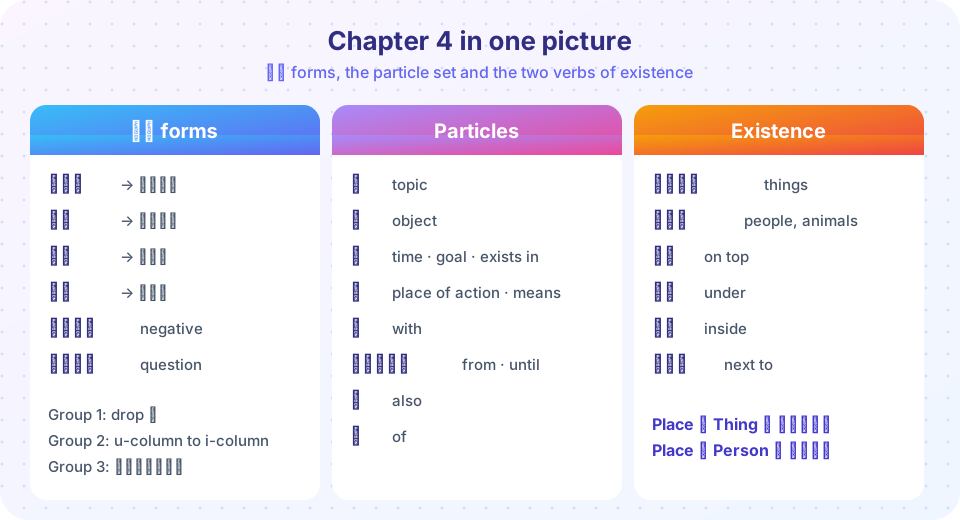
What you will learn
- how well you can form the ます form and its friends
- which particle to choose for time, place, means, company and direction
- how to describe where things are and what you have
Key terms
ます form: the polite non-past verb form.
Verb groups: 1 (る-verbs), 2 (う-verbs), 3 (する and くる).
Particles: は, が, を, も, に, で, へ, と, から, まで.
あります / います: existence verbs for things and for living beings.
Position word: うえ, した, なか, となり and so on.
The recap table
| Topic | Rule to remember | Example |
|---|---|---|
| Group 1 | Drop る, add ます | たべる → たべます |
| Group 2 | u-column to i-column, add ます | のむ → のみます |
| Group 3 | する → します, くる → きます | べんきょうします |
| Endings | ます, ません, ますか, ましょう, ませんか | いきませんか |
| Topic | は (read wa) | わたしは |
| Object | を (read o) | パンを |
| Subject / new info | が; required after question words | だれが きますか |
| Also | も replaces は, が, を | おちゃも |
| Time | に after specific times; none after あした, きょう | 7じに おきます |
| Goal | に or へ after the destination | がっこうへ いきます |
| Place of action | で | うちで たべます |
| Means | で | バスで いきます |
| With | と | ともだちと いきます |
| From, until | から, まで | 9じから 5じまで |
| Existence | Place に Thing が あります / います | へやに ねこが います |
| Position | Object の position に | つくえの うえに |
The usual order of a sentence
A fuller sentence usually follows this order, with the verb always last. Most real sentences use only some of the slots:
- Topic は
- Time に
- With whom と
- Place で or means で
- Object を
- Verb ます
For example: リサさんは ごご 3じに ともだちと こうえんで ほんを よみます。 (Risa-san wa gogo sanji ni tomodachi to kōen de hon o yomimasu.) "Lisa reads a book in the park with a friend at 3 p.m."
Mistakes to watch for
- Dropping る from every verb. Only Group 1 verbs do it. かえる becomes かえります.
- Using に for an action place. Use で for actions (うちで たべます) and に for existence and destinations.
- Adding に to あした. Relative time words take no に.
- Using は after a question word subject. Use が: だれが きますか.
- Mixing up あります and います. Ask whether the thing is alive.
- Putting something after the verb. The verb is last, except for か, ね and similar sentence-ending particles.
A project: describe your day
Write six to eight sentences about your typical day, using the pattern 時間に + verb. Here is a model for you to copy and change:
わたしは まいあさ 6じに おきます。 7じに うちで パンを たべます。 8じに バスで がっこうへ いきます。 がっこうで にほんごを べんきょうします。 12じに ともだちと ごはんを たべます。 5じに うちに かえります。 よる 11じに ねます。
Check each sentence against this list: Does the verb come last? Does a specific time take に? Does an action place take で? Is each verb in the ます form of the correct group? Then read it aloud twice. A short routine like this is a complete piece of Japanese writing, and by chapter 9 you will expand it with adjectives and the past tense.
Self-check: I can ...
- I can sort a verb into Group 1, 2 or 3 and build its ます form.
- I can make ません, ますか, ましょう and ませんか.
- I can choose between は, が, を and も.
- I can choose between に, で, へ and と for time, place, means and company.
- I can say what is in a room and where it is with あります, います and the position words.
- I can write six sentences about my own day.
What comes next
Part 2 of the course builds on exactly this skeleton. Chapter 5 adds numbers, prices, shopping and adjectives, so that you can describe things (a big house, a cheap book) and ask how many and how much. Chapter 6 adds the past tense and the て-form, which lets you make requests, link actions and say what is happening right now. Chapter 7 introduces your first kanji, and chapters 8 and 9 bring everything together in conversations and projects. Because every new topic hangs on the patterns you have just practised, a little extra review now will save you time later.
Common misconceptions
"Particles are optional." In casual speech some are dropped, but in careful speech and in writing they make the meaning clear. While learning, always use them.
"The order of sentence parts is fixed." Only the verb position is fixed. The other parts can move to put different things in the spotlight.
"I know the particles, so I can stop reviewing." Particles take time to feel natural. Read and write many short sentences.
Try it
First, a routine writer. Pick a time and an activity, add it to your day, and the page writes correct Japanese sentences with particles.
Second, a self-check. Each English sentence has your attempt and the model answer. Replace the attempts with your own Japanese (keep the same quotes), run the program, and see which ones match.
Press Run (or Ctrl + Enter) to see the console output here.
No output.
Check your understanding
Quick check · 10 questions
of 10 answered You scored / 10 · perfect!
-
1. What is the ます form of みる (to watch)?
みる is a Group 1 verb: drop る and add ます. -
2. What is the ます form of かえる (to return)?
かえる (return) is a Group 2 exception: かえります. -
3. Which particle marks where an action happens?
で marks the place of an action: うちで たべます. -
4. Which sentence is correct for "I get up at 6 every day"?
まいにち takes no に, but a specific clock time does. -
5. Which particle marks the subject after a question word?
だれが きますか: が is required after a question-word subject. -
6. How do you say "There is a dog in the park"?
Place に animal が います. -
7. Which sentence is a polite invitation?
ませんか invites: "Won't you go?". -
8. What does ともだちと いきます mean?
と after a person means with. -
9. Which word means "until"?
まで means until; から means from. -
10. What is the correct word order?
The verb is always last.
Summary
- Group 1 drops る, Group 2 shifts to the i-column, Group 3 is する and くる; ます, ません, ますか, ましょう and ませんか follow the stem.
- は marks the topic, を the object, が the subject (and after question words), も adds "also".
- に marks times and goals, で marks places of action and means, へ gives direction, と means with, から and まで mark ranges.
- あります is for things, います for living beings; position words attach with の.
- You now have the skeleton of Japanese grammar. Part 2 adds adjectives, numbers, the past tense and the て-form.
Track your progress
Create a free account to tick off lessons and pick up where you left off on any device.
of Japanese for Beginners lessons completed