


















Lesson 44 of 50 · Conversation and Culture
Chapter 8 review: conversation and culture
Review chapter 8: greetings, politeness levels, restaurant, train and direction phrases, and the customs behind them, with a recap table and a ten-question quiz.
This chapter turned your grammar into conversation. You now have the fixed phrases for greetings, a sense of the three politeness levels, scripts for the restaurant, the station and the street, and some knowledge of the customs that explain them. Here they are on a single page, followed by a short practice conversation and ten questions.
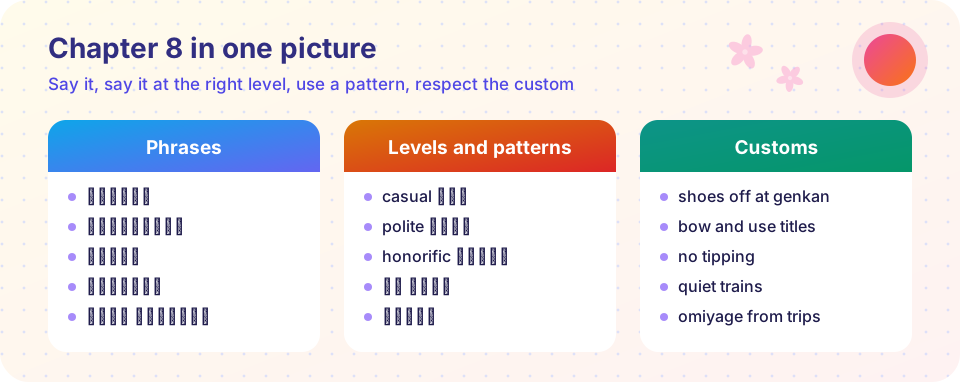
The chapter in one table
| Topic | Key phrases and ideas | Example |
|---|---|---|
| Greetings | time of day and situation decide | おはようございます, こんにちは, こんばんは |
| Thanks and apology | ありがとう, すみません, ごめんなさい | すみません = excuse me, sorry, thanks |
| Meeting | はじめまして + name + よろしくおねがいします | たなかです |
| Titles | さん for others, never for yourself; せんせい for teachers | たなかさん |
| Levels | casual, polite (です/ます), keigo | たべる, たべます, めしあがる |
| Listening | あいづち | はい, そうですか, なるほど |
| Soft refusal | ちょっと… | |
| Ordering | 〜をください, 〜をおねがいします | これを ください |
| Asking | ありますか, どこですか, いくらですか | トイレは どこですか |
| Wanting | verb stem + たいです | たべたいです |
| Station | きっぷ, 〜ばんせん, のりかえ, 〜ゆき | とうきょうゆき |
| Directions | まっすぐ, みぎ, ひだり, まがる, かど | みぎに まがって ください |
| Customs | shoes off, bow, chopsticks, no tipping, quiet trains, omiyage | おじゃまします |
| Region | standard Japanese plus dialects | おおきに (Kansai) |
Choosing the right level
When you open your mouth, ask yourself three quick questions.
- Who is this person? A stranger, a shop assistant, a teacher or a customer gets polite style or more. A close friend or a family member gets casual style.
- How formal is the situation? A business meeting or an official counter calls for polite or honorific speech even among people who are friends in private.
- Am I asking or giving? Requests are softened with すみません and ちょっと, refusals are gentle, and thanks are generous.
If in doubt, use polite style. It is safe almost everywhere.
A practice conversation
Read this aloud, then cover the Japanese and rebuild it from the English.
You: すみません、ふたりです。 (Sumimasen, futari desu.) Excuse me, two people. Staff: こちらへ どうぞ。 (Kochira e douzo.) This way, please. You: ラーメンを ふたつ ください。 (Raamen o futatsu kudasai.) Two ramen, please. Staff: かしこまりました。 (Kashikomarimashita.) Certainly. (After the meal.) You: ごちそうさまでした。 おかいけいを おねがいします。 (Gochisousama deshita. Okaikei o onegai shimasu.) Thank you for the meal. The bill, please. Staff: はい。 レジで おねがいします。 (Hai. Reji de onegai shimasu.) Yes, please pay at the register. You: カードは つかえますか。 (Kaado wa tsukaemasu ka.) Can I use a card?
Common slips to check
- Adding さん to your own name.
- Using あなた where a name and さん would be natural.
- Tipping or expecting to pay at the table in every restaurant.
- Using the wrong marker: ほしい is for objects (みずが ほしいです), たい is for verbs (のみたいです).
- Using casual speech with strangers, shop staff or older acquaintances.
- Saying さようなら for every goodbye, which sounds final.
Try it
The first tool converts dictionary-form verbs into the polite form, the wanting form (たいです) and the te-form, so you can use the verbs from the earlier chapters in the restaurant patterns.
Press Run (or Ctrl + Enter) to see the result here.
Program input · what you'd type while the program runs
Type the answers before you press Run, one per line. Each time the program reads a line (with input()), it gets the next line from this box.
The second tool lists the key phrases of the chapter by situation. Add your own phrases to the lists and keep it as a pocket phrasebook.
Press Run (or Ctrl + Enter) to see the console output here.
No output.
Check your understanding
Quick check · 10 questions
of 10 answered You scored / 10 · perfect!
-
1. Which phrase do you say before eating?
いただきます starts a meal; ごちそうさまでした ends it. -
2. How do you introduce yourself correctly?
Never add a title to your own name. -
3. Which style is the safe default with strangers?
Polite style is safe in almost every situation. -
4. What does ちょっと… usually signal in reply to an invitation?
An unfinished ちょっと… politely says no. -
5. How do you say 'I want to eat'?
ます-stem plus たいです. -
6. What does 'みぎに まがって ください' mean?
みぎ is right and まがる is to turn. -
7. In a typical Japanese restaurant, what about tipping?
There is no tipping culture. -
8. What do you do with outdoor shoes at the genkan?
Shoes come off at the genkan. -
9. Which phrase do you say when entering a friend's home?
おじゃまします means 'excuse me for intruding'. -
10. What is Kansai-ben?
Kansai-ben is the dialect of the Kansai region.
Summary
- Greetings are fixed phrases tied to situations; すみません has three uses.
- Use さん for others, polite style by default, and soften refusals with ちょっと….
- Travel patterns: 〜をください, 〜はありますか, 〜はどこですか, 〜はいくらですか, 〜たいです.
- Customs: shoes off, bows, no tipping, quiet public places, omiyage; dialects exist alongside standard Japanese.
Track your progress
Create a free account to tick off lessons and pick up where you left off on any device.
of Japanese for Beginners lessons completed