


















Lesson 26 of 50 · Daily Life and Questions
Numbers and counters
Count in Japanese from 0 to 99,999, read prices in yen, use ひとつ-style counting, and pick the right counter for people, flat things and animals.
Numbers are the first thing you need in a shop, a taxi or a restaurant, and Japanese numbers are, on the whole, wonderfully regular. Once you know one through ten, almost everything else is built by simple arithmetic: eleven is "ten-one," twenty is "two-ten," and a hundred is just "hundred." The difficulty is not the system. It is a small number of sound changes and a family of little words called counters that you attach to numbers when you count things. This lesson gives you both.
What you will learn
- Say any number from 0 to 99,999 and recognize 100,000 and above.
- Read prices in yen, phone numbers and years.
- Count small quantities with the native series ひとつ, ふたつ, みっつ.
- Choose a counter (人, 枚, 本, 匹, 個, 冊) and apply its sound changes.
Key terms
Sino-Japanese numbers: the いち, に, さん series, borrowed from Chinese long ago and used for most counting, prices and dates.
Native numbers: the ひとつ, ふたつ, みっつ series, an older Japanese system that covers one to ten.
Counter (助数詞, josuushi): a short word, such as 本 (hon), attached to a number to count a type of thing.
Sound change: a predictable change in the first sound of a counter or number word, for example ひゃく (hyaku) becoming ぴゃく (pyaku) after ろく (roku).
Man (万): the unit of ten thousand, which is the key difference from English groups of three digits.
One to ten
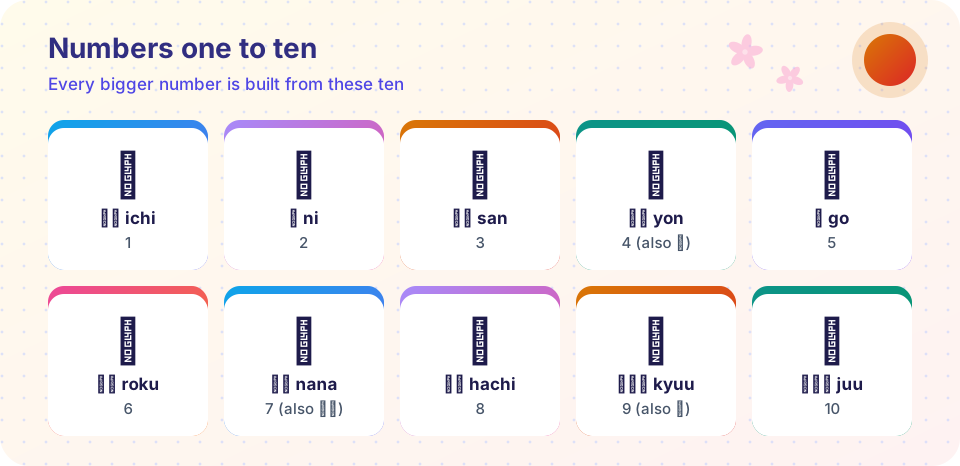
The basic series is shown in the picture above. Here it is in a table, with the alternative readings you will also hear.
| Number | Kanji | Hiragana | Romaji | Notes |
|---|---|---|---|---|
| 0 | 零 / 〇 | れい / ぜろ | rei / zero | ゼロ is the everyday word |
| 1 | 一 | いち | ichi | |
| 2 | 二 | に | ni | |
| 3 | 三 | さん | san | |
| 4 | 四 | よん / し | yon / shi | よん is the safe default |
| 5 | 五 | ご | go | |
| 6 | 六 | ろく | roku | |
| 7 | 七 | なな / しち | nana / shichi | なな is easier to hear |
| 8 | 八 | はち | hachi | |
| 9 | 九 | きゅう / く | kyuu / ku | きゅう is the default |
| 10 | 十 | じゅう | juu |
The doubled readings come from history. し (shi) sounds like the word for "death" (死), and く (ku) can sound like "suffering" (苦), so people often prefer よん and きゅう in daily speech, and some buildings skip the number 4 for room numbers. Do not overthink the superstition. Just remember that よん, なな and きゅう are the readings you can always use, while し, しち and く appear inside fixed expressions such as 四月 (しがつ, shigatsu, April) and 九時 (くじ, kuji, nine o'clock). The next lesson returns to those.
Building larger numbers
For 11 to 99 you simply say the tens and the ones in order:
- 11 = 十一 = じゅういち (juuichi), "ten-one".
- 20 = 二十 = にじゅう (nijuu), "two-ten".
- 47 = 四十七 = よんじゅうなな (yonjuunana).
- 99 = 九十九 = きゅうじゅうきゅう (kyuujuukyuu).
Note that 10 is just じゅう and not いちじゅう: you only say the multiplier when it is greater than one.
Hundreds and thousands work the same way, with a few sound changes. Compare the plain pattern with the irregular items:
| Number | Reading | Romaji | Why |
|---|---|---|---|
| 100 | ひゃく | hyaku | no いち needed |
| 200 | にひゃく | nihyaku | regular |
| 300 | さんびゃく | sanbyaku | h becomes b after ん |
| 400 | よんひゃく | yonhyaku | regular |
| 600 | ろっぴゃく | roppyaku | roku shortens to ろっ, h becomes p |
| 800 | はっぴゃく | happyaku | hachi shortens to はっ, h becomes p |
| 1,000 | せん | sen | no いち needed (いっせん is also fine) |
| 3,000 | さんぜん | sanzen | s becomes z after ん |
| 8,000 | はっせん | hassen | hachi shortens |
All other hundreds and thousands are regular: 500 is ごひゃく (gohyaku), 2,000 is にせん (nisen), 7,000 is ななせん (nanasen).
The ten-thousand step
English groups digits in threes (thousand, million), but Japanese groups them in fours. The next unit after 1,000 is 万 (man, 10,000), and then 億 (oku, 100,000,000). That means 10,000 is いちまん (ichiman), and here you must say いち. And 100,000 is "ten man", じゅうまん (juuman), while one million is "a hundred man", ひゃくまん (hyakuman). When you read a large price, put a comma every four digits in your head, not every three.
So 12,345 reads as "1 man, 2 thousand, 3 hundred, 4 ten, 5": いちまんにせんさんびゃくよんじゅうご (ichiman nisen sanbyaku yonjuu go). The program below does this arithmetic for you.
Prices, phone numbers and years
Prices end with 円 (えん, en), the yen. 500円 is ごひゃくえん (gohyaku en), 1,200円 is せんにひゃくえん (sen nihyaku en), and 10,000円 is いちまんえん (ichiman en). Phone numbers are read digit by digit, with の (no) between the groups, 0 as ゼロ or れい, and 4 and 7 as よん and なな: 090 becomes ゼロきゅうゼロ. Years use the same system and the word 年 (ねん, nen): 2026年 is にせんにじゅうろくねん (nisen nijuuroku nen).
Counting with ひとつ
For quantities of one to ten there is also a native series, used for things that have no particular counter, for example when you order food or count items of mixed kinds:
| 1 | 2 | 3 | 4 | 5 |
|---|---|---|---|---|
| ひとつ (hitotsu) | ふたつ (futatsu) | みっつ (mittsu) | よっつ (yottsu) | いつつ (itsutsu) |
| 6 | 7 | 8 | 9 | 10 |
|---|---|---|---|---|
| むっつ (muttsu) | ななつ (nanatsu) | やっつ (yattsu) | ここのつ (kokonotsu) | とお (too) |
From eleven onward you switch back to the plain number, usually with a counter or with こ (ko), so "eleven" is じゅういち (juuichi). The question "how many?" with this series is いくつ (ikutsu). Ages use a related counter, 歳 (さい, sai): 1 is いっさい, 8 is はっさい, 10 is じゅっさい, and 20 has its own word, はたち (hatachi).
Counters
When you count objects, you attach a counter to the number. The counter is chosen by what the object looks like, not by its name. The most useful ones for a beginner:
| Counter | Used for | Examples |
|---|---|---|
| 人 (にん, nin) | people | さんにん (three people) |
| 枚 (まい, mai) | flat things: paper, tickets, shirts | ごまい (five sheets) |
| 本 (ほん, hon) | long, thin things: pens, bottles, trains | にほん (two bottles) |
| 匹 (ひき, hiki) | small animals | さんびき (three cats) |
| 個 (こ, ko) | small compact things | ろっこ (six pieces) |
| 冊 (さつ, satsu) | bound things: books | じゅっさつ (ten books) |
Three kinds of change appear. First, people are irregular for one and two: ひとり (hitori) and ふたり (futari), while three and above are regular (さんにん, よにん, ごにん). Second, the sounds 1, 6, 8 and 10 shorten to a small っ before a k, s, t or h sound (いっ, ろっ, はっ, じゅっ). Third, counters starting with h turn into p after a shortened number and into b after 3: いっぽん (ippon), にほん (nihon), さんぼん (sanbon), よんほん (yonhon), ろっぽん (roppon), はっぽん (happon), じゅっぽん (juppon).
In a sentence, the counter phrase comes after the object and its particle, directly in front of the verb: りんごを みっつ かいました (ringo o mittsu kaimashita), "I bought three apples." To ask, replace the number with なん (nan): なんぼん ですか (nanbon desu ka), "How many (long things)?"
A dialogue at the shop
A: このりんごは いくらですか。 (Kono ringo wa ikura desu ka.) How much is this apple? B: ひとつ ひゃくごじゅうえんです。 (Hitotsu hyaku gojuu en desu.) It is 150 yen each. A: みっつ ください。 (Mittsu kudasai.) Three, please. B: ぜんぶで よんひゃくごじゅうえんです。 (Zenbu de yonhyaku gojuu en desu.) That comes to 450 yen in total.
A quick check: 3 × 150 = 450, and the clerk says よんひゃくごじゅう, not よんびゃく, because 4 is regular.
Common misconceptions
"Four is always よん." Not quite. よん is the default for counting, but 4 o'clock is よじ (yoji), April is しがつ (shigatsu), and four people is よにん (yonin). Learn the exceptions with the words that use them.
"The first number must always be いち." In 100 and 1,000 you drop it (ひゃく, せん), but in 10,000 you must say いちまん. Without it, まん alone sounds incomplete.
"Counters come before the noun like English 'three cats'." In Japanese the number and counter follow the noun: ねこが さんびき います (neko ga sanbiki imasu).
Try it
The first program converts any number up to 99,999 into hiragana with romaji. Change the list to test your own predictions before you run it.
Press Run (or Ctrl + Enter) to see the result here.
Program input · what you'd type while the program runs
Type the answers before you press Run, one per line. Each time the program reads a line (with input()), it gets the next line from this box.
The second program applies the counter rules from this lesson to a table. Check that the sound changes match what you learned (1, 6, 8, 10 shorten; 3 voices the next sound).
Press Run (or Ctrl + Enter) to see the result here.
Program input · what you'd type while the program runs
Type the answers before you press Run, one per line. Each time the program reads a line (with input()), it gets the next line from this box.
Check your understanding
Quick check · 5 questions
of 5 answered You scored / 5 · perfect!
-
1. How do you say 600?
Six shortens to ろっ and the next h-sound turns into p, giving ろっぴゃく (roppyaku). -
2. What is 10,000 in Japanese?
Unlike 100 and 1,000, the number 10,000 needs the いち: いちまん (ichiman). ひゃくまん is one million. -
3. Which counter fits three bottles of juice (long, thin objects)?
本 counts long thin objects, and after 3 the h of ほん voices to b: さんぼん (sanbon). -
4. How do you say 'two people'?
People are irregular for one and two: ひとり (1) and ふたり (2). -
5. What is 150 yen times three (the shop dialogue total)?
3 × 150 = 450, which reads よんひゃくごじゅう (yonhyaku gojuu); 4 does not change the following h.
Summary
- Numbers 1 to 10 plus multiplication and addition build every number; 10 and 100 and 1,000 drop the いち.
- Japanese groups large numbers by units of 10,000 (万), so 100,000 is じゅうまん.
- 300, 600 and 800 and 3,000 and 8,000 have sound changes; learn them as a small block.
- The native series ひとつ to とお covers 1 to 10 and is also used for ages in the form はたち (20).
- Counters follow the noun and its particle; 人 is irregular for 1 and 2, and 本 and 匹 use b/p sounds.
Next: Time and dates
Track your progress
Create a free account to tick off lessons and pick up where you left off on any device.
of Japanese for Beginners lessons completed