


















Lesson 40 of 50 · Conversation and Culture
Chapter 8 overview: conversation and culture
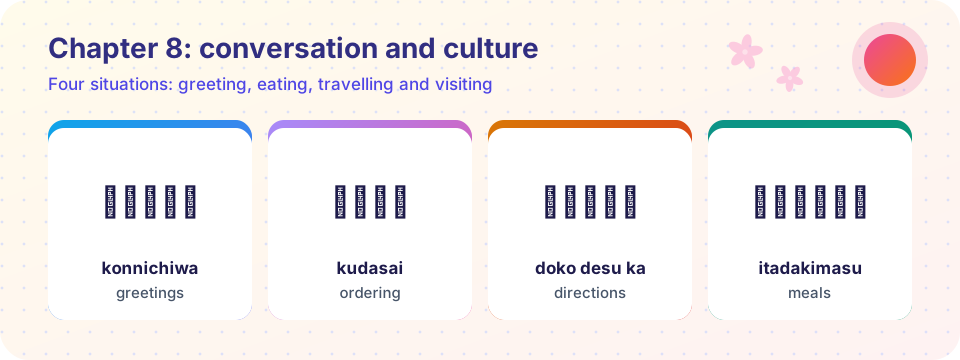
A map of chapter 8: greetings and politeness levels, practical dialogues for restaurants, trains and directions, and the customs that make your Japanese sound natural.
You now have grammar, vocabulary and some kanji. What separates a textbook sentence from a conversation, though, is something that grammar books can only partly capture: knowing what to say in a given situation, how formal to sound, and how people expect you to behave. Japanese puts unusual weight on these matters. The right greeting on entering a shop, the right phrase when you start a meal, and the right level of politeness toward a teacher or a stranger are all part of speaking the language well. This chapter brings your grammar together with these social skills.
The big picture
Language and culture are two sides of the same coin in Japanese, and the chapter treats them together.
- Fixed phrases carry social meaning. Words such as いただきます (itadakimasu, said before eating) and よろしくおねがいします (yoroshiku onegai shimasu, said when meeting someone or asking a favor) have no exact English translation. They are social rituals more than sentences, and using them correctly makes a strong impression.
- Politeness has levels. The です/ます style you have learned is the safe, polite default. Friends use a casual style; formal situations use honorific language (keigo, 敬語). Choosing the right level is a skill.
- Real situations repeat. Ordering food, buying tickets and asking the way follow predictable scripts. If you learn each script, you can handle a surprising number of encounters.
- Customs explain language. Removing shoes at the entrance, bowing, quiet trains and the absence of tipping all shape the way people talk.
Chapter 8 at a glance
Politeness levels
Useful ritual phrases
Customs
What each lesson covers
- Greetings and politeness covers the everyday greetings, titles such as さん, the three levels of politeness, listening responses (あいづち) and a first-meeting dialogue.
- Restaurants, trains and directions gives you complete scripts for ordering a meal, paying, buying a ticket, and asking where something is.
- Etiquette and everyday Japan explains the customs behind the language: bowing, homes, chopsticks, gifts, seasons and regional speech.
- Chapter 8 review pulls the phrases onto one page and tests them with ten questions.
How to study this chapter
Learn phrases as wholes. For example, すみません is not "sorry" plus "me" but a single chunk that you will use for "excuse me," "sorry" and "thank you" depending on the situation. Practice them aloud in the context of a small scene: stand at your own door and say ただいま, sit at a table and say いただきます. The act of saying the phrase in a matching place anchors it.
Also remember that politeness is a choice, not a rule you must apply identically everywhere. A friend of yours will not be offended by casual speech, and a shopkeeper expects polite speech. If you are ever unsure, use the です/ます style. It is almost never wrong.
A course cannot replace speaking with people. Customs vary by region, family and generation; what this chapter describes are widely shared defaults, not universal rules. Pay attention to what people around you do, and when in doubt, ask politely: これで いいですか (Kore de ii desu ka), "Is this okay?"
Check your understanding
Quick check · 3 questions
of 3 answered You scored / 3 · perfect!
-
1. Which speech style is the safe default for a foreigner meeting new people?
The polite です/ます style is the safe default; casual is for friends and family. -
2. What kind of phrases are いただきます and ごちそうさま?
They are fixed phrases said before and after a meal. -
3. What is the best way to learn fixed phrases?
Whole phrases with a scene attached are easier to remember and use correctly.
Summary
- Chapter 8 joins grammar to practical situations and cultural habits.
- Fixed phrases act as social rituals; politeness comes in levels, with です/ます as the safe default.
- Scripts for restaurants, trains and directions let you handle common encounters.
- Customs vary; watch what people around you do and ask politely.
Next: Greetings and politeness
Track your progress
Create a free account to tick off lessons and pick up where you left off on any device.
of Japanese for Beginners lessons completed