


















Lesson 23 of 50 · Verbs and Particles
あります and います: existence
Learn to say what exists and where: あります for things, います for people and animals, the pattern Place に Thing が あります, position words like うえ and した, and having.
How do you say "There is a cat under the desk" or "Is there a bank near here?" Japanese does not use です for this. It uses two special verbs of existence: あります (arimasu) for things and います (imasu) for people and animals. With them, and a small set of position words such as うえ (on top) and した (under), you can describe a room, ask whether a place exists nearby, and even say that you have something.
This lesson builds directly on what you learned about particles. The pattern uses に for the place and が for the thing that exists, and the position words work like nouns joined with の.
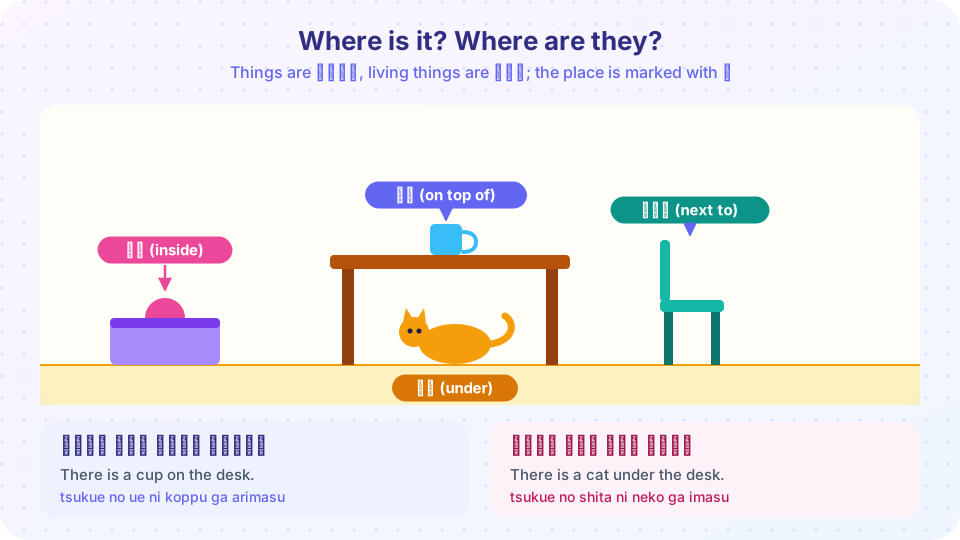
What you will learn
- when to use あります and when to use います
- the pattern Place に Thing が あります, and its topic version
- ten position words and how to attach them with の
- how to ask what, who and where
- how existence verbs also express having
Key terms
あります (arimasu): there is, there are, for inanimate things.
います (imasu): there is, there are, for people and animals.
Position word (位置): a noun such as うえ (above) used after の to say where.
Existence (存在): the idea of "being there", distinct from "being X".
あります or います?
The choice depends on whether the thing is alive and able to move on its own.
- あります for objects, buildings, events and plants: ほん (book), えき (station), ぎんこう (bank), き (tree).
- います for people and animals: ひと (person), ともだち (friend), ねこ (cat), いぬ (dog), とり (bird).
Both verbs fit the ます pattern: あります is from ある (Group 2, with る → り), and います is from いる (Group 1). The negatives are ありません (arimasen) and いません (imasen), and the questions are ありますか and いますか.
Do not confuse these with です. です says what something is (たなかさんは せんせいです); あります and います say that something exists in a place.
The pattern: Place に Thing が あります
The basic structure is:
Place に Thing が あります / います。
- へやに ベッドが あります。 (Heya ni beddo ga arimasu.) "There is a bed in the room."
- こうえんに ひとが います。 (Kōen ni hito ga imasu.) "There are people in the park."
- ここに かさが あります。 (Koko ni kasa ga arimasu.) "There is an umbrella here."
- あそこに ねこが います。 (Asoko ni neko ga imasu.) "There is a cat over there."
Two particles are doing the work: に marks the place where something exists, and が marks the new thing that is introduced. The thing is new to the listener, so が is the right choice. Note that the place gets に here, not で, because existence is not an action.
The topic version: Thing は Place に あります
If you want to say where a known thing is, put it first as a topic with は:
- ベッドは へやに あります。 (Beddo wa heya ni arimasu.) "The bed is in the room."
- ねこは あそこに います。 (Neko wa asoko ni imasu.) "The cat is over there."
Compare the two. へやに ベッドが あります answers "What is in the room?" (new information: a bed). ベッドは へやに あります answers "Where is the bed?" (the bed is the known topic, the place is the new information).
Asking questions
- なにが ありますか。 (Nani ga arimasu ka?) "What is there?"
- だれが いますか。 (Dare ga imasu ka?) "Who is there?"
- ほんは どこに ありますか。 (Hon wa doko ni arimasu ka?) "Where is the book?"
- ちかくに ぎんこうが ありますか。 (Chikaku ni ginkō ga arimasu ka?) "Is there a bank nearby?"
Answer with はい、あります or いいえ、ありません (and for people and animals, はい、います and いいえ、いません).
Position words
To say exactly where, use a position word. It acts like a noun and attaches to the reference object with の: [Object] の [position] に.
| Word | Romaji | Meaning |
|---|---|---|
| うえ | ue | on, above |
| した | shita | under, below |
| なか | naka | inside |
| そと | soto | outside |
| まえ | mae | in front of |
| うしろ | ushiro | behind |
| よこ | yoko | beside (to the side) |
| となり | tonari | next to (adjacent) |
| ちかく | chikaku | nearby |
| あいだ | aida | between |
Examples:
- つくえの うえに コップが あります。 (Tsukue no ue ni koppu ga arimasu.) "There is a cup on the desk."
- つくえの したに ねこが います。 (Tsukue no shita ni neko ga imasu.) "There is a cat under the desk."
- はこの なかに ボールが あります。 (Hako no naka ni bōru ga arimasu.) "There is a ball in the box."
- えきの となりに ぎんこうが あります。 (Eki no tonari ni ginkō ga arimasu.) "There is a bank next to the station."
- がっこうの ちかくに こうえんが あります。 (Gakkō no chikaku ni kōen ga arimasu.) "There is a park near the school."
The structure is exactly the A の B pattern from chapter 3: "the top of the desk" is つくえの うえ.
Listing several things
To list items, join them with と: ベッドと つくえと いすが あります。 (Beddo to tsukue to isu ga arimasu.) "There are a bed, a desk and a chair." The が comes after the last item only.
Having: "I have a car"
Japanese often expresses possession as existence near the owner: わたしは くるまが あります。 (Watashi wa kuruma ga arimasu.) "I have a car." (Literally: "As for me, a car exists.") With a friend or relative, the verb is います: わたしは ともだちが います。 "I have a friend." The same pattern shows up for あります with a thing and います with a person or animal. If you need "I have a cat", say わたしは ねこが います。
A dialogue
リサ: たなかさんの へやに なにが ありますか。 Tanaka-san no heya ni nani ga arimasu ka. "What is in your room, Mr. Tanaka?"
たなか: ベッドと つくえと いすが あります。つくえの うえに パソコンが あります。 Beddo to tsukue to isu ga arimasu. Tsukue no ue ni pasokon ga arimasu. "There is a bed, a desk and a chair. There is a computer on the desk."
リサ: ねこは いますか。 Neko wa imasu ka. "Is there a cat?"
たなか: はい、います。ベッドの したに います。 Hai, imasu. Beddo no shita ni imasu. "Yes, there is. It is under the bed."
Describing your room step by step
Describing a room is the best way to practise existence sentences. Use this four-step pattern.
- Start with the general contents. へやに ベッドと つくえが あります。 "There are a bed and a desk in my room."
- Add one position. つくえの うえに パソコンが あります。 "There is a computer on the desk."
- Add a living thing. ベッドの したに ねこが います。 "There is a cat under the bed."
- Ask a question to test yourself. まどの ちかくに なにが ありますか。 "What is near the window?"
A paragraph of five or six such sentences is already a real piece of Japanese. Read it aloud, then try to draw your room from your own description: if the picture matches, your sentences are clear.
います also means "to be (somewhere)"
For people and animals, います does double duty as "there is" and "someone is at a place". たなかさんは うちに います (Tanaka-san wa uchi ni imasu) is "Mr. Tanaka is at home". Similarly, if someone asks うちに いますか (Uchi ni imasu ka?) they are asking "Are you at home?". You will use this in daily life, for example when you answer the phone: いま がっこうに います (Ima gakkō ni imasu), "I am at school now".
When you need a verb for a person who does something at a place, such as eating or studying, use the action verb with で: がっこうで べんきょうします. The existence verb います does not describe an action, only presence.
Practice prompts
Answer each prompt in Japanese, then check your sentences against the patterns above.
- What is on your desk? (つくえの うえに なにが ありますか。)
- Who is in your family? (かぞくに だれが いますか。)
- Is there a convenience store near your home? (うちの ちかくに コンビニが ありますか。)
- Where is your bag? (かばんは どこに ありますか。)
- Is there a cat in your house? (ねこは いますか。)
If you do not know a noun, look it up and add it to your list. Existence sentences are the easiest place to collect new vocabulary because you can describe anything you see around you.
Common misconceptions
"There is = です." です links two nouns ("X is Y"). Existence needs あります or います.
"Use で for the place: へやで ねこが います." に marks where something exists. で marks where an action takes place.
"Plants and cars are います." In standard Japanese, plants, vehicles and other non-animals use あります.
"The thing that exists takes は by default." For new information, use が: へやに ベッドが あります.
Try it
First, a room builder. Choose an object, a position and a reference object. The program picks あります or います by whether the object is a living thing, and writes the sentence in Japanese, romaji and English.
Second, a console program that makes existence sentences, questions and negatives. It chooses あります or います from a flag and then conjugates.
Press Run (or Ctrl + Enter) to see the console output here.
No output.
Check your understanding
Quick check · 6 questions
of 6 answered You scored / 6 · perfect!
-
1. Which verb fits "There is a cat"?
Animals and people use います. -
2. Which sentence means "There is a book on the desk"?
Reference の position に thing が あります: the place takes に. -
3. How do you ask "Where is the bank?"?
どこに ありますか asks about location. -
4. What is the negative of います?
いません is the polite negative of います; ありません belongs to あります. -
5. Which is the position word for "inside"?
なか means inside; した is under and うしろ is behind. -
6. How do you say "I have a friend"?
People take います, and the thing that exists is marked with が.
Summary
- あります is for things and plants, います is for people and animals.
- Place に Thing が あります gives new information; Thing は Place に あります answers "Where?".
- Position words (うえ, した, なか, となり, まえ ...) attach with の: つくえの うえに.
- Ask with なにが, だれが and どこに; negatives are ありません and いません.
- わたしは ねこが います expresses having something.
Next: Chapter 4 review
Track your progress
Create a free account to tick off lessons and pick up where you left off on any device.
of Japanese for Beginners lessons completed