


















Lesson 8 of 50 · Sounds and Hiragana
Hiragana 2: the N, H and M rows
Learn 15 more hiragana in the N, H and M rows, with stroke counts, origins, lookalikes, real words and the particles は and へ that change their sound.
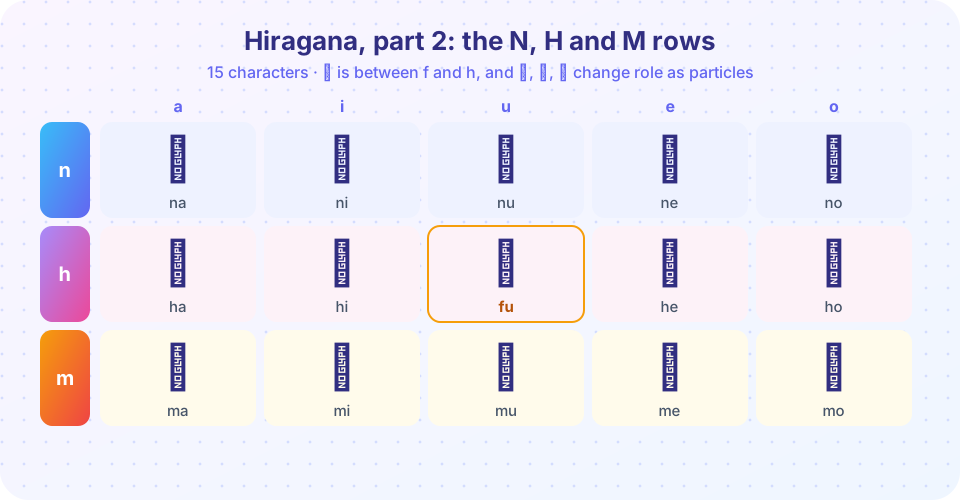
With the vowels and the K, S and T rows behind you, you have already covered almost half of the hiragana table. In this lesson you add three more rows: N (な に ぬ ね の), H (は ひ ふ へ ほ) and M (ま み む め も). That is 15 new characters and 35 in total. With these, you can already read your first full words that matter in daily life: なまえ (namae, name), ひと (hito, person), ほし (hoshi, star) and ねこ (neko, cat).
This lesson also solves a puzzle that surprises every learner. Two of today's characters, は and へ, change their sound when they work as grammar words. You will see why, so you will not be thrown off when you read your first sentences.
What you will learn
- the 15 characters of the N, H and M rows
- why ふ is read fu, and what its sound is
- why は is read wa and へ is read e when they are particles
- stroke counts and shapes for the trickiest characters
- how to read about 15 real words
Key terms
Particle (助詞): a small word that marks the role of the word before it.
Topic marker (は): the particle that says "as for ..." and is pronounced wa.
Direction marker (へ): the particle that points toward a place and is pronounced e.
Lookalike: two characters that are easy to confuse, such as ぬ and め.
The N row: な に ぬ ね の
| Kana | Sound | Strokes | Comes from |
|---|---|---|---|
| な | na | 4 | 奈 |
| に | ni | 3 | 仁 |
| ぬ | nu | 2 | 奴 |
| ね | ne | 2 | 祢 |
| の | no | 1 | 乃 |
The sound is a clean n followed by the vowel. の is the particle you will use most, meaning "of" or "'s" (わたしの ほん, watashi no hon, "my book"). It is also a beautiful one-stroke character: a single smooth loop.
The H row: は ひ ふ へ ほ
| Kana | Sound | Strokes | Comes from |
|---|---|---|---|
| は | ha | 3 | 波 |
| ひ | hi | 1 | 比 |
| ふ | fu | 4 | 不 |
| へ | he | 1 | 部 |
| ほ | ho | 4 | 保 |
Four of the five are regular, with an English-like h. The exception is ふ. Its sound is not "hoo": it is a soft puff of air between the lips, /ɸɯ/, close to an f made without teeth, as when you blow out a candle. Romaji spells it fu, which is close enough, but you do not need to bite your lip.
The M row: ま み む め も
| Kana | Sound | Strokes | Comes from |
|---|---|---|---|
| ま | ma | 3 | 末 |
| み | mi | 2 | 美 |
| む | mu | 3 | 武 |
| め | me | 2 | 女 |
| も | mo | 3 | 毛 |
The M row is entirely regular. Pay attention to the lookalikes below, which show up most often here.
は, へ and を: the characters with two voices
The character は is ha in words such as はな (hana, flower) and はは (haha, my mother). When は is the particle that marks the topic of a sentence, it is read wa: わたしは (watashi wa, "as for me"). The reason is historical. In older Japanese the topic particle really was ha, then the pronunciation of the particle changed to wa, but the spelling was kept for it. The same happened to へ: it is he in へや (heya, room) but e as a direction particle: がっこうへ (gakkō e, "toward school"). The third such character, を, is read o and appears in the next lesson.
The rule is simple: only the particle changes. Inside any other word, は stays ha and へ stays he. You will see both uses throughout the course, always with the same logic. You also met this in こんにちは (konnichiwa), where は is the old particle and is read wa.
Real words
| Word | Romaji | Meaning |
|---|---|---|
| なまえ | namae | name |
| なつ | natsu | summer |
| ねこ | neko | cat |
| はな | hana | flower or nose (pitch differs) |
| はは | haha | (my) mother |
| ひと | hito | person |
| ふね | fune | boat |
| へや | heya | room |
| ほし | hoshi | star |
| まち | machi | town |
| みみ | mimi | ear |
| むし | mushi | insect |
| め | me | eye |
| もも | momo | peach |
| ひとつ | hitotsu | one (thing) |
| なにか | nanika | something |
The word はな is a good reminder that Japanese has many homophones, words with the same sound. 花 means flower and 鼻 means nose. In speech, a slight difference in pitch helps; in writing, kanji settle it. For now, context tells you what is meant.
Lookalikes
- ぬ and め: the two look alike. ぬ ends in a small loop at the bottom right; め has no loop.
- ね and ぬ: ね has a vertical line at the left and ends in a loop, ぬ starts with a curved stroke instead.
- は and ほ: ほ has an extra crossbar. Look at the top: は has one bar, ほ has two.
- ま and も: ま has a loop at the bottom, も ends in a hook and has two crossbars.
- ひ and し: ひ has a flat top that bends left and then right, し is a smooth hook with no angles.
When two characters look the same to you, draw them side by side on one line, labeled with their sounds. Naming the difference out loud is what fixes it in memory.
A three-day plan for the N, H and M rows
Fifteen new characters fit comfortably into three days, with a review of the previous rows at the start of each session.
Day 1: the N row. Begin with a five-minute review of the first 20 characters, then learn な, に, ぬ, ね, の. Write each one five times and read なつ, にく (niku, meat) and ねこ. The one-stroke character の is usually the easiest to remember, so use it as an anchor.
Day 2: the H row. Learn は, ひ, ふ, へ, ほ. Practise the particle readings aloud: say わたしは as watashi wa, and say がっこうへ as gakkō e. Then read はな, ひと, ふね, へや and ほし. Notice how different the written and spoken versions of は feel until the particle rule becomes automatic.
Day 3: the M row and a mixed review. Learn ま, み, む, め, も, read まち, みみ, むし and もも, and finish with the quiz in "mixed" mode so that the old rows keep circulating.
Reading without romaji
By now you can begin to practise reading directly from kana to sound without translating to romaji in your head. Try this method with a word such as なにか (nanika, "something"):
- Look at the whole word, not the individual characters.
- Say each beat in order: na - ni - ka.
- Say it again at normal speed.
- Only then check the romaji.
Treat romaji as an answer key rather than a crutch. If you always look at the romaji first, your eyes learn to skip the kana. This is the most common reason learners remain stuck at the "I know the table but I cannot read" stage.
Two small words you will see everywhere
Two of today's characters are also tiny grammar words you will meet in nearly every sentence. の links two nouns: ほしの なまえ (hoshi no namae) is "the name of a star". ね at the end of a sentence turns it into a gentle appeal for agreement, like "isn't it?" or "right?": あおいですね (aoi desu ne), "it is blue, isn't it?" You will use both soon in conversation, and recognising them now will help.
Same sound, different meaning
Japanese has many homophones, words that sound the same but mean different things. Hiragana alone cannot tell them apart, so context and kanji do the work. A few examples that use only today's rows and earlier ones: かみ (kami) can be paper (紙), hair (髪) or a god (神); はな can be a flower (花) or a nose (鼻); あめ can be rain (雨) or candy (飴). In speech, a different pitch pattern often helps, and the rest of the sentence nearly always settles the meaning: ほんの かみ is clearly "paper of a book". This is one reason kanji exist, and it is a good reason to be patient when you meet them in chapter 7. For now, remember that a single hiragana spelling can stand for several words and let the context guide you.
Common misconceptions
"は is always wa." Only as the topic particle (and in こんにちは, こんばんは). In はな, はは and ひとは... the は inside a word is ha.
"ふ is pronounced like English foo." The lips do not touch the teeth. A soft, breathy sound is the real one, and learners who say English foo are still understood.
"の and ん look similar, so they are the same." の is no, ん is n. They are in different rows and have different shapes.
Try it
First, a quiz on the 15 new characters (the first 20 are mixed in so you review them too). Type the romaji.
Second, a reader that knows the particle rule. It reads each word kana by kana, but if a word ends in は or へ and has more than one character, it treats that last character as a particle and reads it wa or e.
Press Run (or Ctrl + Enter) to see the console output here.
No output.
Check your understanding
Quick check · 5 questions
of 5 answered You scored / 5 · perfect!
-
1. How is は read when it is the topic particle?
As a particle, は is read wa. Inside words such as はな it is ha. -
2. Which character is read fu?
ふ is fu, a soft lip sound. ほ is ho and ぬ is nu. -
3. What does ひと mean?
ひと (hito) is a person. ほし is a star and へや is a room. -
4. Which pair is hard to tell apart because of a loop?
ぬ ends in a loop and め does not; compare them side by side. -
5. How is へ read as a direction particle?
As a particle, へ is read e (がっこうへ: gakkō e). In へや it is he.
Summary
- The N, H and M rows add 15 characters: な に ぬ ね の, は ひ ふ へ ほ, ま み む め も.
- ふ is a soft lip sound, written fu in romaji.
- Only as particles are は and へ read wa and e; inside words they stay ha and he.
- Lookalike pairs (ぬ and め, は and ほ, ま and も) need direct comparison.
Track your progress
Create a free account to tick off lessons and pick up where you left off on any device.
of Japanese for Beginners lessons completed