


















Lesson 22 of 50 · Verbs and Particles
Particles に, で, と and more
Learn に for time and goal, で for place of action and means, へ for direction, と for with, and から and まで for from and until, with clock times and a dialogue.
You can now say what someone does: パンを たべます. But real sentences also say when, where, by what means and with whom. Each of those questions has its own particle, and together they let you build sentences such as わたしは まいあさ 7じに うちで パンを たべます, "I eat bread at home at 7 every morning."
This lesson covers the six particles you will use most after は, が and を: に, で, へ, と, から and まで. We start with the clock, because time is the easiest place to see に at work. Then we look at the most important contrast in the chapter: に for where something is or goes, and で for where something happens.
What you will learn
- how to tell the time and when to attach に
- に for goals and targets, and へ for direction
- で for the place of an action and for means
- と for "with" and "and"
- から and まで for from and until
Key terms
に: marks a point in time, a goal or a target.
で: marks the place where an action happens, or the means used.
へ: marks a direction (read e).
と: "with" or "and".
から / まで: "from" and "until".
Telling the time
Clock hours are a number plus じ (ji, o'clock). Three of the hours have special readings: 4 is よじ, 7 is しちじ and 9 is くじ.
| Hour | Reading | Hour | Reading |
|---|---|---|---|
| 1 | いちじ (ichiji) | 7 | しちじ (shichiji) |
| 2 | にじ (niji) | 8 | はちじ (hachiji) |
| 3 | さんじ (sanji) | 9 | くじ (kuji) |
| 4 | よじ (yoji) | 10 | じゅうじ (jūji) |
| 5 | ごじ (goji) | 11 | じゅういちじ (jūichiji) |
| 6 | ろくじ (rokuji) | 12 | じゅうにじ (jūniji) |
Add はん (han) for "half past": 3じはん (sanji han) is 3:30. Use ごぜん (gozen, a.m.) and ごご (gogo, p.m.) before the hour: ごぜん 9じ is 9 a.m. To ask the time, say なんじ (nanji, "what time?").
に: a point in time
Put に after a specific clock time or date to say "at":
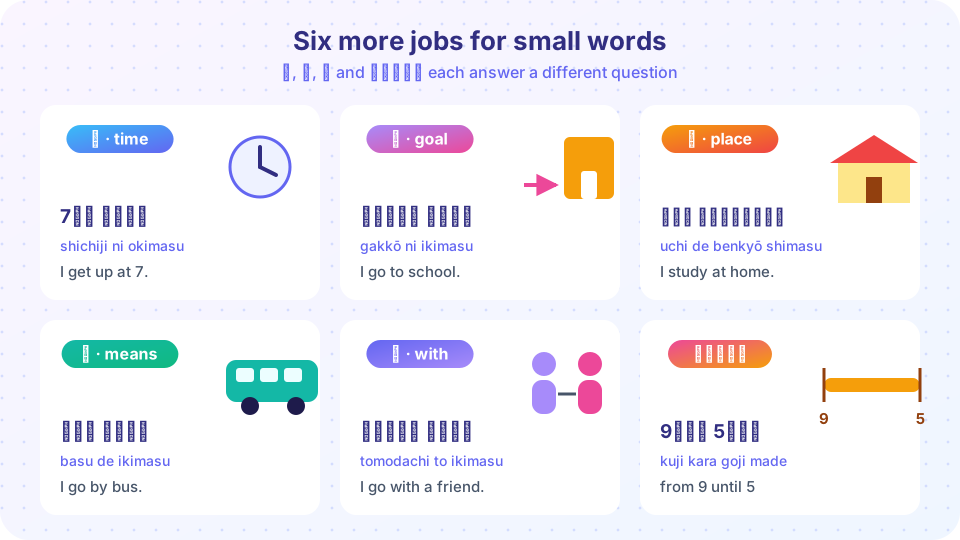
- 7じに おきます。 (Shichiji ni okimasu.) "I get up at 7."
- ごご 3じに あいましょう。 (Gogo sanji ni aimashō.) "Let's meet at 3 p.m."
- なんじに ねますか。 (Nanji ni nemasu ka?) "What time do you go to bed?"
An important rule: に is only used with specific points. Relative and repeating words such as きょう (today), あした (tomorrow), きのう (yesterday), いま (now), まいにち (every day) and まいあさ (every morning) do not take に: あした いきます, まいにち ほんを よみます.
に: a goal or target
に also marks where something moves to, and who is the target of an action.
- がっこうに いきます。 (Gakkō ni ikimasu.) "I go to school."
- うちに かえります。 (Uchi ni kaerimasu.) "I return home."
- ともだちに あいます。 (Tomodachi ni aimasu.) "I meet a friend." (Meeting is something you do to someone, so あう takes に.)
- ともだちに でんわします。 (Tomodachi ni denwa shimasu.) "I call a friend."
For movement verbs (いきます, きます, かえります), the particle へ (written へ, read e) works almost the same: がっこうへ いきます. The difference is subtle: へ stresses the direction, に stresses the destination. In everyday speech they are interchangeable here. Only に can mark a time or the target of あいます.
で: where an action happens
で marks the place where an action takes place:
- うちで ごはんを たべます。 (Uchi de gohan o tabemasu.) "I eat a meal at home."
- としょかんで ほんを よみます。 (Toshokan de hon o yomimasu.) "I read books in the library."
- がっこうで にほんごを べんきょうします。 (Gakkō de Nihongo o benkyō shimasu.) "I study Japanese at school."
- レストランで たべます。 (Resutoran de tabemasu.) "I eat at a restaurant."
Learners often confuse に and で for places. A rule that works: ask whether something happens there or goes/exists there. If the verb is an action (eat, read, work), the place takes で. If the verb is a movement toward a place, the place takes に (or へ). For existence ("there is"), the place takes に, and you will meet that in the next lesson.
で: means and tools
で also marks the means, the thing you use or the way you travel:
- バスで いきます。 (Basu de ikimasu.) "I go by bus."
- でんしゃで かえります。 (Densha de kaerimasu.) "I return by train."
- ペンで かきます。 (Pen de kakimasu.) "I write with a pen."
You will see で twice in a sentence, once for place and once for means. It is not a problem: the context shows which is which.
と: with and "and"
と (to) has two jobs. After a person, it means with: ともだちと いきます (Tomodachi to ikimasu), "I go with a friend." Between two nouns, it means and: パンと たまご (pan to tamago), "bread and eggs"; えんぴつと ペン (enpitsu to pen), "pencils and pens". Notice that と for "and" connects only nouns, never verbs.
から and まで
から (kara) means "from" and まで (made) means "until, up to". They work for times and places:
- 9じから 5じまで はたらきます。 (Kuji kara goji made hatarakimasu.) "I work from 9 to 5."
- とうきょうから おおさかまで でんしゃで いきます。 (Tōkyō kara Ōsaka made densha de ikimasu.) "I go from Tokyo to Osaka by train."
Time words with から and まで do not take に: the pair stands alone.
Stacking them in a sentence
A longer sentence collects these pieces in a usual order: topic, time, with whom, place or means, object, verb.
わたしは まいあさ 7じに うちで パンを たべます。 Watashi wa maiasa shichiji ni uchi de pan o tabemasu. "Every morning at 7 I eat bread at home."
あした ともだちと バスで がっこうへ いきます。 Ashita tomodachi to basu de gakkō e ikimasu. "Tomorrow I will go to school by bus with a friend."
Note the position of ともだちと: the order of these middle pieces is flexible; just keep the verb at the end.
A dialogue
リサ: たなかさんは まいあさ なんじに おきますか。 Tanaka-san wa maiasa nanji ni okimasu ka. "What time do you get up every morning, Mr. Tanaka?"
たなか: 6じに おきます。7じに がっこうへ いきます。 Rokuji ni okimasu. Shichiji ni gakkō e ikimasu. "I get up at 6. I go to school at 7."
リサ: なんで いきますか。 Nan de ikimasu ka. "How do you go?"
たなか: でんしゃで いきます。リサさんは? Densha de ikimasu. Risa-san wa? "I go by train. And you, Lisa?"
リサ: わたしは バスで いきます。ともだちと いきます。 Watashi wa basu de ikimasu. Tomodachi to ikimasu. "I go by bus. I go with a friend."
Choosing the particle: a short decision guide
When you are unsure which particle to use, ask these questions in order:
- Is it a clock time or a date? Use に. (7じに, but not あした.)
- Is it a place the verb moves toward? Use に or へ. (がっこうに いきます.)
- Is it a person you meet or call? Use に. (ともだちに あいます.)
- Is it a place where an action happens? Use で. (うちで たべます.)
- Is it a tool, a language or a vehicle? Use で. (バスで いきます.)
- Is it a companion? Use と. (ともだちと いきます.)
- Is it a starting or finishing point? Use から or まで.
Most of the time one question settles it. If two seem to fit, remember that the sentence can carry both: ともだちと バスで がっこうへ いきます uses と, で and へ at once.
Why に is used for both time and goal
It can seem strange that に marks both a time (7じに) and a destination (がっこうに). The common idea is a point: a point in time or a point in space that the action touches. Getting up touches the time 7:00; going touches the school. When there is no point, only a stretch of time or a general period (まいにち, あした), the verb has nothing to touch, and に is omitted. Thinking of に as a "target point" helps you decide, and it also helps with あいます, where the friend is the point you reach.
A few typical sentences for a day
Try reading these aloud and then change one word in each.
- ごぜん 7じに おきます。 (Gozen shichiji ni okimasu.) I get up at 7 a.m.
- バスで がっこうへ いきます。 (Basu de gakkō e ikimasu.) I go to school by bus.
- ともだちと ひるごはんを たべます。 (Tomodachi to hirugohan o tabemasu.) I eat lunch with a friend.
- としょかんで べんきょうします。 (Toshokan de benkyō shimasu.) I study in the library.
- ごご 6じに うちに かえります。 (Gogo rokuji ni uchi ni kaerimasu.) I return home at 6 p.m.
- よる 11じに ねます。 (Yoru jūichiji ni nemasu.) I go to bed at 11 at night.
Common misconceptions
"に and で both mean at." They do not. で is for where an action happens, に for a point in time, a destination or where something exists.
"Every time word takes に." Only specific points do (7じに, にちようびに). きょう, あした and まいにち do not.
"と joins any two things." と joins nouns. It cannot connect two verbs or two sentences.
"へ is read he as a particle." It is read e.
Try it
First, a particle drill. Each sentence has a blank; choose the particle.
Second, a clock reader in the console. It turns a time into Japanese and builds a sentence with に. The irregular hours (4, 7, 9) are handled by a lookup.
Press Run (or Ctrl + Enter) to see the console output here.
No output.
Check your understanding
Quick check · 6 questions
of 6 answered You scored / 6 · perfect!
-
1. Which particle goes after 7じ in "I get up at 7"?
A specific time takes に: 7じに おきます. -
2. How do you say "I eat at a restaurant"?
The action eat happens at the restaurant, so the place takes で. -
3. How is 4:00 read?
4 o'clock is よじ. -
4. What does ともだちと いきます mean?
と after a person means with. -
5. Which time word does NOT take に?
あした (tomorrow) is a relative time word and takes no に. -
6. Which sentence means "I go by train"?
で marks the means of transport.
Summary
- Clock hours are number + じ, with よじ, しちじ and くじ as special readings; add はん for half past.
- に marks specific times, destinations and the target of actions such as あう.
- で marks where an action happens and the means used.
- へ (read e) marks direction, と means with and "and", から and まで mean from and until.
- Do not attach に to あした, きょう, まいにち and other relative time words.
Next: あります and います: existence
Track your progress
Create a free account to tick off lessons and pick up where you left off on any device.
of Japanese for Beginners lessons completed