


















Lesson 5 of 50 · Sounds and Hiragana
Sounds and Hiragana: overview
Chapter 2 overview: the five Japanese vowels, the mora rhythm, pitch accent and the 46 hiragana, with a map of every lesson in the chapter.
Chapter 2 is where Japanese starts to feel like a real language in your mouth and in your hand. You will learn how the sounds work, why a Japanese word has a steady, even rhythm and how to read and write all 46 basic hiragana plus the marks that create about 60 more sounds. By the end you will be able to read any simple Japanese word written in hiragana, which opens the door to the rest of the course.
The sound system of Japanese is gentle on English speakers. There are only five vowels, and they are the same five every time. There are no tones as in Chinese and no clusters of consonants as in English "strengths". The part that needs attention is the rhythm, because Japanese counts beats (called mora) rather than syllables, and a small stress-free pitch pattern separates a few words that look the same.
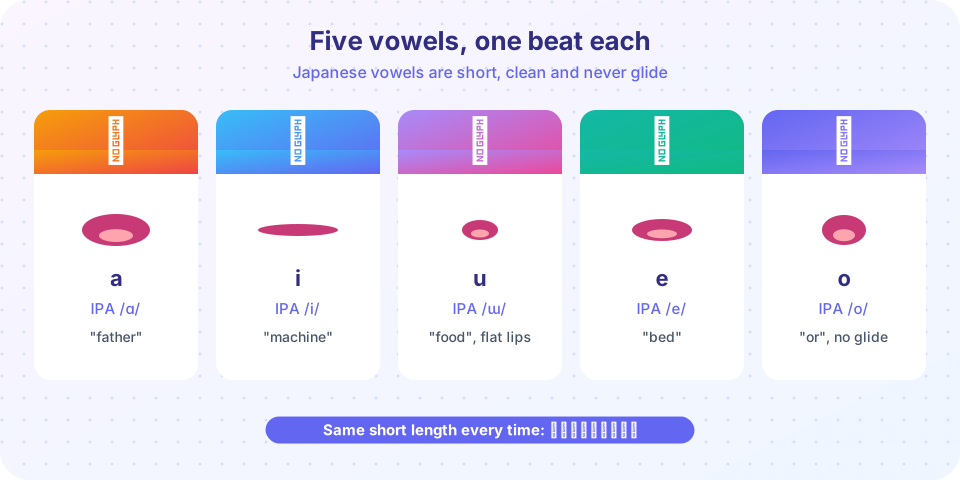
What you will learn
- the five vowels and the consonants that join them
- how the mora rhythm works, and why that matters for the speed of your speech
- how all 46 basic hiragana are laid out in a table
- how two small marks and small kana expand the table
- how to read long vowels, double consonants and combinations
Key terms
Mora (拍, haku): a beat of equal length. Each kana normally stands for one mora.
Hiragana (ひらがな): the rounded syllable script, 46 basic characters.
Dakuten (゛): two small strokes that voice a consonant (か becomes が).
Handakuten (゜): a small circle that changes the h-row into the p-row (は becomes ぱ).
Pitch accent: a pattern of high and low pitch inside a word, rather than stress.
The chapter in one deck
Five vowels
One beat per kana
46 basic hiragana
Marks and small kana
What each lesson covers
| Lesson | What you get |
|---|---|
| Mora, rhythm and pitch | The vowels in detail, the consonants, beats and pitch accent |
| Hiragana 1: vowels and K, S, T | 20 characters and your first real words |
| Hiragana 2: N, H, M | 15 characters; why は and へ sometimes sound different |
| Hiragana 3: Y, R, W and ん | the last 11 characters, including を and ん |
| Hiragana 4: marks, combos, long vowels | dakuten, small kana and the long-vowel rules |
| Chapter 2 review | one-page chart, recap and a ten-question quiz |
How to learn kana without tears
The 46 hiragana are not a memory test to cram. They are a pattern you recognise with practice. A method that works for most learners:
- Learn five to eight characters per day, no more. Learn a row, then use the row immediately in real words.
- Write each character by hand in the correct stroke order, saying its sound as you write. Stroke order is not decoration: it gives every character a recognisable shape and a rhythm, and it makes handwriting readable.
- Group lookalikes and compare them directly (for example さ and き, ぬ and め, わ and れ).
- Test yourself with a random order. A row recited in order is only half-learned.
- Review the day before's characters first, then add new ones.
A first look at the beat rhythm
Counting beats is the single skill that improves your pronunciation the most. Try the console exercise below. It counts the mora of a hiragana word using three rules you will meet in this chapter: normally each kana is one beat, a small や, ゆ, よ glues to the previous kana and adds no beat, and a small っ, the long-vowel mark ー and the sound ん each take one full beat of their own.
Press Run (or Ctrl + Enter) to see the console output here.
No output.
The second exercise is a vowel listening game. If your device offers a Japanese voice, it can read the vowel aloud; if not, the button tells you so, and you can still use the game to practice matching characters to sounds.
Common misconceptions
"Hiragana is for children." It is the working script of Japanese. Every adult uses it in every sentence, for grammar and for many everyday words.
"The kana table is 46 characters, so that is all the sounds." The table is only the beginning: marks and small kana add about 60 more sounds, and you will learn them in lesson 6 of this chapter (hiragana 4).
"I will remember the kana without writing." Reading comes first, but writing makes the shapes stick. Write them.
Check your understanding
Quick check · 4 questions
of 4 answered You scored / 4 · perfect!
-
1. How many basic hiragana characters are there?
There are 46 basic hiragana; with dakuten, handakuten and small kana you can write many more sounds. -
2. What does the word "mora" mean?
Japanese rhythm counts moras. Each kana is normally one mora, with the small ゃ ゅ ょ as exceptions. -
3. How many beats does さくら have?
さ + く + ら: one beat each, so three beats. -
4. Which marks change か into が?
Dakuten (゛) voices the consonant: k becomes g.
Summary
- Japanese has five pure vowels, a steady beat (mora) and a light pitch accent instead of stress.
- There are 46 basic hiragana in a grid of vowel rows and consonant columns.
- Dakuten, handakuten and small kana add dozens more sounds.
- Learn a few characters per day, write them and mix the order when you test yourself.
Next: Mora, rhythm and pitch
Track your progress
Create a free account to tick off lessons and pick up where you left off on any device.
of Japanese for Beginners lessons completed