


















Lesson 16 of 50 · Katakana and Basic Grammar
X は Y です: basic sentences
Build your first Japanese sentences: X は Y です for statements, か for questions, じゃありません for negatives, も for also and の for possession, with a dialogue.
Everything you have learned so far was preparation for this moment: you can now build real sentences. The most important pattern in beginner Japanese is X は Y です. It is how you introduce yourself, name things, describe people and answer "What is it?". A huge share of everyday conversation uses this one frame, and the rest of the language grows out of it.
You already met the pieces. は is the topic particle you read as wa. です (desu) is the polite way to say "is", "am" or "are". In this lesson you learn how they work together, how to turn a statement into a question or a negative, and how to add "also" and "of".
What you will learn
- the basic pattern X は Y です and what each part does
- how to ask yes-no questions with か and answer with はい and いいえ
- how to say "is not" with じゃありません
- how to say "also" with も and "of" or "'s" with の
- how to introduce yourself in four short sentences
Key terms
Topic (主題): what the sentence is about. は marks it: "as for X".
です (desu): the polite copula, "is / am / are".
か (ka): a question particle placed at the end of a sentence.
じゃありません (ja arimasen): the polite negative of です, "is not".
さん (-san): the polite title added to someone else's name.
The basic frame: X は Y です
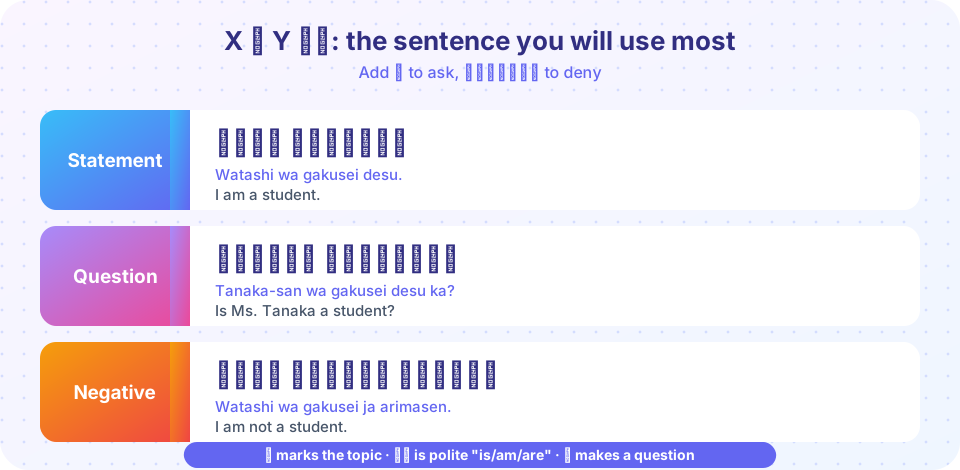
Read this sentence aloud: わたしは がくせいです。 (Watashi wa gakusei desu.) "I am a student."
- わたし is the topic, "I".
- は is the particle that marks it, read wa.
- がくせい is the information about the topic, "student".
- です closes the sentence politely.
A better way to think about は is "as for ...": As for me, (I am) a student. The sentence announces the topic and then adds a comment. That is why the same pattern covers so much: name, job, nationality, color, price, weather, whatever you want to say about the topic.
The full pattern needs no separate word for "a" or "the". がくせい is "student" or "a student", and context supplies the rest. です does not change for person either: the same ending serves for "I am", "you are", "she is" and "they are".
Useful nouns for the pattern:
| Word | Romaji | Meaning |
|---|---|---|
| わたし | watashi | I |
| がくせい | gakusei | student |
| せんせい | sensei | teacher (also a respectful word for doctors and others) |
| かいしゃいん | kaishain | company employee |
| いしゃ | isha | doctor |
| エンジニア | enjinia | engineer |
| ともだち | tomodachi | friend |
| にほんじん | Nihonjin | Japanese person |
| アメリカじん | Amerikajin | American |
The suffix じん (人, "person") turns a country name into a nationality: アメリカ becomes アメリカじん, イギリス becomes イギリスじん, カナダ becomes カナダじん. It also attaches to にほん (Japan): にほんじん.
Avoiding "you"
English uses "you" all the time. Japanese avoids it. The word あなた (anata) exists, but it can sound pointed or even rude when you use it directly with someone you are speaking to. The natural alternative is to use the person's name plus さん: たなかさんは がくせいですか。 (Tanaka-san wa gakusei desu ka?), "Are you a student, Ms. Tanaka?". If you do not know the name, use a title like せんせい (for a teacher) or simply drop the subject.
For yourself, わたし is polite and works for everyone. Men in casual settings often say ぼく (boku), and some say おれ (ore) with close friends, but you do not need them now.
Asking questions with か
To turn a statement into a yes-no question, add か (ka) to the end. There is no word-order change, and the voice rises slightly on か.
- たなかさんは がくせいですか。 (Tanaka-san wa gakusei desu ka?) "Is Mr. Tanaka a student?"
Answer with はい (hai, "yes") or いいえ (iie, "no"), and then a short sentence:
- はい、がくせいです。 (Hai, gakusei desu.) "Yes, (he) is a student."
- いいえ、かいしゃいんです。 (Iie, kaishain desu.) "No, (he) is a company employee."
A question mark is allowed in modern writing but not required: か already says it is a question, and Japanese text uses 。 as the full stop.
Saying "is not": じゃありません
To make a negative, replace です with じゃ ありません (ja arimasen):
- わたしは せんせいじゃ ありません。 (Watashi wa sensei ja arimasen.) "I am not a teacher."
In formal writing and polite speech you also see ではありません (dewa arimasen), which is the same thing in a stiffer style. Both are correct. In everyday conversation, じゃありません is the more natural choice.
You can ask a negative question too: がくせいじゃ ありませんか。 (Gakusei ja arimasen ka?) "Aren't you a student?"
Adding "also" with も
The particle も (mo) means "also" or "too". It takes the place of は:
- わたしは がくせいです。 I am a student.
- リサさんも がくせいです。 (Risa-san mo gakusei desu.) "Lisa is a student too."
If you keep は, you change the meaning, so use も whenever "also" is the point. This is an easy but important habit.
"Of" and "'s": の
The particle の (no) links two nouns, and the first one describes the second:
- わたしの ともだち (watashi no tomodachi), "my friend" ("friend of me")
- にほんごの せんせい (Nihongo no sensei), "Japanese-language teacher"
- たなかさんの ほん (Tanaka-san no hon), "Tanaka's book"
The pattern is A の B, with B as the main word. You will use it hundreds of times.
A dialogue
リサ: はじめまして。リサです。アメリカじんです。がくせいです。 Hajimemashite. Risa desu. Amerikajin desu. Gakusei desu. "How do you do? I am Lisa. I am American. I am a student."
たなか: たなかです。にほんじんです。かいしゃいんです。リサさんは がくせいですか。 Tanaka desu. Nihonjin desu. Kaishain desu. Risa-san wa gakusei desu ka. "I am Tanaka. I am Japanese. I am a company employee. Are you a student, Lisa?"
リサ: はい、がくせいです。たなかさんも がくせいですか。 Hai, gakusei desu. Tanaka-san mo gakusei desu ka. "Yes, I am a student. Are you a student too, Mr. Tanaka?"
たなか: いいえ、がくせいじゃ ありません。かいしゃいんです。 Iie, gakusei ja arimasen. Kaishain desu. "No, I am not a student. I am a company employee."
Notice how often the subject disappears: in Lisa's introduction, she names herself once and then drops "I" from the next two sentences.
A template for introducing yourself
An introduction is the first sentence pattern most learners use in real life. Here is a template with five steps:
- はじめまして。 (Hajimemashite.) Greet.
- Name + です。 リサです。 (Risa desu.)
- Nationality + です。 アメリカじんです。 (Amerikajin desu.)
- Job or status + です。 がくせいです。 (Gakusei desu.)
- どうぞ よろしく おねがいします。 (Dōzo yoroshiku onegai shimasu.) Close.
Replace the name, the nationality and the job, and you have a working introduction. Japanese introductions rarely include age, and a personal question about salary or family can feel intrusive. School or company, on the other hand, is a typical piece of information: かいしゃいんです (kaishain desu) tells the listener what role you play in society.
です and the plain form だ
You will sometimes hear a shorter, plainer form of です: だ (da). Friends and family say わたしは がくせいだ, or even drop it altogether: がくせい. The plain negative is じゃない (ja nai). Anime and dramas use these forms constantly, so you will recognise them. For now, stay with です; it is always safe, and it is the form your first Japanese teachers and colleagues will expect.
A curious extra
Because は simply means "as for", the pattern is more flexible than "X equals Y". In a café, a friend may say ぼくは コーヒーです。 (Boku wa kōhī desu.), literally "As for me, coffee is", which means "I'll have coffee". Context decides the meaning. You do not need to use this as a beginner, but you will hear it, and it explains why は is described as marking the topic rather than the subject.
Common misconceptions
"です means to be in every case." It is a polite ending for noun sentences. For existence ("there is a cat") Japanese uses different verbs (あります and います), which you will meet in chapter 4.
"I must always say わたし." Drop it whenever the subject is clear. Over-using わたし sounds unnatural.
"か needs a question mark." It does not. か is the question marker.
"You can say anata to a teacher." Use the person's name with さん or the title.
Try it
The first demo is a sentence builder. Choose a topic, a noun and a mood, and read the Japanese, the romaji and the English.
The second demo builds the same sentences in code, so you can see that the pattern is just text assembly. It prints a short self-introduction.
Press Run (or Ctrl + Enter) to see the console output here.
No output.
Check your understanding
Quick check · 6 questions
of 6 answered You scored / 6 · perfect!
-
1. What does は mark in わたしは がくせいです?
は marks the topic, "as for me". -
2. How do you turn たなかさんは せんせいです into a question?
Add か at the end: たなかさんは せんせいですか。 -
3. Which sentence means "I am not a student"?
じゃ ありません is the polite negative of です. -
4. Which word means "also" and replaces は?
も means also: リサさんも がくせいです。 -
5. How do you say "my friend"?
A の B: わたしの ともだち, "friend of me". -
6. Why should you avoid あなた when speaking to a person?
Japanese prefers a name plus さん or a title instead of a direct "you".
Summary
- X は Y です is the basic pattern: topic, description, polite ending.
- Add か to ask a yes-no question; answer with はい or いいえ.
- じゃ ありません is the negative of です; ではありません is more formal.
- も replaces は for "also"; の links two nouns as in わたしの ともだち.
- Use name + さん instead of "you", and drop obvious subjects.
Track your progress
Create a free account to tick off lessons and pick up where you left off on any device.
of Japanese for Beginners lessons completed