


















Lesson 14 of 50 · Katakana and Basic Grammar
Katakana 2: ハ to ン
Finish the 46 katakana (H, M, Y, R, W rows and ン), then add dakuten, handakuten, small ッ ャ ュ ョ and the long-vowel bar, with lookalikes and real loanwords.
You know 25 katakana. This lesson adds the remaining 21 and then applies everything from hiragana chapter 4 to katakana: the marks that voice consonants, the small ャ ュ ョ for combinations, the small ッ for double consonants and the long-vowel bar. If you did chapter 2 carefully, the second half is not new at all: the rules are exactly the same, only the shapes change.
With this lesson finished you can read almost any foreign word in Japanese: コーヒー, ハンバーガー, ホテル, ピアノ, サッカー, ジュース. It is one of the most satisfying moments in learning the language: suddenly, half the words on a street sign make sense.
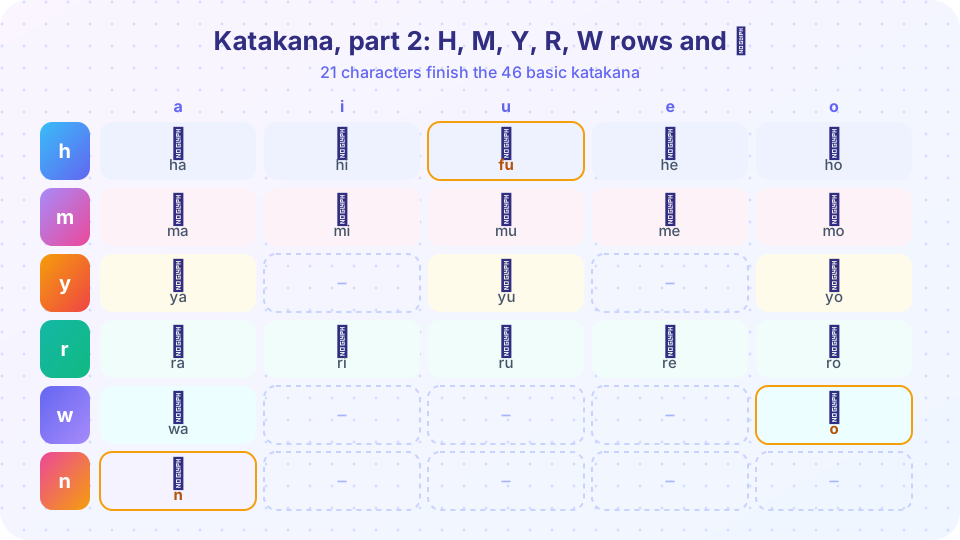
What you will learn
- the katakana H, M, Y, R and W rows and ン
- the extra lookalikes: ウ / ワ / フ, コ / ユ, ミ / シ / ツ
- how dakuten, handakuten, small ッ and ャ ュ ョ work in katakana
- how to read a dozen more loanwords
Key terms
Dakuten (゛) and handakuten (゜): marks that voice a consonant or turn h into p, the same as in hiragana.
Small ッ: a silent beat that doubles the next consonant, as in サッカー.
Yōon (拗音): a fused sound such as シャ, ジュ or チョ.
Long-vowel bar (ー): one extra beat for the previous vowel.
The new characters
| Row | Characters | Sounds | Stroke counts |
|---|---|---|---|
| H | ハ ヒ フ ヘ ホ | ha hi fu he ho | 2, 2, 1, 1, 4 |
| M | マ ミ ム メ モ | ma mi mu me mo | 2, 3, 2, 2, 3 |
| Y | ヤ ユ ヨ | ya yu yo | 2, 2, 3 |
| R | ラ リ ル レ ロ | ra ri ru re ro | 2, 2, 2, 1, 3 |
| W and N | ワ ヲ ン | wa o n | 2, 3, 2 |
Where they come from: ハ from 八, ヒ from 比, フ from 不, ヘ from 部, ホ from 保, マ from 末, ミ from 三, ム from 牟, メ from 女, モ from 毛, ヤ from 也, ユ from 由, ヨ from 与, ラ from 良, リ from 利, ル from 流, レ from 礼, ロ from 呂, ワ from 和 and ヲ from 乎. The sources are not important for reading, but they explain the simple shapes: ミ is literally three strokes like the number 三.
Sound notes: フ is fu (the soft lip sound), ヲ is o (it is almost never used in katakana, because the object particle is always written in hiragana), and ン is the same full beat as ん.
More lookalikes
- ウ, ワ and フ: ウ has a short stroke on top and an open hook; ワ has no top stroke and a hook that turns inward; フ is a single hooked stroke.
- コ and ユ: コ is two flat lines joined at the right; ユ has a longer bottom bar that sticks out to the right.
- ミ, シ and ツ: ミ has three long, nearly parallel horizontal strokes; シ and ツ have two short strokes and one long stroke, as you learned.
- ヌ and ス: ヌ has a cross stroke that ス lacks.
- メ and ナ: メ is an X shape; ナ has a horizontal bar crossing a vertical stroke.
- ル and レ: ル has two parts, レ is a single stroke with a bend.
- ヘ (katakana) and へ (hiragana): almost identical in shape, and the same sound. Context tells which script you are in.
Marks and small kana (the same rules as hiragana)
Dakuten and handakuten work exactly as in hiragana:
- G row: ガ ギ グ ゲ ゴ (ga gi gu ge go)
- Z row: ザ ジ ズ ゼ ゾ (za ji zu ze zo)
- D row: ダ ヂ ヅ デ ド (da ji zu de do), though ヂ and ヅ are very rare
- B row: バ ビ ブ ベ ボ (ba bi bu be bo)
- P row: パ ピ プ ペ ポ (pa pi pu pe po)
The small ャ, ュ and ョ fuse into one beat with the preceding i-row kana: キャ (kya), シュ (shu), チョ (cho), ジュ (ju), ニュ (nyu), ヒョ (hyo), ミュ (myu), リョ (ryo) and so on. The small ッ doubles the next consonant: サッカー (sakkā, soccer), ベッド (beddo, bed), ホットドッグ (hottodoggu, hot dog). And the long-vowel bar ー continues to add one beat: ビール (bīru), ラーメン (rāmen).
You will also meet a special katakana, ヴ (vu), used to write the v of foreign words. In practice, most Japanese people still use バ-row sounds: バイオリン (baiorin, violin) is more common than ヴァイオリン.
Real words
| Word | Romaji | Meaning | Note |
|---|---|---|---|
| コーヒー | kōhī | coffee | from English |
| ホテル | hoteru | hotel | |
| ハンバーガー | hanbāgā | hamburger | |
| パン | pan | bread | from Portuguese pão |
| ミルク | miruku | milk | |
| メール | mēru | from "mail" | |
| ラーメン | rāmen | ramen | a Chinese-origin noodle dish |
| ロボット | robotto | robot | |
| ワイン | wain | wine | |
| レモン | remon | lemon | |
| ピアノ | piano | piano | |
| カメラ | kamera | camera | |
| サッカー | sakkā | soccer | |
| ジュース | jūsu | juice | |
| シャツ | shatsu | shirt | |
| チーズ | chīzu | cheese |
Some of these words have a surprise. ミルク sounds like "milk" with vowels inserted, and ロボット is robotto because Japanese must add a vowel after every consonant and the final t becomes a doubled consonant plus to. You will study these rules in the loanword lesson.
Katakana in daily life
With the full table you can read much of a typical restaurant or shopping street. Common words include コンビニ (konbini, convenience store), スーパー (sūpā, supermarket), レストラン (resutoran, restaurant), トイレ (toire, toilet), エレベーター (erebētā, elevator) and メニュー (menyū, menu). On a menu you may see ランチセット (ranchi setto, lunch set), サラダ (sarada, salad), ドリンク (dorinku, drink), ハンバーグ (hanbāgu, a hamburger steak), ピザ (piza) and ポテト (poteto, potatoes or fries).
The Japanese menu is also a good place to see that katakana adapts rather than copies. Salad ends in a consonant in English but ends in a vowel in サラダ, and potato becomes poteto. The sounds are Japanese even when the word is foreign.
A learning plan for the last 21 characters
Here is a plan that fits four short sessions:
- Session 1: the H row (ハ, ヒ, フ, ヘ, ホ) with a review of the first 25.
- Session 2: the M and Y rows (マ, ミ, ム, メ, モ, ヤ, ユ, ヨ).
- Session 3: the R and W rows and ン (ラ, リ, ル, レ, ロ, ワ, ヲ, ン).
- Session 4: the marks and small characters, then the reader above.
At the end of each session, take the quiz in mixed mode and read three of the words from the tables. If one session feels too heavy, split it; it is better to finish a short session well than to finish a long one badly.
Spot the loanword
Katakana reading is a detective game. When you meet an unknown katakana word, say it aloud and listen for the English hiding inside. ミルク (miruku) sounds like "milk". ホームページ (hōmupēji) is "home page". マヨネーズ (mayonēzu) is "mayonnaise". アメリカ (Amerika) is America. Not every word is English: パン came from Portuguese, and ビール from Dutch. As your reading grows, you will discover that katakana is a map of how Japan has met the world.
Mixing hiragana and katakana in one word
Occasionally a single word mixes scripts. In ラーメンを たべます (rāmen o tabemasu, "I eat ramen") you see katakana for ramen, hiragana for the particle and the verb. The rule of thumb is simple: katakana for the foreign noun, hiragana for the grammar around it. Because the scripts differ visually, you can find word boundaries at a glance. That is a hidden advantage of Japanese's multi-script system, and it is the reason Japanese can be written without spaces.
Katakana in comics and sound effects
Japanese comics, called manga, print their sound effects in katakana. A cat says ニャー (nyā), a dog says ワンワン (wan wan), a pounding heart goes ドキドキ (doki doki), and a door closes with a ガタン (gatan). These words are called onomatopoeia, and Japanese has thousands of them. They give you a fun way to practise: pick up any comic, find a katakana sound effect and read it aloud. Because the shapes are often drawn large and stylised, you will also learn to recognise katakana written in different fonts and handwriting styles, which prepares you for real-life signs.
Common misconceptions
"ヲ is a common katakana." The particle を is written in hiragana. ヲ is almost never used.
"ヘ and へ are different sounds." They are the same sound he (or e as a particle) in two scripts.
"Voiced katakana are different characters to learn." They are the same characters with the same marks as in hiragana.
Try it
First, a katakana reader. It builds its table from the hiragana table by adding 0x60 to every code point, which shows how closely the two scripts mirror each other. It handles marks, small characters, the long-vowel bar and double consonants.
Press Run (or Ctrl + Enter) to see the console output here.
No output.
Second, a quiz on the second half of the table and on the voiced katakana.
Check your understanding
Quick check · 6 questions
of 6 answered You scored / 6 · perfect!
-
1. How is フ read?
フ is fu, the same soft lip sound as ふ. -
2. What does ジュース mean?
ジュース (jūsu) is juice. チーズ is cheese. -
3. How many beats does サッカー have?
サ, ッ, カ, ー: the small ッ and the bar each count as a beat, so four beats. -
4. Which katakana is a flat X shape?
メ (me) is an X shape; ナ has a horizontal bar and a vertical stroke. -
5. Which sounds are written ガ ギ グ ゲ ゴ?
Dakuten turns the K row into the G row. -
6. Why is the object particle written を and not ヲ?
Grammar particles are written in hiragana, so ヲ is almost never used.
Summary
- The remaining katakana are the H, M, Y, R and W rows and ン, which completes the 46.
- Dakuten, handakuten, small ャ ュ ョ, small ッ and ー work exactly as in hiragana.
- ウ, ワ and フ, コ and ユ, and ミ, シ and ツ need careful attention.
- Katakana lets you read hundreds of loanwords: コーヒー, ハンバーガー, サッカー.
Track your progress
Create a free account to tick off lessons and pick up where you left off on any device.
of Japanese for Beginners lessons completed