


















Lesson 39 of 50 · Kanji and Reading
Chapter 7 review: kanji and reading
Review chapter 7: kanji types, stroke order, on and kun readings, okurigana, compound sound changes and everyday kanji, with a recap table and a ten-question quiz.
In this chapter you met the third script of Japanese and learned the rules that make it manageable. You can now explain what a kanji is, write a character with a reasonable stroke order, predict whether a word uses an on or a kun reading, and read a short sentence by splitting it at the kana. This page collects it all, gives you a reading text to try, and finishes with ten questions.
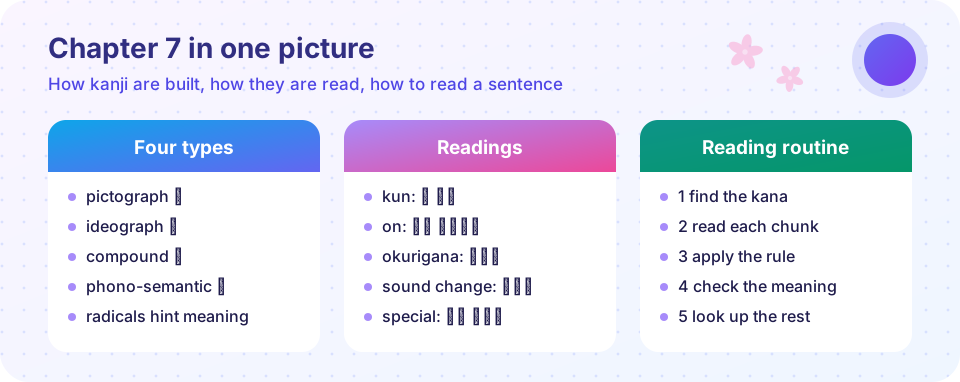
The chapter in one table
| Topic | Key idea | Example |
|---|---|---|
| Three scripts | kanji for content, hiragana for grammar, katakana for loanwords | 食べます, コーヒー |
| Jōyō kanji | 2,136 official everyday characters; 1,026 taught in elementary school | |
| Four types | pictograph, simple ideograph, compound ideograph, phono-semantic | 山, 三, 休, 校 |
| Radicals | recurring parts that hint at meaning | 氵 water, 亻 person, 言 speech |
| Stroke order | top to bottom, left to right, horizontal before vertical, outside before inside | 十, 国 |
| On'yomi | Chinese-derived; usually in compounds | 学校 がっこう |
| Kun'yomi | native Japanese; usually single kanji with okurigana | 山 やま, 食べる たべる |
| Okurigana | the changing kana tail of verbs and adjectives | 大きい, 行きます |
| Sound changes | doubling, voicing, special readings | がっこう, てがみ, きょう |
| Reading routine | find kana, read chunks, apply the rule, check meaning, look up | 私は毎日... |
| Numbers and prices | digits before the unit kanji | 一万二千円 |
| Signs | 出口, 入口, 駅, 休み | でぐち, いりぐち |
The 22 kanji of lesson 2 and the extra ones from lesson 4
- Nature and days: 日 月 火 水 木 金 土 山 川
- People and body: 人 口 目 手 友
- Size and place: 大 小 中 上 下 前 後 右 左
- School and life: 学 生 先 本 年 国 毎 今 何 時 間
- Verbs: 食 飲 見 行 来 出 入 話 聞 読 書 買 会 休
- Things: 駅 電 車 高 安 新 白 円 千 百 万
If any of these look unfamiliar, go back to the earlier lessons, because kanji are cumulative: each one you recognize helps you read compounds that contain it.
A reading text
Try to read this short text before you look at the readings. Break it at the kana first.
今日は日曜日です。 友達と駅の前で会います。 それから、電車で山へ行きます。 川の水を見て、お茶を飲みます。 Kyou wa nichiyoubi desu. Tomodachi to eki no mae de aimasu. Sorekara, densha de yama e ikimasu. Kawa no mizu o mite, ocha o nomimasu. Today is Sunday. I meet a friend in front of the station. Then we go to the mountains by train. We look at the river water and drink tea.
Notice how the hiragana particles (は, と, の, で, へ, を) split the text into chunks, and how the verbs show okurigana (会います, 行きます, 見て, 飲みます). The compounds 今日, 日曜日, 友達 and 電車 use readings you know from this chapter, while お茶 (おちゃ, tea) is a new word that you can look up.
Common slips to check
- Reading a single kanji with okurigana by its on reading (行く as こうく).
- Dropping okurigana (writing 食る instead of 食べる).
- Writing 休む when you mean 安い (they sound alike: やす).
- Reading 日本 as ひほん; it is にほん or にっぽん.
- Forgetting that 口 reads ぐち in 出口 and 入口.
Try it
The first tool builds a study list from the chapter's vocabulary, grouped by reading type. Add words of your own to the lists.
Press Run (or Ctrl + Enter) to see the console output here.
No output.
The second tool prints a little self-test: it hides the readings of some words, which you should say out loud before reading the answer line.
Press Run (or Ctrl + Enter) to see the result here.
Program input · what you'd type while the program runs
Type the answers before you press Run, one per line. Each time the program reads a line (with input()), it gets the next line from this box.
Check your understanding
Quick check · 10 questions
of 10 answered You scored / 10 · perfect!
-
1. Which script do verb endings such as ます normally use?
Grammar (particles and verb endings) is written in hiragana. -
2. How many jōyō kanji are there?
The official list of everyday kanji contains 2,136 characters (2010 revision); 1,026 of them are taught in elementary school. -
3. Which kanji type is 校 (school, こう)?
校 combines a tree radical (meaning) with 交 (sound こう). -
4. How do you write 国 correctly?
Outside before inside, with the bottom line closing the box last. -
5. Which reading is used for 山 in 山 (alone, 'mountain')?
Single kanji usually use kun readings: やま. -
6. What do 学 (ガク) + 校 (コウ) become together?
The sounds double into がっこう (gakkou). -
7. What are the okurigana in 大きい?
大 is the kanji; きい is the hiragana tail that shows the adjective ending. -
8. How is 今日 read?
今日 is a jukujikun: きょう (today). -
9. How do you write 3,000 yen in kanji?
三 (3) plus 千 (1,000): 三千円 (さんぜんえん). -
10. What does the sign 休み mean on a shop door?
休み means rest or day off; on a shop door it means the shop is closed.
Summary
- Kanji carry meaning; hiragana carry grammar; katakana write loanwords.
- Four kanji types, radicals, and stroke-order rules make characters easier to learn.
- On'yomi mostly in compounds, kun'yomi mostly alone or with okurigana; sounds change in compounds.
- Read sentences by splitting at the kana, reading chunks and checking the meaning.
- Learn kanji inside words and review a little every day.
Track your progress
Create a free account to tick off lessons and pick up where you left off on any device.
of Japanese for Beginners lessons completed