


















Lesson 50 of 50 · Projects and Practice
Further study: where to go next in Japanese
Plan your next steps in Japanese: grammar to learn next, kanji and reading habits, speaking practice, the JLPT, and related tracks on this site.
You have reached the end of the second half of this course. You can count, tell the time, ask questions, talk about the past, link actions with the te-form, read your first kanji and handle the most common social situations. That is a real foundation. This last lesson helps you decide what to do next: which grammar to learn, how to keep growing your vocabulary and kanji, how to practice speaking, how to use a proficiency test as a goal, and which other tracks on this site connect with what you are learning.
What you will learn
- Choose the next grammar topics in a sensible order.
- Build a habit for kanji, vocabulary, reading and listening.
- Plan speaking practice with real people.
- Understand how the JLPT levels can serve as goals.
Key terms
JLPT (日本語能力試験): the Japanese-Language Proficiency Test, a widely recognized exam with five levels from N5 (easiest) to N1 (hardest).
Plain form (普通形, futsuukei): the casual forms of verbs and adjectives, the base for many later patterns.
Graded reader: a book written for learners, with a limited vocabulary and grammar.
Shadowing: repeating speech immediately after hearing it, to train rhythm and pronunciation.
Spaced repetition: reviewing items at growing intervals, usually with an app or flashcards.
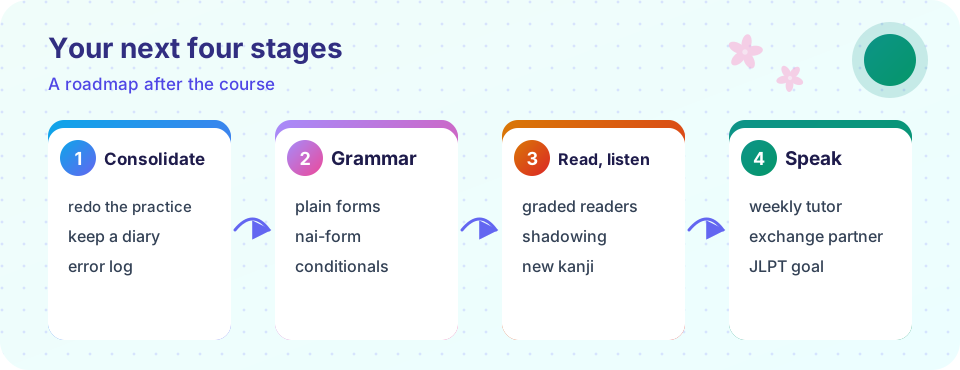
Stage 1: consolidate
Before adding new material, make sure that the material of the course is solid. Return to the practice lesson and the cheat sheet, and ask yourself whether you can do the following without a table:
- Say any number to 99,999 and read a price.
- Tell the time and say a date, with the special days of the month.
- Ask the main questions and understand the answers.
- Form the polite past and the te-form of any common verb.
- Read the 40 kanji from chapter 7 in simple sentences.
- Give a self-introduction and order a meal.
The fastest way to consolidate is to use the material. Write a short diary every day for two weeks (see the diary project), record yourself giving the self-introduction, and ask a friend or a tutor to correct your writing. When you spot repeated errors, put them in your error log and review them at the start of each session.
Stage 2: extend the grammar
The next grammar topics build directly on what you know. A sensible order is:
- The plain (casual) forms. You have already met the dictionary form, the casual past (たべた) and the casual wish (たべたい). Learn the casual negative (たべない, tabenai) and the casual negative past (たべなかった). Plain forms are essential for conversation with friends and are the base for nearly everything after this.
- The nai-form patterns. The negative request (〜ないでください, "please do not"), and obligation (〜なければなりません, "must").
- Reasons and connections. 〜から and 〜ので (because), 〜けど and 〜が (but), 〜とき (when).
- Ability and permission. The potential form (できる, "can do"), which lets you say "I can read kanji."
- Opinions and quotations. 〜と おもいます ("I think that ..."), 〜と いいました ("said that ...").
- Conditionals. 〜たら, 〜と, 〜ば and 〜なら ("if", "when").
- Giving and receiving. あげる, もらう, くれる, which are central to Japanese social talk.
- Passive, causative and honorific forms, which lead into keigo.
Learn one pattern at a time, make five sentences about your own life with it, and then use it in your diary or in conversation within a week. A pattern that you have used in a real situation stays with you.
Stage 3: read and listen
Reading and listening drive vocabulary growth.
- Graded readers and learner news. Start with simple stories and with news aimed at learners, which has furigana and short sentences. Read a small amount each day.
- Kanji. Add a handful of new kanji per week, learned inside words. Aim for the next few hundred common characters, and review with spaced repetition. Writing by hand helps.
- Listening. Choose material with transcripts: learner podcasts, dialogues with subtitles, and short videos. Listen once for the gist, once with the transcript, and once more without it.
- Shadowing. Pick a short audio clip and repeat each sentence just after the speaker. It improves rhythm and the pitch of your speech.
- Vocabulary. Build your own flashcards from words you meet in real material, with an example sentence and the reading. Avoid memorizing long lists out of context.
A course cannot replace speaking with people, and listening practice only works if you listen to real speakers, in all their variety: fast speech, slang, dialects and different voices.
Stage 4: use the language
Speaking is a skill that grows only with practice, and a short session with a real person is worth more than hours alone.
- Tutors and exchange partners. A weekly session of thirty minutes can be enough to keep improving. Prepare a topic in advance, such as your week or a short story, and ask your partner to correct two or three mistakes, not all of them.
- Local communities. Many cities have Japanese clubs, cultural centers and language cafes.
- Travel and online communities. If you can visit Japan, use every chance to order, ask and chat. If you cannot, join online conversation groups.
- Think in Japanese. Describe what you see, in simple sentences, while you walk or cook.
Do not wait until you feel ready: beginners who speak early, and make mistakes, usually progress faster than those who wait.
Using the JLPT as a goal
The JLPT has five levels, N5 to N1, and it tests vocabulary, grammar, reading and listening (it has no speaking section). Many learners use it as a milestone. N5 and N4 are the beginner levels, and what you have learned in these lessons overlaps with both, although you will need more vocabulary, more kanji and the plain forms. Unofficial lists suggest roughly a hundred kanji for N5, but the test publishes no official list, so use a study book or an app with practice tests. The test is usually offered once or twice a year, so check the official site for dates and registration in your country. A goal date gives a deadline, which helps many people study consistently.
Connections to other tracks on this site
Your Japanese study connects to several other subjects, and learning about them can reinforce it:
- Mandarin Chinese for Beginners shares many characters with Japanese kanji, although their readings and some meanings differ. Comparing the two can strengthen your memory for characters.
- Language Learning Methods explains how memory, spaced repetition, listening and speaking practice work, which will help you design your own study plan.
- Linguistics explores how languages are structured, including writing systems, sounds and grammar, and puts Japanese in context.
- Study Skills and Exam Technique offers tools for planning, revising and taking tests such as the JLPT.
A sample plan
A realistic plan is about thirty to sixty minutes a day. Split it into four short blocks: review (flashcards and your error log), new grammar (one pattern), reading or listening (one short item), and output (a diary entry or a spoken recording). Once a week, have a conversation with a partner. Once a month, check your progress by re-doing the practice sets and giving the self-introduction again, and notice what has become easier.
Common misconceptions
"I should finish all the grammar before I speak." Speaking early makes the grammar stick; waiting delays it.
"I need to know all the kanji first." Reading real, simple texts with furigana is a better way to grow.
"Long sessions are the best." Short daily sessions beat long irregular ones.
"The JLPT is the only measure of Japanese." It is a useful milestone, but real use matters just as much.
Try it
The first tool estimates how many hours of study a plan produces over twelve weeks and plots the cumulative total. It is only arithmetic (minutes per day times days), not a prediction of your level.
Press Run (or Ctrl + Enter) to see the result here.
Program input · what you'd type while the program runs
Type the answers before you press Run, one per line. Each time the program reads a line (with input()), it gets the next line from this box.
The second tool is a checklist for your next steps. Tick the items you have done; the bar shows your progress.
Check your understanding
Quick check · 4 questions
of 4 answered You scored / 4 · perfect!
-
1. Which grammar topic is a sensible next step after this course?
Plain negatives and the nai-form patterns build directly on the casual past and te-form. -
2. How many levels does the JLPT have?
N5 (easiest) to N1 (hardest). -
3. What is shadowing?
Shadowing trains rhythm and pronunciation. -
4. Which approach to study is best?
Short, regular sessions build memory better than rare long ones.
Summary
- First consolidate: redo the practice, record yourself, and keep an error log.
- Then extend the grammar: plain forms, nai-form patterns, reasons, ability, conditionals and giving and receiving.
- Read, listen and shadow every day, and speak with real people weekly.
- Use the JLPT as an optional goal, and explore the related tracks on this site.
Congratulations on finishing the course! Go back to the Japanese for Beginners course page whenever you want to review a lesson.
Track your progress
Create a free account to tick off lessons and pick up where you left off on any device.
of Japanese for Beginners lessons completed