


















Lesson 42 of 50 · Conversation and Culture
Restaurants, trains and directions
Practical Japanese scripts for ordering food, paying, buying train tickets and asking the way, with ください, たいです, まっすぐ and full dialogues.
The three places where a visitor most needs Japanese are the restaurant, the train station and the street. Fortunately, they are also the places where conversations follow the most predictable scripts. A server asks the same four questions in nearly every restaurant, ticket machines always ask for a destination and a fare, and when you ask for directions the answer will contain a small set of words: straight, right, left, corner, near. In this lesson you will collect the phrases for each of these scripts, learn the pattern 〜たいです (tai desu, "I want to ..."), and practice with full dialogues.
What you will learn
- Order, ask for the bill and use the key restaurant phrases.
- Buy a train ticket and understand station signs.
- Ask and follow directions with まっすぐ, みぎ, ひだり and かど.
- Say what you want with 〜たいです and ask for something with 〜をください.
Key terms
〜をください (o kudasai): "please give me ...", the main ordering pattern.
〜をおねがいします (o onegai shimasu): "I would like ... please", slightly more polite.
〜はどこですか (wa doko desu ka): "where is ...?"
〜たいです (tai desu): "I want to ..."; made from the ます-stem of a verb.
〜ありますか (arimasu ka): "do you have ...?" (for objects).
Five patterns that do most of the work
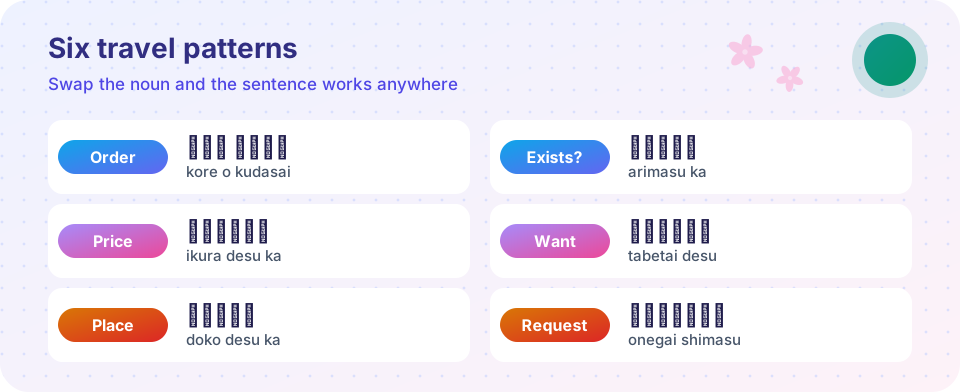
- 〜をください asks for something: これを ください (Kore o kudasai), "This, please." Add a quantity after the item: ラーメンを ふたつ ください (Raamen o futatsu kudasai), "Two bowls of ramen, please," using the counting words from chapter 5.
- 〜はありますか asks whether something exists: みずは ありますか (Mizu wa arimasu ka), "Do you have water?"
- 〜はどこですか asks where: トイレは どこですか (Toire wa doko desu ka), "Where is the toilet?"
- 〜はいくらですか asks the price: この きっぷは いくらですか (Kono kippu wa ikura desu ka), "How much is this ticket?"
- 〜たいです says what you want to do. Take the polite verb, remove ます, and add たいです: たべます becomes たべたいです (tabetai desu, "I want to eat"), のみます becomes のみたいです (nomitai desu, "I want to drink"), いきます becomes いきたいです (ikitai desu, "I want to go"), みます becomes みたいです (mitai desu, "I want to see"). In the negative, change い to くない: たべたくないです (tabetakunai desu).
You can reach most of what you want with these five. If you do not know a word, point and say これ (kore, "this") plus ください.
At a restaurant
A typical visit follows this script:
- Entering. Staff call out いらっしゃいませ (Irasshaimase, "Welcome"). They will ask なんめいさまですか (Nanmei sama desu ka), "How many people?" Answer with the people counter from chapter 5: ひとりです (Hitori desu, one), ふたりです (Futari desu, two), さんにんです (Sannin desu, three).
- Seating. こちらへ どうぞ (Kochira e douzo), "This way, please."
- Ordering. Ask for the menu: メニューを おねがいします (Menyuu o onegai shimasu). Ask for a recommendation: おすすめは なんですか (Osusume wa nan desu ka), "What do you recommend?" Order: これを ひとつ ください. In many casual restaurants you press a call button or say すみません (Sumimasen) to call the server.
- Dietary questions. たまごが はいって いますか (Tamago ga haitte imasu ka), "Does it contain egg?" uses the te-form of はいる (to be inside). Ask for no ingredient with a helper phrase you can point at, or show a written note.
- Paying. Many restaurants have you pay at the cash register on your way out, not at the table: レジで はらいます (Reji de haraimasu, "I pay at the register"). At the table, ask おかいけいを おねがいします (Okaikei o onegai shimasu), "The bill, please." Ask カードは つかえますか (Kaado wa tsukaemasu ka), "Can I use a card?" Do not leave a tip; it is not expected in Japan.
- Leaving. Say ごちそうさまでした (Gochisousama deshita), "Thank you for the meal."
For food to go, say もちかえりで おねがいします (Mochikaeri de onegai shimasu), "Takeout, please," and for eating in, ここで たべます (Koko de tabemasu).
A restaurant dialogue
Staff: いらっしゃいませ。 なんめいさまですか。 (Irasshaimase. Nanmei sama desu ka.) Welcome. How many people? You: ふたりです。 (Futari desu.) Two. Staff: こちらへ どうぞ。 (Kochira e douzo.) This way, please. You: すみません、メニューを おねがいします。 (Sumimasen, menyuu o onegai shimasu.) Excuse me, the menu, please. Staff: はい、どうぞ。 (Hai, douzo.) Here you are. You: おすすめは なんですか。 (Osusume wa nan desu ka.) What do you recommend? Staff: ラーメンが にんきです。 (Raamen ga ninki desu.) The ramen is popular. You: じゃあ、ラーメンを ふたつ ください。 (Jaa, raamen o futatsu kudasai.) Then, two ramen, please.
At a train station
Stations in big cities have signs in kanji, hiragana and often also in English and romaji, so the kanji you learned in chapter 7 are a head start: 駅 (eki, station), 出口 (deguchi, exit), 入口 (iriguchi, entrance), 右 and 左 (right, left). The usual vocabulary:
| Word | Reading | Meaning |
|---|---|---|
| 切符 | きっぷ (kippu) | ticket |
| 改札 | かいさつ (kaisatsu) | ticket gate |
| 〜番線 | 〜ばんせん (bansen) | platform number: 三番線 さんばんせん |
| 乗り場 | のりば (noriba) | boarding place |
| 乗り換え | のりかえ (norikae) | transfer |
| 〜行き | 〜ゆき (yuki) | bound for: とうきょうゆき |
| 次の駅 | つぎのえき (tsugi no eki) | next station |
| 片道 / 往復 | かたみち / おうふく (katamichi / oufuku) | one way / round trip |
Useful sentences:
- とうきょうまで いくらですか。 (Toukyou made ikura desu ka.) How much is it to Tokyo?
- とうきょうまでの きっぷを ください。 (Toukyou made no kippu o kudasai.) A ticket to Tokyo, please.
- おとなひとり、かたみちです。 (Otona hitori, katamichi desu.) One adult, one way.
- つぎの でんしゃは なんじですか。 (Tsugi no densha wa nanji desu ka.) What time is the next train?
- なんばんせんですか。 (Nanbansen desu ka.) Which platform is it?
- つぎの えきで おります。 (Tsugi no eki de orimasu.) I get off at the next station.
On a train, people keep conversations quiet and put phones on silent. If you need to pass someone, say すみません (Sumimasen).
Asking and understanding directions
First, ask politely. すみません、えきは どこですか (Sumimasen, eki wa doko desu ka), "Excuse me, where is the station?" Or, if you want to go there, えきへ いきたいです (Eki e ikitai desu), "I want to go to the station." The answer will often be a chain of te-forms, using the sequence pattern from chapter 6.
| Word | Reading | Meaning |
|---|---|---|
| まっすぐ | massugu | straight ahead |
| 右 | みぎ (migi) | right |
| 左 | ひだり (hidari) | left |
| 曲がる | まがる (magaru) | to turn |
| 角 | かど (kado) | corner |
| 信号 | しんごう (shingou) | traffic light |
| 交差点 | こうさてん (kousaten) | intersection |
| 近く | ちかく (chikaku) | nearby |
| 〜の前 / 後ろ | 〜のまえ / うしろ | in front of / behind |
| 〜の隣 / 横 | 〜のとなり / よこ | next to / beside |
A typical reply might be: まっすぐ いって、ふたつめの かどを みぎに まがって ください (Massugu itte, futatsume no kado o migi ni magatte kudasai), "Go straight, and turn right at the second corner." The ending 〜つめ (tsume) turns a number into an order: ひとつめ (hitotsume, the first), ふたつめ (futatsume, the second).
To ask how far, say ここから どのくらいですか (Koko kara dono kurai desu ka), "How far is it from here?" and expect あるいて じゅっぷんぐらいです (Aruite juppun gurai desu), "About ten minutes on foot." Here 〜ぐらい (gurai) means "about." If you do not understand, say もういちど おねがいします (Mou ichido onegai shimasu), "Once more, please," or ゆっくり おねがいします (Yukkuri onegai shimasu), "Slowly, please." You can also ask the person to show you on a map: ちずで おしえて ください (Chizu de oshiete kudasai), "Please show me on the map."
A directions dialogue
A: すみません、えきは どこですか。 (Sumimasen, eki wa doko desu ka.) Excuse me, where is the station? B: まっすぐ いって、ふたつめの かどを みぎに まがって ください。 (Massugu itte, futatsume no kado o migi ni magatte kudasai.) Go straight and turn right at the second corner. A: ここから どのくらいですか。 (Koko kara dono kurai desu ka.) How far is it from here? B: あるいて ごふんぐらいです。 (Aruite gofun gurai desu.) About five minutes on foot. A: ありがとうございます。 (Arigatou gozaimasu.) Thank you.
Common misconceptions
"I must tip or the server will be offended." There is no tipping in Japan. Leaving money can cause confusion; the staff may run after you to return it.
"I can say 'I want' with ほしい for anything." ほしい (hoshii) is for objects (みずが ほしいです, "I want water"); たい attaches to verbs (みずを のみたいです, "I want to drink water").
"Paying always happens at the table." In many shops and restaurants you take the bill to the register.
"右 and 左 look alike, so I can ignore them." They are two different characters (右 has 口 at the bottom). Learn them as a pair.
Try it
First, an order calculator. It builds a spoken order with counts and totals the price, and it reads the total aloud in kana.
Press Run (or Ctrl + Enter) to see the result here.
Program input · what you'd type while the program runs
Type the answers before you press Run, one per line. Each time the program reads a line (with input()), it gets the next line from this box.
The second tool is a direction game. Use the buttons to guide the arrow from the start to the station (えき), using the Japanese phrases for straight, turn right and turn left.
Check your understanding
Quick check · 5 questions
of 5 answered You scored / 5 · perfect!
-
1. How do you ask 'Where is the toilet?'
〜は どこですか asks where something is. -
2. How do you say 'I want to eat'?
Take the ます-stem (たべ) and add たいです. -
3. What does 'まっすぐ いって、ひだりに まがって ください' mean?
まっすぐ is straight ahead and ひだり is left. -
4. Which is true about tipping in Japan?
There is no tipping culture; good service is part of the price. -
5. How do you ask 'How much is it to Tokyo?' at the station?
〜まで いくらですか asks the price of getting to a place.
Summary
- Five patterns: 〜をください, 〜はありますか, 〜はどこですか, 〜はいくらですか, 〜たいです.
- Restaurant script: いらっしゃいませ, number of people, order, pay at the register (no tipping), ごちそうさまでした.
- Station vocabulary: きっぷ, ばんせん, のりかえ, 〜ゆき, 出口 and 入口.
- Directions: まっすぐ, 右, 左, まがる, かど; ask もういちど おねがいします when needed.
Track your progress
Create a free account to tick off lessons and pick up where you left off on any device.
of Japanese for Beginners lessons completed