


















Lesson 20 of 50 · Verbs and Particles
The ます form
Learn the polite ます form: how to sort Japanese verbs into three groups, build ます and ません, invite with ましょう and ませんか, with tables, a conjugator and drills.
Every Japanese verb has a dictionary form that ends in a u-sound, such as たべる (taberu, to eat) or のむ (nomu, to drink). This is the form you look up and the form friends use with one another. To speak politely, you turn it into the ます form: たべます (tabemasu), のみます (nomimasu). It is the form you use with teachers, shop staff, new acquaintances and in most of this course.
Making the ます form is a small, regular procedure, but it depends on which of three groups the verb belongs to. This lesson shows you how to recognize the group, how to build the ます form and its everyday companions ません, ますか, ましょう and ませんか, and how to practice until it is automatic. You will see that Japanese has very few irregular verbs: only two.
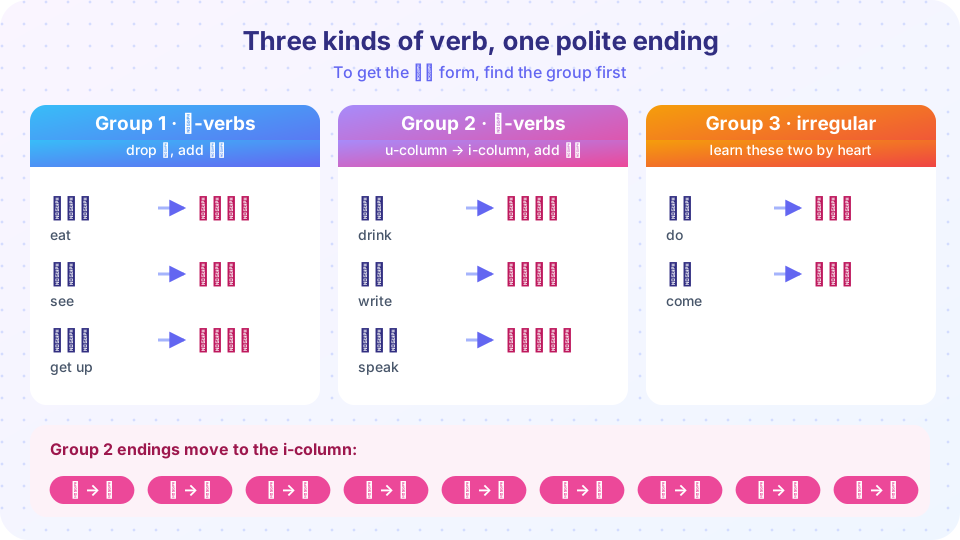
What you will learn
- the three verb groups and how to sort a verb into one
- how to build ます, ません, ますか, ましょう and ませんか
- the nine endings of Group 2 and their i-column partners
- about 25 everyday verbs
Key terms
Dictionary form (辞書形): the plain form that ends in a u-sound.
Group 1 (一段, ichidan) verbs: "る-verbs": the dictionary form ends in いる or える.
Group 2 (五段, godan) verbs: "う-verbs": all other verbs that are not irregular.
Group 3 verbs: the two irregular verbs する and くる.
Stem (ます stem): the part before ます, such as たべ in たべます.
Step 1: find the group
Look at the dictionary form.
- Group 3 (irregular): the verbs する (do) and くる (come), plus any noun + する such as べんきょうする (to study).
- Group 1 (る-verbs): the verb ends in る and the kana before る is from the i-column or e-column (い き し ち に ひ み り; え け せ て ね へ め れ). Examples: たべる, みる, おきる, ねる, でる.
- Group 2 (う-verbs): everything else. That means every verb that does not end in る, and every る-verb with an a-, u- or o-column kana before it, such as ある, のる, とる and つくる.
There is a short list of false friends: Group 2 verbs that end in いる or える. The most common are かえる (kaeru, to return), はいる (hairu, to enter), しる (shiru, to get to know), はしる (hashiru, to run) and にぎる (nigiru, to grip). Learn them as exceptions. When you meet a new verb that ends in いる or える, the dictionary will tell you its group.
Step 2: build the ます stem
Group 1: drop る.
| Dictionary | Stem | ます form | Meaning |
|---|---|---|---|
| たべる | たべ | たべます | eat |
| みる | み | みます | see, watch |
| おきる | おき | おきます | get up |
| ねる | ね | ねます | sleep, go to bed |
| でる | で | でます | go out, leave |
| おしえる | おしえ | おしえます | teach |
Group 2: change the last kana from the u-column to the i-column.
| Ending | Becomes | Dictionary → ます | Meaning |
|---|---|---|---|
| う | い | かう → かいます | buy |
| く | き | かく → かきます | write |
| く | き | いく → いきます | go |
| ぐ | ぎ | およぐ → およぎます | swim |
| す | し | はなす → はなします | speak |
| つ | ち | まつ → まちます | wait |
| ぬ | に | しぬ → しにます | die |
| ぶ | び | あそぶ → あそびます | play |
| む | み | のむ → のみます | drink |
| る | り | かえる → かえります | return |
| る | り | ある → あります | exist (things) |
Notice that the Group 2 pattern, u-column to i-column, is exactly the shift you see in the kana chart: う→い, く→き, す→し, つ→ち, ぬ→に, ぶ→び, む→み, る→り. Because し and ち are irregular kana, the stems of はなす and まつ end in し and ち, so はなします and まちます, not "hanasimasu" or "matimasu".
Group 3: irregular.
| Dictionary | ます form | Meaning |
|---|---|---|
| する | します | do |
| くる | きます | come |
| べんきょうする | べんきょうします | study |
| さんぽする | さんぽします | take a walk |
The two irregular verbs are common, but the rule for する + noun is regular: noun + します. Japanese uses this to turn nouns into verbs: れんしゅうします (practise), りょこうします (travel), でんわします (make a phone call).
Step 3: the five endings
Once you have the stem, five endings cover most polite conversation.
| Ending | Meaning | Example (たべる) |
|---|---|---|
| ます | polite non-past (present habit or future) | たべます (tabemasu) |
| ません | polite negative | たべません (tabemasen) |
| ますか | polite question | たべますか (tabemasu ka) |
| ましょう | "let's ..." | たべましょう (tabemashō) |
| ませんか | "won't you ...?" (invitation) | たべませんか (tabemasen ka) |
Two further notes. First, the ます form covers present and future: まいにち コーヒーを のみます (Mainichi kōhī o nomimasu), "I drink coffee every day"; あした いきます (Ashita ikimasu), "I will go tomorrow". The past ました is the topic of chapter 6, and "I am eating right now" needs the て-form in chapter 6 as well. Second, the verb form is the same for every subject: わたしは, たなかさんは and ともだちは all take たべます.
The pair ませんか and ましょう is how you invite someone. いっしょに いきませんか。 (Issho ni ikimasen ka?) "Won't you go together?" invites politely; the friendly reply is はい、いきましょう。 (Hai, ikimashō.) "Yes, let's go." Negative questions are the polite way to invite, because they give the other person an easy way to refuse.
A mini dialogue
たなか: リサさん、あした いっしょに えいがを みませんか。 Risa-san, ashita issho ni eiga o mimasen ka. "Lisa, won't you watch a movie with me tomorrow?"
リサ: はい、みましょう。なんじに あいますか。 Hai, mimashō. Nanji ni aimasu ka. "Yes, let's watch one. What time shall we meet?"
たなか: 3じに あいましょう。 Sanji ni aimashō. "Let's meet at 3."
The verbs みる (see) and あう (meet) are in different groups: みる is Group 1 (みます), あう is Group 2 (あいます).
Why there are groups at all
The groups are not arbitrary. They reflect how verbs behave inside. A Group 1 verb has a stem that never changes: tabe- stays tabe- in every form. These verbs are called ichidan (one-step) verbs for that reason. A Group 2 verb has a stem that ends in a consonant, and that consonant takes different vowels as the verb changes shape: kak- gives kak-a, kak-i, kak-u, kak-e and kak-o, one for each vowel, which is why these verbs are called godan (five-step) verbs. The ます form uses the i step, written き in かきます.
When you later learn the negative, the conditional and the volitional forms, you will use the other steps of the same ladder (か, け and こ for かく). So learning the u-to-i shift of Group 2 now is the first rung of a ladder you will climb again and again, not an isolated trick.
Thirty useful verbs
Learn these in their dictionary forms, together with their ます forms. They cover a large share of beginner conversation.
- Group 1: たべる / たべます (eat), みる / みます (see, watch), おきる / おきます (get up), ねる / ねます (sleep), でる / でます (go out), あける / あけます (open), しめる / しめます (close), おしえる / おしえます (teach), おぼえる / おぼえます (remember), かりる / かります (borrow).
- Group 2: いく / いきます (go), かく / かきます (write), きく / ききます (listen, ask), あるく / あるきます (walk), はたらく / はたらきます (work), およぐ / およぎます (swim), はなす / はなします (speak), まつ / まちます (wait), あそぶ / あそびます (play), のむ / のみます (drink), よむ / よみます (read), やすむ / やすみます (rest), かう / かいます (buy), あう / あいます (meet), かえる / かえります (return), のる / のります (ride), つくる / つくります (make), とる / とります (take), わかる / わかります (understand).
- Group 3: する / します (do), くる / きます (come), べんきょうする / べんきょうします (study), れんしゅうする / れんしゅうします (practise).
Notice that Group 2 is the biggest group by far. That is why a rule of thumb helps: when in doubt about a verb ending in る, check the vowel before る. If it is い or え, suspect Group 1; any other vowel, and it is certainly Group 2.
A practice routine
Verbs are the part of the vocabulary that benefits most from regular recall. Try this routine for a week:
- Write each of the 30 verbs on a card, the dictionary form on one side and the ます form on the other.
- Each day, take ten cards at random. Say the ます form from the dictionary form, then flip to check.
- Make one sentence with each verb you got right, using a topic and an object, such as わたしは ほんを よみます.
- Put wrong cards back into the pile for tomorrow.
You can also keep a small "verb diary": every evening write three ます sentences about what you did or will do tomorrow, for example あした ともだちに あいます (Ashita tomodachi ni aimasu). After a week you will notice that the groups and the shifts feel automatic.
Common misconceptions
"Every verb that ends in る drops it." Only Group 1 verbs do. かえる becomes かえります, not かえます (which would mean "will change" for かえる 変える, a different Group 1 verb!). This is the most common error.
"ます is the present tense." It is non-past: present habits, facts and the future.
"ません is just ます with a negative sound." It is a separate ending, and the question form is ますか, not ませんか (that one is an invitation).
"I can skip the groups and memorize each verb." The rule is short, so learn it; use the dictionary for the few exceptions.
Try it
First, a conjugator in Python. It sorts a verb into its group, builds the stem and prints the five endings. The exception list holds the false friends. Add your own verbs to the list at the bottom.
Press Run (or Ctrl + Enter) to see the result here.
Program input · what you'd type while the program runs
Type the answers before you press Run, one per line. Each time the program reads a line (with input()), it gets the next line from this box.
Second, a drill. A dictionary-form verb appears and you type its ます form. The game uses the same rules, so use it as a test of how well you have learned the groups.
Check your understanding
Quick check · 6 questions
of 6 answered You scored / 6 · perfect!
-
1. What is the ます form of たべる?
たべる is a Group 1 (る-verb): drop る and add ます. -
2. What is the ます form of のむ?
のむ is Group 2: む becomes み, so のみます. -
3. Which verb is a Group 2 verb even though it ends in える?
かえる (return) is an exception: かえります. -
4. How do you politely invite someone to go together?
ませんか is the polite invitation: "Won't you go?". The reply いきましょう means "Let's go". -
5. What is the ます form of べんきょうする?
Noun + する follows the irregular する: します. -
6. What is the ます form of はなす (to speak)?
す becomes し: はなします (hanashimasu).
Summary
- Sort a verb into Group 1 (る-verbs), Group 2 (う-verbs) or Group 3 (する and くる).
- Group 1: drop る, add ます. Group 2: u-column to i-column, add ます. Group 3: します and きます.
- ます covers present habits and the future; ません is negative; ますか asks; ましょう and ませんか suggest and invite.
- Watch the false friends: かえる, はいる, しる, はしる and にぎる are Group 2.
Next: Particles は, が and を
Track your progress
Create a free account to tick off lessons and pick up where you left off on any device.
of Japanese for Beginners lessons completed