


















Lesson 41 of 50 · Conversation and Culture
Greetings and politeness
Learn everyday Japanese greetings, how to use さん and other titles, the three levels of politeness, listening responses and a first-meeting dialogue.
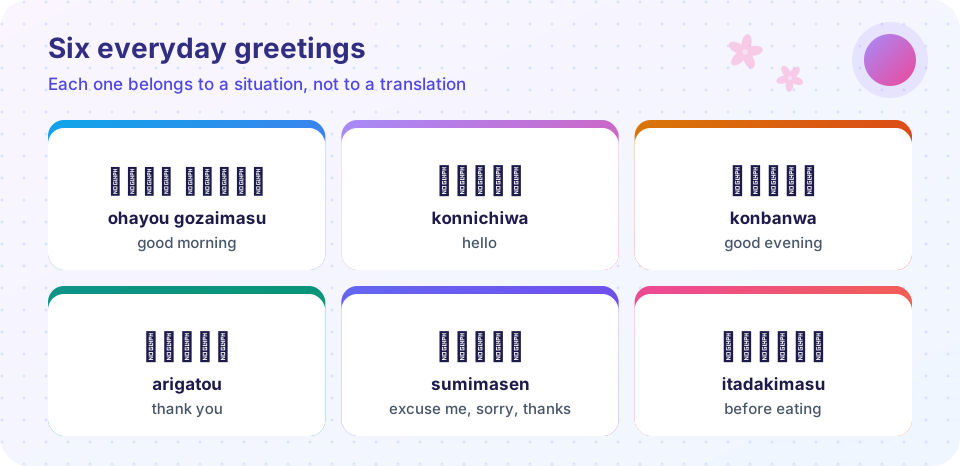
Japanese conversation starts well before the first real sentence. A good greeting, said at the right moment in the right tone, tells people that you are polite and approachable, and it often matters more than perfect grammar. Many Japanese greetings are fixed expressions that do not translate neatly, so the best method is to learn each as a whole and attach it to its situation. This lesson covers the greetings you will use every day, how to address people, the three levels of politeness, and the small listening sounds that make you a good conversation partner.
What you will learn
- Use the main greetings and thanks, and choose between them by situation.
- Address people with さん, くん, ちゃん and せんせい.
- Introduce yourself and answer a self-introduction.
- Distinguish casual, polite and honorific speech, and respond with あいづち.
Key terms
あいさつ (aisatsu): a greeting or other fixed social expression.
さん (san): the default title after a name; never used for yourself.
敬語 (keigo): honorific language, divided into respectful (尊敬語) and humble (謙譲語) forms.
丁寧語 (teineigo): the plain polite style: です and ます.
あいづち (aizuchi): short listening responses such as はい, ええ and そうですか.
Everyday greetings
| Situation | Japanese | Romaji | Notes |
|---|---|---|---|
| morning | おはようございます | ohayou gozaimasu | casual: おはよう |
| daytime | こんにちは | konnichiwa | used from late morning until evening |
| evening | こんばんは | konbanwa | |
| before bed | おやすみなさい | oyasumi nasai | casual: おやすみ |
| thanks | ありがとうございます | arigatou gozaimasu | casual: ありがとう |
| you are welcome | どういたしまして | dou itashimashite | often replaced by いいえ |
| excuse me, sorry, thanks | すみません | sumimasen | very flexible |
| sorry (apology) | ごめんなさい | gomen nasai | personal apology |
| meeting someone new | はじめまして | hajimemashite | "how do you do" |
| please treat me well | よろしくおねがいします | yoroshiku onegai shimasu | after your introduction |
| before a meal | いただきます | itadakimasu | "I humbly receive" |
| after a meal | ごちそうさまでした | gochisousama deshita | thanks for the meal |
| leaving home | いってきます | itte kimasu | "I will go and come back" |
| reply | いってらっしゃい | itterasshai | "go and come back" |
| coming home | ただいま | tadaima | "I am home" |
| reply | おかえりなさい | okaeri nasai | "welcome back" |
| at work | おつかれさまです | otsukaresama desu | "thanks for your hard work" |
| shops | いらっしゃいませ | irasshaimase | "welcome" (said by staff) |
| goodbye | さようなら | sayounara | quite final; casual: じゃあね, またね, ばいばい |
Some of these deserve a note. すみません is the most useful word you can learn: it gets someone's attention (すみません、すみません, "excuse me"), it apologizes lightly (すみません、おくれました, "Sorry, I am late"), and it can mean "thank you" for a favor, because the speaker acknowledges the trouble caused. ごめんなさい is a more personal apology. さようなら is often thought of as the word for goodbye, but in daily life people more often say じゃあ、また (jaa, mata, "well, see you") or またあした (mata ashita, "see you tomorrow"), because さようなら suggests a longer separation. When leaving a workplace before others, the polite phrase is おさきに しつれいします (osaki ni shitsurei shimasu), "Excuse me for leaving first."
Names and titles
Japanese names are written family name first: たなか ひろし (Tanaka Hiroshi) is Mr. Tanaka, whose given name is Hiroshi. To address someone, add a title after the name:
| Title | Use | Example |
|---|---|---|
| さん | default, polite, any gender or age | たなかさん (Tanaka-san) |
| くん | boys and younger men, from a senior or a teacher | ひろしくん |
| ちゃん | small children, close friends, family (affectionate) | ゆきちゃん |
| さま | very formal; customers, letters | たなかさま |
| せんせい | teachers, doctors, lawyers, instructors | たなか せんせい |
Never add さん to your own name: say たなかです, not たなかさんです, when you introduce yourself. Also notice how rarely Japanese people say あなた (anata, "you"). Instead they use the person's name with さん, or their role (せんせい, "teacher"). Using あなた to a stranger or a superior can sound blunt, so avoid it in the beginning. For "I", わたし (watashi) is safe for everyone; ぼく (boku) and おれ (ore) are casual choices used by men and are best left for later.
Introducing yourself
A typical self-introduction has a fixed shape:
はじめまして。 わたしは ジョンです。 アメリカから きました。 よろしく おねがいします。 (Hajimemashite. Watashi wa Jon desu. Amerika kara kimashita. Yoroshiku onegai shimasu.) Nice to meet you. I am John. I came from America. Please treat me well.
Notice きました (kimashita), the polite past of くる, which you learned in chapter 6, with から (kara, "from"). The final phrase よろしくおねがいします does not mean "please" in the usual sense; it asks the other person to look kindly on you in the relationship that is just starting. The expected reply is どうぞ よろしく おねがいします (douzo yoroshiku onegai shimasu).
Three levels of politeness
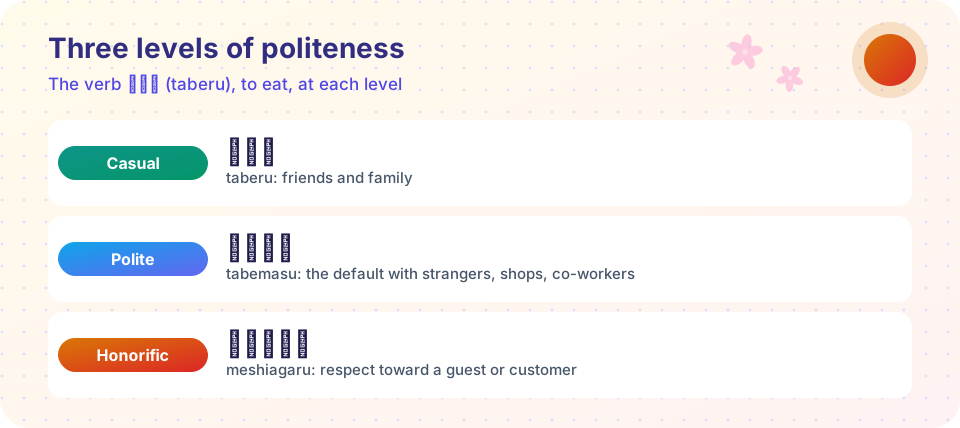
Japanese has a system in which the same idea can be said at different levels, depending on who you are talking to and how well you know them.
- Casual (plain) style is used with family and close friends. You use the dictionary form and the casual past (the ta-form you learned): たべる (taberu), たべた (tabeta), いく (iku), いった (itta). The casual form of です is だ (da). A question may simply be said with a rising voice: たべる? (Taberu?)
- Polite style (丁寧語, teineigo) is the です/ます style you have used throughout this course. It is the default for strangers, shop staff, co-workers and anyone older than you whom you do not know well.
- Honorific language (敬語, keigo) is used to show a high degree of respect to superiors, customers and in formal situations. It has two parts: respectful forms (尊敬語, sonkeigo) raise the other person's actions, and humble forms (謙譲語, kenjougo) lower your own.
Here is the same word at each level:
| Meaning | Casual | Polite | Respectful (their action) | Humble (my action) |
|---|---|---|---|---|
| eat | たべる | たべます | めしあがる | いただく |
| see | みる | みます | ごらんになる | はいけんする |
| go / come / be | いく, くる, いる | いきます, きます, います | いらっしゃる | まいる, おる |
| say | いう | いいます | おっしゃる | もうす |
| do | する | します | なさる | いたす |
You do not need to use keigo yet, but you should recognize a few expressions you will hear every day: いらっしゃいませ (welcome), おまたせしました (omatase shimashita, "sorry to have kept you waiting"), かしこまりました (kashikomarimashita, "certainly"). If you speak polite style to everybody, you will rarely offend anybody. The usual mistake is the reverse: using casual speech with someone older who is not yet a friend.
Listening responses
In English we may stay quiet while listening. In Japanese, a conversation without small responses seems cold, so listeners add あいづち (aizuchi) constantly:
- はい (hai) / ええ (ee): yes, I am listening, I agree.
- そうですか (sou desu ka): oh, I see, really? (falling tone for acceptance)
- そうですね (sou desu ne): that's right; well, let me think.
- なるほど (naruhodo): I see; that makes sense.
- へえ (hee): oh really? (surprise, casual)
- うん (un): casual yes.
Answering a compliment: if someone says にほんごが じょうずですね (Nihongo ga jouzu desu ne), "Your Japanese is good," the traditional humble reply is いいえ、まだまだです (Iie, mada mada desu), "No, I still have a long way to go." You may of course answer ありがとうございます as well; both are acceptable for a learner.
Softening and indirectness
Japanese conversation avoids hard refusals. Instead of "No," people say ちょっと… (chotto..., "it is a bit..."), and leave the sentence unfinished, or むずかしいですね (muzukashii desu ne), "that is difficult, isn't it." This is not dishonesty; it is a way to protect everyone's feelings. When you invite someone and hear ちょっと…, accept that the answer is "no" and try another time. Also use すみません before requests: すみません、ちょっと いいですか (Sumimasen, chotto ii desu ka), "Excuse me, do you have a moment?"
A first-meeting dialogue
A: はじめまして。 たなかです。 よろしく おねがいします。 (Hajimemashite. Tanaka desu. Yoroshiku onegai shimasu.) Nice to meet you. I am Tanaka. B: はじめまして。 マリアです。 スペインから きました。 どうぞ よろしく。 (Hajimemashite. Maria desu. Supein kara kimashita. Douzo yoroshiku.) Nice to meet you. I am Maria. I came from Spain. A: マリアさんは がくせいですか。 (Maria-san wa gakusei desu ka.) Are you a student, Maria? B: はい、だいがくせいです。 (Hai, daigakusei desu.) Yes, I am a university student. A: そうですか。 にほんごが じょうずですね。 (Sou desu ka. Nihongo ga jouzu desu ne.) I see. Your Japanese is good. B: いいえ、まだまだです。 (Iie, mada mada desu.) No, I still have a long way to go.
Common misconceptions
"Sayounara is the word for goodbye." It is a formal and rather final goodbye. In daily life use じゃあ、また, またあした or しつれいします.
"Sumimasen means only sorry." It also means "excuse me" and "thank you (for the trouble)."
"I should add さん to my own name." Never: it is for other people's names.
"Casual speech is rude." It is natural among friends; it is rude only when used with the wrong person.
"Anata is the Japanese word for you." It exists, but names and titles are normally used instead.
Try it
The first tool is a phrase finder. Choose a situation and it shows the right expression with romaji.
The second tool shows a few verbs at the casual, polite, respectful and humble levels. Notice that the honorific forms are separate words, not just new endings.
Press Run (or Ctrl + Enter) to see the result here.
Program input · what you'd type while the program runs
Type the answers before you press Run, one per line. Each time the program reads a line (with input()), it gets the next line from this box.
Check your understanding
Quick check · 5 questions
of 5 answered You scored / 5 · perfect!
-
1. What do you say just before you start eating?
いただきます (itadakimasu) is said before eating; ごちそうさまでした after. -
2. How do you introduce yourself correctly?
Never add さん to your own name: たなかです. -
3. Which style is the safe default with strangers?
The polite style is the safe default. -
4. What does ちょっと… often mean when a person is invited somewhere?
An unfinished ちょっと… is a soft 'no'; accept it and try another time. -
5. Which pair shows respectful and humble forms of 'eat'?
めしあがる (respectful, for the other person) and いただく (humble, for you) are the keigo forms of 'eat'.
Summary
- Greetings are fixed expressions tied to situations; すみません is the most flexible.
- Use さん after names (never for yourself), and names or roles instead of あなた.
- Introduce yourself with はじめまして, your name, and よろしくおねがいします.
- Three levels: casual (friends), polite です/ます (default), keigo (respect).
- Show you are listening with あいづち; refuse softly with ちょっと….
Track your progress
Create a free account to tick off lessons and pick up where you left off on any device.
of Japanese for Beginners lessons completed