


















Lesson 10 of 50 · Sounds and Hiragana
Hiragana 4: marks, small kana and long vowels
Go beyond the 46 basic hiragana: dakuten and handakuten, the combination sounds きゃ しゅ ちょ, the small っ for double consonants and the rules for long vowels.
You now know the 46 basic hiragana, but spoken Japanese has more sounds than the table shows. Words such as がっこう (gakkō, school), ひゃく (hyaku, one hundred) and おかあさん (okāsan, mother) use extra marks, tiny characters and long vowels. This lesson shows how a small set of rules builds all of them. The good news is that nothing here is a new character to memorize from scratch. Everything is made by modifying kana you already know.
After this lesson you will be able to read nearly any hiragana word. Take your time with the long-vowel rules at the end, since they decide the length of beats, and length changes meaning.
What you will learn
- how dakuten (゛) and handakuten (゜) create 25 more sounds
- how the small ゃ, ゅ and ょ form 33 combination sounds
- how a small っ doubles the next consonant
- how to write and read long vowels
- how to type all of this on a Japanese keyboard
Key terms
Dakuten (濁点, ゛): two small strokes at the upper right of a kana that voice its consonant.
Handakuten (半濁点, ゜): a small circle that turns the H row into the P row.
Yōon (拗音): a combination sound made with a small ゃ, ゅ or ょ.
Sokuon (促音, っ): the small っ that doubles the following consonant.
Chōon (長音): a long vowel, held for two beats.
Dakuten and handakuten
Add two small strokes to a kana in the K, S, T or H row and the consonant becomes voiced (your vocal cords vibrate): k becomes g, s becomes z, t becomes d and h becomes b. Add a small circle to the H row and h becomes p.
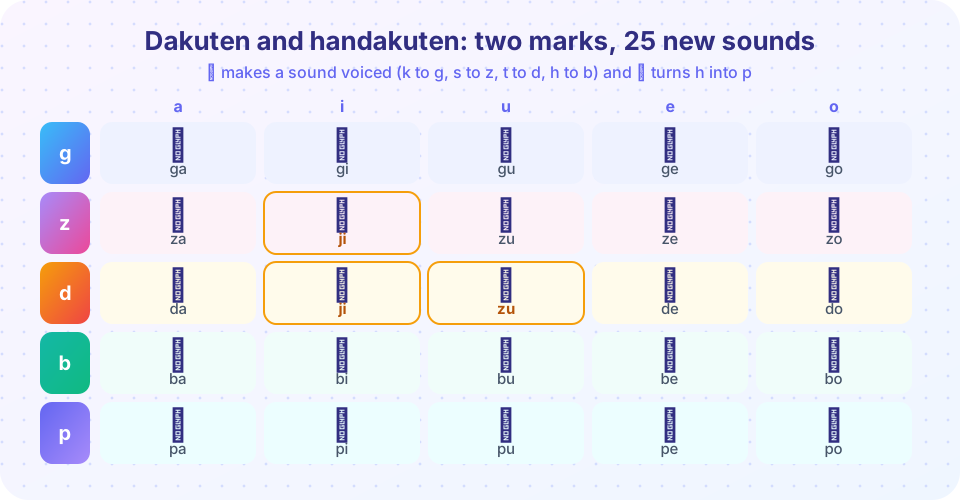
| Plain | Voiced | Row |
|---|---|---|
| か き く け こ (ka ki ku ke ko) | が ぎ ぐ げ ご (ga gi gu ge go) | K → G |
| さ し す せ そ (sa shi su se so) | ざ じ ず ぜ ぞ (za ji zu ze zo) | S → Z |
| た ち つ て と (ta chi tsu te to) | だ ぢ づ で ど (da ji zu de do) | T → D |
| は ひ ふ へ ほ (ha hi fu he ho) | ば び ぶ べ ぼ (ba bi bu be bo) | H → B |
| は ひ ふ へ ほ (ha hi fu he ho) | ぱ ぴ ぷ ぺ ぽ (pa pi pu pe po) | H → P |
Two details deserve attention. First, じ is ji, and ぢ is also ji; ず is zu and づ is also zu. The characters ぢ and づ are rare. They appear mostly in words where a plain ち or つ became voiced, such as つづく (tsuzuku, to continue) and はなぢ (hanaji, nosebleed). If you hear ji or zu, write じ or ず unless you are in one of those special words. Second, when you hand-write the marks, put them at the upper right, small and clear.
Real words:
- がくせい (gakusei), student
- ぎんこう (ginkō), bank
- げんき (genki), healthy, in good spirits
- ごはん (gohan), cooked rice, a meal
- かぞく (kazoku), family
- じかん (jikan), time
- だいがく (daigaku), university
- でんわ (denwa), telephone
- ともだち (tomodachi), friend
- べんきょう (benkyō), study
- ぱん (pan), bread
- さんぽ (sanpo), a walk
Combination sounds with small ゃ, ゅ, ょ
A small や, ゆ or よ attached to a kana of the i column (き, し, ち, に, ひ, み, り, ぎ, じ, び, ぴ) fuses with it into one beat. Examples are き + ゃ = きゃ (kya), し + ゅ = しゅ (shu) and ち + ょ = ちょ (cho).
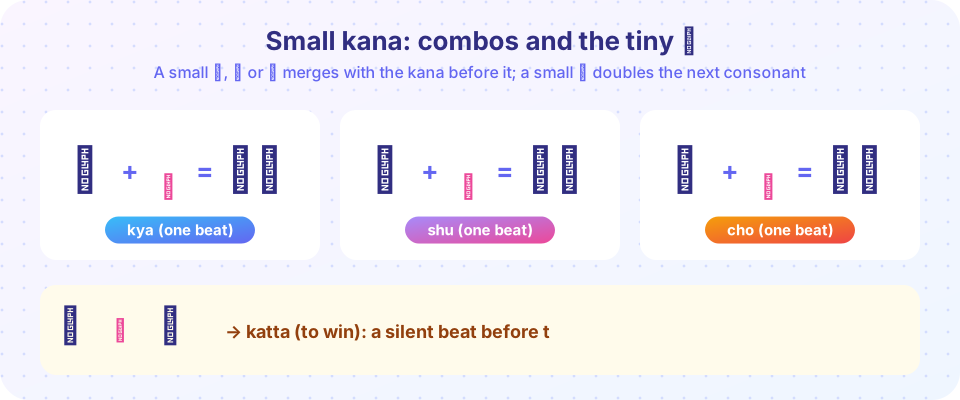
There are 11 such starting kana and 3 small letters, so 33 combinations in total:
| ゃ | ゅ | ょ | Starting kana |
|---|---|---|---|
| きゃ kya | きゅ kyu | きょ kyo | き |
| しゃ sha | しゅ shu | しょ sho | し |
| ちゃ cha | ちゅ chu | ちょ cho | ち |
| にゃ nya | にゅ nyu | にょ nyo | に |
| ひゃ hya | ひゅ hyu | ひょ hyo | ひ |
| みゃ mya | みゅ myu | みょ myo | み |
| りゃ rya | りゅ ryu | りょ ryo | り |
| ぎゃ gya | ぎゅ gyu | ぎょ gyo | ぎ |
| じゃ ja | じゅ ju | じょ jo | じ |
| びゃ bya | びゅ byu | びょ byo | び |
| ぴゃ pya | ぴゅ pyu | ぴょ pyo | ぴ |
Important points: the small kana is about two-thirds the size of a normal one and sits at the lower right, so しゃ looks like one unit and the two-character form しや means shi-ya (two beats). Compare きゃく (kyaku, guest, two beats) with きやく (kiyaku, terms or rules, three beats). And pronounce a combination as one beat.
Words: ひゃく (hyaku, 100), きょう (kyō, today), しゅみ (shumi, hobby), しゃしん (shashin, photograph), りょこう (ryokō, travel), びょういん (byōin, hospital), じゅう (jū, ten), おちゃ (ocha, tea) and ちょっと (chotto, a little).
The small っ: double consonants
A small っ (the sokuon) goes before a kana of the K, S, T or P rows (and for sh, ch) and tells you to hold the consonant for one extra beat. In practice, you stop your mouth for a short silent beat, and then release the consonant. The romaji doubles the consonant.
- かった: katta (won, bought)
- きって: kitte (stamp)
- ざっし: zasshi (magazine; sh doubles as ssh)
- まっちゃ: matcha (powdered green tea; ch doubles as tch)
- がっこう: gakkō (school)
- ちょっと: chotto (a little)
The doubling matters. Compare きて (kite, come) and きって (kitte, stamp), or おと (oto, sound) and おっと (otto, husband). Learners often shorten the pause, so practise by tapping the table: ki - (silent tap) - te.
Long vowels
A long vowel lasts two beats. Hiragana writes it by adding a vowel kana. The rules:
| Long vowel | Spelling rule | Example |
|---|---|---|
| ā | あ + あ | おかあさん (okāsan, mother) |
| ii | い + い | おにいさん (oniisan, older brother) |
| ū | う + う | くうき (kūki, air) |
| ē | え + え or え + い | おねえさん (onēsan, older sister); せんせい (sensei, teacher) |
| ō | お + う or お + お | とうきょう (Tōkyō), おおきい (ōkii, big) |
Notes on the table: in the e column, え + い is usually pronounced as a long ē, but romaji spells it ei (sensei). In the o column, お + う is the standard spelling and お + お occurs in a small set of words (おおきい ōkii, big; とおい tōi, far; おおい ōi, many). Whatever the spelling, the sound is the same: a held, steady vowel for two beats. This course writes long a, u, e and o with a bar (ā, ū, ē, ō) and long i as ii.
Typing hiragana
On a phone or computer with a Japanese keyboard (IME), you type romaji and the keyboard converts it. Type ka for か; ga for が; kya for きゃ; kk for っ before a k (typing gakkou gives がっこう); nn for ん, or just n when the next letter is a consonant. This is a surprisingly good way to learn spelling: type a word's romaji and watch which kana appear.
Reading strategy for long words
A word like りょこうがいしゃ looks intimidating, but you can decode any hiragana word with a routine:
- Find the small kana first. Circle every ゃ, ゅ, ょ and っ, and join each of the three y-kana to the character on its left.
- Mark the marks. Note the dakuten and handakuten on each character, so you voice or pop the consonant.
- Count the beats. Tap once for every unit: normal kana, ん, っ, the second half of a long vowel, and every merged combination.
- Say it in one breath. Join the beats into a word.
Apply it to おちゃ (ocha, tea): お, ちゃ is two beats. Apply it to ざっし (zasshi, magazine): ざ, っ, し is three beats, with a silent beat in the middle. Apply it to びょういん (byōin, hospital): びょ, う, い, ん is four beats.
Spelling-sound surprises to remember
Hiragana is regular, but the spelling has a few historical quirks that you can learn as a small checklist:
- は and へ as particles are read wa and e (not ha and he).
- を is read o and is used only as a particle.
- おう and おお both give a long ō, and えい is pronounced as a long ē.
- ぢ and づ sound like じ and ず and are written only in special cases.
- ん takes an apostrophe in romaji before a vowel or y (hon'ya).
If you keep this list near your desk for a week, most reading and typing mistakes disappear.
Practice list, with answers
Read these ten words aloud before checking: しゅくだい (shukudai, homework), きょうしつ (kyōshitsu, classroom), ちず (chizu, map), じしょ (jisho, dictionary), ぶたにく (butaniku, pork), ぎゅうにゅう (gyūnyū, milk), ざっし, ひこうき (hikōki, airplane), びじゅつ (bijutsu, art) and ちょうちょう (chōchō, butterfly). Notice how often the long vowel う appears: in ぎゅうにゅう it appears twice, and each time it adds a beat.
Common misconceptions
"The small っ is silent, so it does not count." It is a full beat of silence and it separates words such as きて and きって.
"しゃ is two syllables." It is one syllable and one beat. Compare しゃ with しや (two beats).
"ぢ and づ are as common as じ and ず." They are rare, and used only in special spelling situations.
"Romaji ou is a different sound from ō." In hiragana we write お + う, and we pronounce it as one long vowel.
Try it
First, a converter in Python. It takes hiragana and returns Hepburn romaji. It handles the voiced rows, combinations, the small っ, the apostrophe for ん and long vowels (with macrons in the second column). It is a model of the rules you just learned, so try breaking it with your own words.
Press Run (or Ctrl + Enter) to see the result here.
Program input · what you'd type while the program runs
Type the answers before you press Run, one per line. Each time the program reads a line (with input()), it gets the next line from this box.
Second, a quiz on the voiced and semi-voiced rows. You see the plain kana with a mark in words, such as か + ゛, and you type the new sound.
Check your understanding
Quick check · 6 questions
of 6 answered You scored / 6 · perfect!
-
1. Which mark turns は into ぱ?
The small circle (handakuten) changes the H row to the P row: は becomes ぱ. -
2. How many beats does しゃ have?
A small ゃ merges with the kana before it, so しゃ is one beat. -
3. How do you read がっこう in romaji?
The small っ doubles the k: gakkō (school). -
4. Which spelling gives a long ō?
お + う is the standard way; お + お occurs in a few words such as おおきい. -
5. What is the difference between きて and きって?
きて means come (and) and きって means stamp. The small っ changes the word. -
6. Which kana pair sounds the same as ji?
じ and ぢ are both ji. ち is chi and し is shi.
Summary
- Dakuten voices a consonant (k→g, s→z, t→d, h→b); handakuten turns h into p.
- ぢ and づ sound like じ and ず and appear only in a few special words.
- A small ゃ ゅ ょ fuses with an i-column kana into one beat (きゃ, しゅ, ちょ): 33 combinations in all.
- A small っ is a silent beat that doubles the next consonant (がっこう, きって).
- Long vowels are written with an extra vowel kana, and お + う and え + い are the usual patterns for ō and ē.
Next: Chapter 2 review
Track your progress
Create a free account to tick off lessons and pick up where you left off on any device.
of Japanese for Beginners lessons completed