


















Lesson 17 of 50 · Katakana and Basic Grammar
これ, それ, あれ: pointing words
Learn to point in Japanese: これ, それ, あれ, どれ, the modifiers この, その, あの, the place words ここ, そこ, あそこ and how distance and perspective choose them.
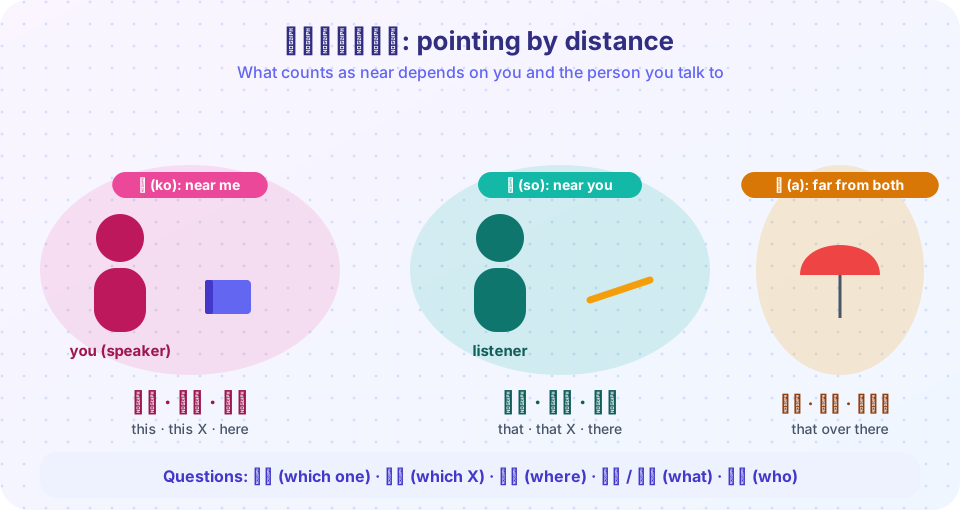
English has two pointing words, this and that. Japanese has three, and the extra one is the interesting part. The words are organized in a tidy system called こ・そ・あ・ど (ko-so-a-do). Each prefix points a different way, and each prefix combines with the same endings to give you words for things, for nouns, for places and for questions. Learn the system once and you get about twenty words for the price of four.
The words are among the most common in the language. You use them every time you shop, ask for directions or point at a menu. And because they work like a grid, they are easy to memorize: four prefixes, four endings, and a short rule about who is near whom.
What you will learn
- the four prefixes こ, そ, あ and ど and the four endings
- how これ (a thing) differs from この (modifies a noun)
- the place words ここ, そこ, あそこ and どこ
- how perspective flips between question and answer
- how to ask "What is this?" and "Whose is that?"
Key terms
Demonstrative: a pointing word such as this or that.
こ・そ・あ・ど (ko-so-a-do): the system of four demonstrative series.
Modifier: a word that sits before a noun and describes it, such as この in このほん.
なん / なに: "what"; なん is used before です, の and counters.
The grid
Memorize the whole table by its columns. The prefix gives the direction; the ending gives the kind of word.
| Prefix | Meaning | Thing (this one) | Before a noun | Place | Polite direction |
|---|---|---|---|---|---|
| こ (ko) | near the speaker | これ (kore) | この (kono) | ここ (koko) | こちら (kochira) |
| そ (so) | near the listener | それ (sore) | その (sono) | そこ (soko) | そちら (sochira) |
| あ (a) | far from both | あれ (are) | あの (ano) | あそこ (asoko) | あちら (achira) |
| ど (do) | question: which? | どれ (dore) | どの (dono) | どこ (doko) | どちら (dochira) |
The あ series is odd in one way: the place word is あそこ (asoko), not あこ. Everything else is regular.
Who is near whom?
Japanese measures distance relative to the speaker and the listener together.
- こ is "my zone": things near the speaker.
- そ is "your zone": things near the listener.
- あ is "neither zone": things far from both.
When you sit side by side, the two of you share one zone, so you both use こ for things in front of you and あ for things across the room. And そ has a second job: it points to something that was just mentioned in the conversation: それは ほんとうですか。 (Sore wa hontō desu ka?) "Is that true?"
これ, それ, あれ: standing alone
These three words replace a noun and can be the topic of a sentence:
- これは ほんです。 (Kore wa hon desu.) "This is a book."
- それは えんぴつです。 (Sore wa enpitsu desu.) "That (near you) is a pencil."
- あれは がっこうです。 (Are wa gakkō desu.) "That (over there) is a school."
And the question word どれ asks "which one?" when there are three or more things: どれが リサさんの かさですか。 is "Which one is Lisa's umbrella?". Use だれ for "who" and なん for "what":
- これは なんですか。 (Kore wa nan desu ka?) "What is this?"
- あの ひとは だれですか。 (Ano hito wa dare desu ka?) "Who is that person?"
For "what", the word is なに (nani) by itself, and なん (nan) before です, の, か and counting words. So you say なんですか, never なにですか in polite everyday speech.
この, その, あの: before a noun
If a noun follows, you must use the modifier forms: この, その, あの, どの. They cannot stand alone, and the noun cannot be missing. Compare:
- ✔ これは ほんです。 "This is a book."
- ✔ この ほんは わたしのです。 "This book is mine."
- ✘ これ ほんは ... (wrong: これ cannot modify a noun)
More examples:
- その かばんは たなかさんのです。 (Sono kaban wa Tanaka-san no desu.) "That bag (near you) is Tanaka's."
- あの ひとは せんせいです。 (Ano hito wa sensei desu.) "That person over there is a teacher."
- どの くるまですか。 (Dono kuruma desu ka?) "Which car is it?"
Places: ここ, そこ, あそこ, どこ
The place words answer "where?":
- ここは がっこうです。 (Koko wa gakkō desu.) "This place is a school."
- トイレは あそこです。 (Toire wa asoko desu.) "The toilet is over there."
- えきは どこですか。 (Eki wa doko desu ka?) "Where is the station?"
When you want to be polite, such as asking for someone's location or introducing a person, use こちら, そちら, あちら, どちら. They are more courteous: こちらは たなかさんです。 (Kochira wa Tanaka-san desu.) "This is Mr. Tanaka." This is the standard polite way to introduce a person.
Perspective flips in the answer
Because こ and そ depend on who is speaking, the same object can change names mid-conversation. If you ask about something near the other person, you say それ. When they reply, they are now the speaker and the object is near them, so they say これ:
リサ: それは なんですか。 Sore wa nan desu ka? "What is that (near you)?" たなか: これは かさです。 Kore wa kasa desu. "This is an umbrella."
If you ask this way and the other person answers with それ, the conversation would sound as though you were pointing at different things. Watch for this flip in the dialogues.
Whose? だれの
To ask "whose?", place の after だれ: これは だれの かさですか。 (Kore wa dare no kasa desu ka?) "Whose umbrella is this?". And の can replace the noun when it is obvious, like English "mine":
- それは わたしのです。 (Sore wa watashi no desu.) "That is mine."
- あれは たなかさんのです。 (Are wa Tanaka-san no desu.) "That is Tanaka's."
A dialogue
リサ: すみません。それは なんですか。 Sumimasen. Sore wa nan desu ka. "Excuse me. What is that?"
たなか: これは かさです。 Kore wa kasa desu. "This is an umbrella."
リサ: その かさは だれのですか。 Sono kasa wa dare no desu ka. "Whose umbrella is that?"
たなか: わたしのです。あの かばんは リサさんのですか。 Watashi no desu. Ano kaban wa Risa-san no desu ka. "It is mine. Is that bag over there yours, Lisa?"
リサ: はい、あれは わたしのです。 Hai, are wa watashi no desu. "Yes, that is mine."
Everyday situations
The こ・そ・あ・ど words appear in nearly every practical situation, so here are three useful scenes.
In a shop. You point at an item and ask: これは いくらですか。 (Kore wa ikura desu ka?), "How much is this?" The word いくら (ikura) means "how much" and you will study prices in chapter 5. If the clerk is holding a different item, you point and say それ or あれ, depending on where the item is.
In a classroom. A particularly helpful sentence for learners is これは にほんごで なんですか。 (Kore wa Nihongo de nan desu ka?), "What is this in Japanese?" Here で marks the language used, the "means" of expression. It lets you collect vocabulary from the things around you: point at a cup, ask, and write down the answer.
On the street. You ask for the station: えきは どこですか。 (Eki wa doko desu ka?). A friendly passer-by points and answers あそこです。 (Asoko desu.), "It is over there." The あ series is ideal for directions because the place is far from both of you.
Beyond objects: こんな, そんな, あんな
The same four prefixes build other words you will meet later. こんな, そんな, あんな and どんな mean "this kind of", "that kind of", "that kind of (far away)" and "what kind of". They are used like adjectives: どんな ほんですか。 (Donna hon desu ka?), "What kind of book is it?" There are also こう, そう, ああ and どう (kō, sō, ā, dō) for "this way, that way", and どう is "how". You do not need them now, but noticing the system will let you pick them up quickly.
A reading tip
When a Japanese text uses それ or その, look back at the sentence before: it points to something that was just mentioned. When it uses これ or この, it often points forward to something you are about to read. Many learners find that tracing こ, そ and あ words in a paragraph is a quick way to follow what refers to what.
Common misconceptions
"そ means that far away." そ is "near you" (or already mentioned), and あ is "far from both". English that covers both, which is why そ takes getting used to.
"これ can go before a noun." It cannot. Use この before a noun.
"The answer should use the same word as the question." The perspective flips: それ in the question becomes これ in the answer.
"There is なにです." Use なん before です, の and か: なんですか.
Try it
First, an interactive model. Move the slider to place an object along the line between you (left) and a far wall. Your friend stands in the middle. The model gives the form a Japanese speaker would choose. It is simplified: real speakers adjust for the situation.
Second, the grid in code. This program builds all sixteen words from a prefix and an ending, then makes a few "What is that?" sentences.
Press Run (or Ctrl + Enter) to see the console output here.
No output.
Check your understanding
Quick check · 6 questions
of 6 answered You scored / 6 · perfect!
-
1. Which word means "that over there, far from both of us"?
あれ points to things far from both speaker and listener. -
2. Which is correct before a noun?
Before a noun use the modifier form: この ほん, "this book". -
3. How do you ask "Where is the station?"?
どこ is the place question word. -
4. You ask: それは なんですか。 How does your friend answer about an object near them?
The perspective flips: the object that was そ for you is こ for the friend. -
5. What does これは わたしのです mean?
の can stand in for the noun: これは わたしの(もの)です, "This is mine". -
6. Which word is the polite way to say "this is" when you introduce a person?
こちらは たなかさんです is the polite way to introduce someone.
Summary
- こ is near the speaker, そ is near the listener, あ is far from both, and ど asks "which?".
- Each prefix combines with れ (thing), の (before a noun), こ (place) and ちら (polite).
- Use この, その, あの before a noun; これ, それ, あれ stand alone.
- Ask with なんですか, だれですか and どこですか.
- の after a name or だれ means "'s" or "whose", and it can replace the noun ("mine").
Next: Chapter 3 review
Track your progress
Create a free account to tick off lessons and pick up where you left off on any device.
of Japanese for Beginners lessons completed