


















Lesson 28 of 50 · Daily Life and Questions
Question words
Ask questions in Japanese with なに, だれ, どこ, いつ, どれ, いくら and more. Learn where question words go, when to use か, and how to answer.
Asking questions is the fastest way to learn a language, because every question forces someone to speak back to you. Luckily, Japanese questions are among the easiest parts of the grammar. You do not rearrange the sentence or add helper verbs as English does ("Where do you live?" versus "You live there."). You keep the sentence exactly as it is, swap the missing piece for a question word, and add か (ka) at the end. This lesson shows you the full set of question words, the quirks of なに and なん, and the answers that go with them.
What you will learn
- Form yes/no questions and information questions with か.
- Use the core question words: なに, だれ, どこ, いつ, どれ, どう, なぜ, いくら, いくつ.
- Choose なん or なに correctly.
- Understand the こ-そ-あ-ど (ko-so-a-do) family and answer questions naturally.
Key terms
か (ka): the sentence-ending particle that turns a statement into a question.
疑問詞 (gimonshi): a question word such as なに or どこ.
こそあど (ko-so-a-do): the four-way family of demonstratives (これ, それ, あれ, どれ).
ね (ne) and よ (yo): sentence-final particles that ask for agreement (ne) or give new information (yo).
The basic recipe
Take a statement:
これは ほんです。 (Kore wa hon desu.) This is a book.
To ask a yes/no question, add か:
これは ほんですか。 (Kore wa hon desu ka.) Is this a book?
To ask an information question, replace the word you want to learn about with a question word:
これは なんですか。 (Kore wa nan desu ka.) What is this?
In writing, a Japanese question usually ends in か followed by a full stop (。); question marks (?) are common in informal writing but are not part of formal style. When you speak, the sentence normally rises a little on か, but the particle already does the job, so there is no need to exaggerate the intonation.
The question words
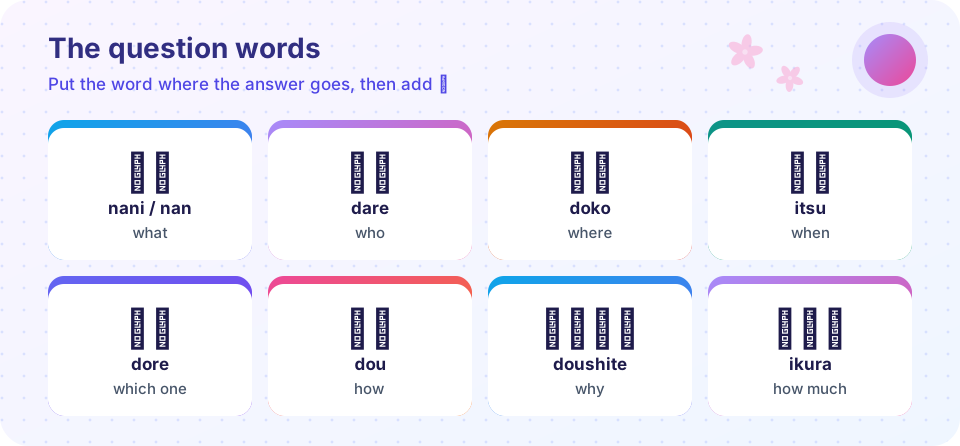
| Word | Reading | Meaning | Example |
|---|---|---|---|
| 何 | なに / なん (nani / nan) | what | なにを たべますか。 (Nani o tabemasu ka.) |
| 誰 | だれ (dare) | who | あのひとは だれですか。 (Ano hito wa dare desu ka.) |
| どこ | どこ (doko) | where | えきは どこですか。 (Eki wa doko desu ka.) |
| いつ | いつ (itsu) | when | たんじょうびは いつですか。 (Tanjoubi wa itsu desu ka.) |
| どれ | どれ (dore) | which (of three or more) | どれが すきですか。 (Dore ga suki desu ka.) |
| どの + noun | どの (dono) | which (noun) | どの かばんですか。 (Dono kaban desu ka.) |
| どう | どう (dou) | how | にほんごは どうですか。 (Nihongo wa dou desu ka.) |
| どんな + noun | どんな (donna) | what kind of | どんな ほんですか。 (Donna hon desu ka.) |
| なぜ / どうして | なぜ / どうして (naze / doushite) | why | どうして にほんごを べんきょうしますか。 (Doushite nihongo o benkyou shimasu ka.) |
| いくら | いくら (ikura) | how much (price) | これは いくらですか。 (Kore wa ikura desu ka.) |
| いくつ | いくつ (ikutsu) | how many (small things), how old | りんごは いくつ ありますか。 (Ringo wa ikutsu arimasu ka.) |
A few more are built from the number words you know: なんじ (nanji, what time), なんにん (nannin, how many people), なんようび (nan youbi, which day of the week), なんがつ (nangatsu, which month), なんさい (nansai, how old).
なに or なん?
Both are the word for "what." Use なん before です, before a counter such as じ or にん, and before sounds in the t, d and n rows (なんですか, なんじ, なんでも). Use なに in most other places, especially before the particles を and が: なにを たべますか (nani o tabemasu ka), "What will you eat?" Before the particle の you hear both, but なんの is more common: なんの せんせいですか (nan no sensei desu ka), "What subject is the teacher for?"
Where question words sit
The question word goes into the position the answer will take. The grammar around it stays the same:
| Statement | Question |
|---|---|
| えきは あそこです。 (Eki wa asoko desu.) | えきは どこですか。 (Eki wa doko desu ka.) |
| しけんは らいしゅうです。 (Shiken wa raishuu desu.) | しけんは いつですか。 (Shiken wa itsu desu ka.) |
| わたしは えいがを みます。 (Watashi wa eiga o mimasu.) | あなたは なにを みますか。 (Anata wa nani o mimasu ka.) |
| この かばんは せんえんです。 (Kono kaban wa sen en desu.) | この かばんは いくらですか。 (Kono kaban wa ikura desu ka.) |
| ともだちと いきます。 (Tomodachi to ikimasu.) | だれと いきますか。 (Dare to ikimasu ka.) |
Notice two rules. First, a question word is not normally the topic of the sentence, so you do not attach は to it (だれは is unusual). Instead you give it the subject particle が: だれが きますか (dare ga kimasu ka), "Who is coming?" Second, the answer repeats the structure and fills the gap: A: だれが きますか。 B: たなかさんが きます。 (Tanaka-san ga kimasu.)
Which one? The ko-so-a-do family
You may recognize this four-way pattern from earlier lessons. The key to "which" words is that they all start with ど:
| Meaning | near me (こ) | near you (そ) | far from both (あ) | which (ど) |
|---|---|---|---|---|
| thing | これ (kore) | それ (sore) | あれ (are) | どれ (dore) |
| noun-modifier | この (kono) | その (sono) | あの (ano) | どの (dono) |
| place | ここ (koko) | そこ (soko) | あそこ (asoko) | どこ (doko) |
| direction/polite | こちら (kochira) | そちら (sochira) | あちら (achira) | どちら (dochira) |
どれ stands alone and means "which one of these (at least three)": どれが あなたの かばんですか (dore ga anata no kaban desu ka). どの needs a noun: どの かばん (dono kaban). どちら is the polite form for "where" and also means "which of two," as in コーヒーと おちゃと どちらが すきですか (koohii to ocha to dochira ga suki desu ka), "Which do you like better, coffee or tea?"
Yes, no and the final particles
For a yes/no question, answer with はい (hai, yes) or いいえ (iie, no), and often repeat the verb or use そうです (sou desu, that is right) or ちがいます (chigaimasu, that is wrong). Notice that Japanese answers agree with the question, not with the facts: if someone asks the negative question あなたは がくせいじゃ ありませんか (anata wa gakusei ja arimasen ka), "Aren't you a student?", then はい means "That is right, I am not," a classic trap, so answer with the full sentence to be safe.
Invitations use the negative question: いっしょに いきませんか (issho ni ikimasen ka), "Won't you come with me?" A friendly reply is いいですね (ii desu ne), "That sounds good." Add ね at the end of a statement to ask for agreement (きょうは あついですね, kyou wa atsui desu ne, "It is hot today, isn't it?") and よ to add new information (もうすぐ はじまりますよ, mousugu hajimarimasu yo, "It will start soon, you know").
A dialogue at the station
A: すみません、えきは どこですか。 (Sumimasen, eki wa doko desu ka.) Excuse me, where is the station? B: あそこです。 (Asoko desu.) It is over there. A: ありがとうございます。 でんしゃは なんじに きますか。 (Arigatou gozaimasu. Densha wa nanji ni kimasu ka.) Thank you. What time does the train come? B: じゅうじごろ です。 (Juuji goro desu.) Around ten.
Common misconceptions
"か is a question mark." か is a spoken particle, not a punctuation mark. You write it even when a question mark is absent, and you must say it in polite speech.
"The question word goes at the start, as in English." It stays in its normal place: usually right before です or the verb.
"は works with all question words." Prefer が with だれ, どれ and similar words as subjects (だれが, どれが), because a question word cannot be the known topic.
Try it
The first program turns statements into questions the way you just saw. It replaces the answer word with the question word and adds か, and then prints a romanization of the result.
Press Run (or Ctrl + Enter) to see the result here.
Program input · what you'd type while the program runs
Type the answers before you press Run, one per line. Each time the program reads a line (with input()), it gets the next line from this box.
The second tool is a quick quiz. Choose the Japanese question word that matches each English prompt.
Check your understanding
Quick check · 5 questions
of 5 answered You scored / 5 · perfect!
-
1. Which sentence means 'Where is the station?'
どこ means where. The question word replaces the answer (あそこ) in the same position. -
2. Which word do you use for 'which one of these three bags'?
どれ stands alone and means which one (of three or more). どの needs a following noun. -
3. Which is correct for 'What time is it?'
Before counters like じ, the word is なん: なんじですか (nanji desu ka). -
4. Someone asks 'あなたは がくせいじゃ ありませんか。' and you are not a student. What does はい mean?
Japanese yes/no agrees with the question, so はい confirms the negative. Answer with the full sentence to avoid confusion. -
5. What does ね at the end of 'きょうは あついですね' do?
ね seeks agreement, like 'isn't it?' in English.
Summary
- Statement plus か makes a yes/no question; replace the missing piece with a question word for information questions.
- Core words: なに/なん, だれ, どこ, いつ, どれ/どの, どう, なぜ/どうして, いくら, いくつ.
- Use なん before です, before counters and before t, d, n sounds; use なに before を and が.
- The ko-so-a-do pattern gives どれ, どの, どこ and どちら for "which" and "where."
- Question words are normally marked with が, not は, and answers fill the same slot.
Next: Chapter 5 review
Track your progress
Create a free account to tick off lessons and pick up where you left off on any device.
of Japanese for Beginners lessons completed