


















Lesson 25 of 50 · Daily Life and Questions
Chapter 5 overview: daily life and questions
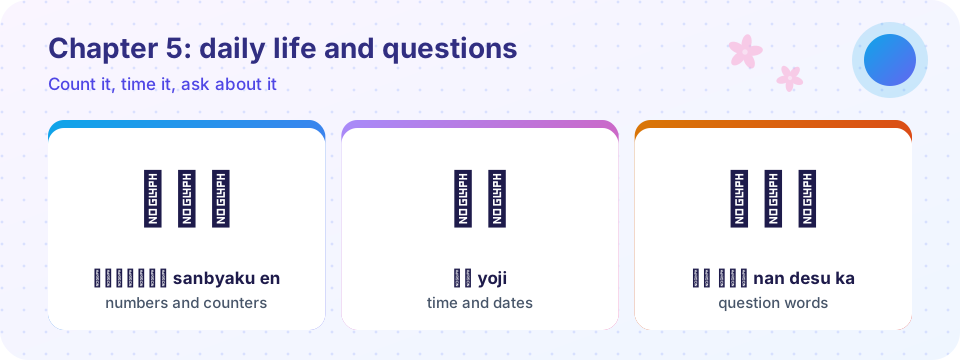
A map of chapter 5: learn to count, tell time, say dates and ask questions in Japanese, the skills you need for shops, trains and small talk.
Up to this point you have learned to read kana, build simple sentences with です (desu) and ます (masu), and use the basic particles. That is enough to introduce yourself, but real days are made of other things: paying for lunch, catching a train at the right minute, planning to meet a friend on Saturday, and asking a stranger where the toilet is. This chapter gives you the tools for those moments. Three skills do almost all of the work: numbers, time, and questions.
None of these topics is hard in the sense of difficult grammar. What makes them tricky is that Japanese has a lot of small sound changes, and every one of them is worth learning once so that it stops surprising you. For example, 300 is さんびゃく (sanbyaku) but 600 is ろっぴゃく (roppyaku). A single hour, 4 o'clock, is よじ (yoji) and never よんじ. By the end of the chapter you will know why such changes happen and, more usefully, which ones you need to memorize and which ones follow a pattern.
The big picture
Think of the chapter as three tools that you will keep combining.
- Counting answers "how many?" and "how much?" You will learn the numbers up to ten thousand and beyond, the native Japanese counting series (ひとつ, ふたつ, みっつ), and the first counters, the small words that you attach to numbers when you count people, flat objects, long objects, and animals.
- Time answers "when?" You will read clock times, say the days of the week, the months and the days of the month, and use the particle に (ni) correctly with time words.
- Questions answer nothing by themselves, but they let you ask for everything else: what, who, where, when, which, how, why, and how much.
Chapter 5 at a glance
Counting
Sounds change: ろっぴゃく
Time
Questions
What each lesson covers
- Numbers and counters takes you from 0 to 99,999, shows how prices are read, introduces the native series for small quantities, and explains the sound changes in counters such as 本 (hon) and 匹 (hiki).
- Time and dates covers the clock, the days of the week, months, the unusual day-of-the-month words, and the words for today, tomorrow and yesterday.
- Question words gives you the whole family of か questions and shows where each word goes in a sentence.
- Chapter 5 review puts everything on one page and tests it with ten mixed questions.
A word about romanization
In this chapter, and in every later chapter, each Japanese example is given in native script first, then in romaji (Latin letters), then in English. Romaji is a crutch, and you should aim to put it down as soon as you can, because it hides real information: the particle は is read "wa" but the same character is read "ha" inside a word, and long vowels are easy to miss, so ここ (koko, here) and こうこう (koukou, high school) look deceptively alike. We use the common Hepburn style and write long vowels by doubling them (juu, ookii, ou). Keep reading the kana whenever you can.
How to study this chapter
Numbers and times are memorization topics, so treat them like a small vocabulary drill rather than like grammar. A few habits help a great deal.
- Say numbers aloud as you meet them. Read the price tags in a photo of a Japanese store, or the numbers on your own bus ticket. A number you have only seen is not a number you can use.
- Learn the irregular items as a block. There are only a handful: three or four for hundreds and thousands, a few for each counter, and the minute words. Write them on one card and review the card daily for a week.
- Practice with the runnable tools. The lessons contain small programs that read a number or a clock time for you. Try to predict the answer first, then press Run and compare.
- Ask and answer. Each lesson ends with a dialogue. Read both parts aloud, then cover the Japanese and rebuild it from the English.
A course cannot replace speaking with real people. The sound changes in this chapter are easy to read and hard to say smoothly, so find a tutor, an exchange partner, or a recording by a native speaker and imitate the rhythm. Spoken Japanese is quite even: each kana is about the same length, and the small っ is one silent beat.
Check your understanding
Quick check · 3 questions
of 3 answered You scored / 3 · perfect!
-
1. Which skill does this chapter NOT cover?
Katakana belongs to an earlier chapter. This chapter is about numbers, time and questions. -
2. Why is romaji only a crutch?
Kana show every sound exactly, while romaji can hide the difference between short and long vowels and between similar spellings. -
3. How should the lessons' irregular sound changes be studied?
There are only a few irregular items per topic, so a single reference card reviewed daily works well.
Summary
- Chapter 5 teaches numbers and counters, time and dates, and question words.
- The grammar is light, but the sound changes need deliberate memorization.
- Each example is shown in Japanese script, romaji and English; try to rely on the kana.
- A course cannot replace speaking with people, so practice aloud.
Next: Numbers and counters
Track your progress
Create a free account to tick off lessons and pick up where you left off on any device.
of Japanese for Beginners lessons completed