


















Lesson 35 of 50 · Kanji and Reading
Chapter 7 overview: kanji and reading
A map of chapter 7: what kanji are, how readings and okurigana work, the first 40 everyday characters, and a method for reading real Japanese sentences.
Until now you have read Japanese in hiragana and katakana, two sets of 46 basic symbols that stand for sounds. Real Japanese text adds a third script: kanji (漢字), characters borrowed from Chinese that stand for meanings as well as sounds. A newspaper headline, a train timetable or a restaurant menu will always mix all three. This chapter is your introduction to kanji, and it aims at a practical goal: by the end you will recognize about forty of the most common characters, understand why each has several readings, and have a method for working out an unfamiliar sentence.
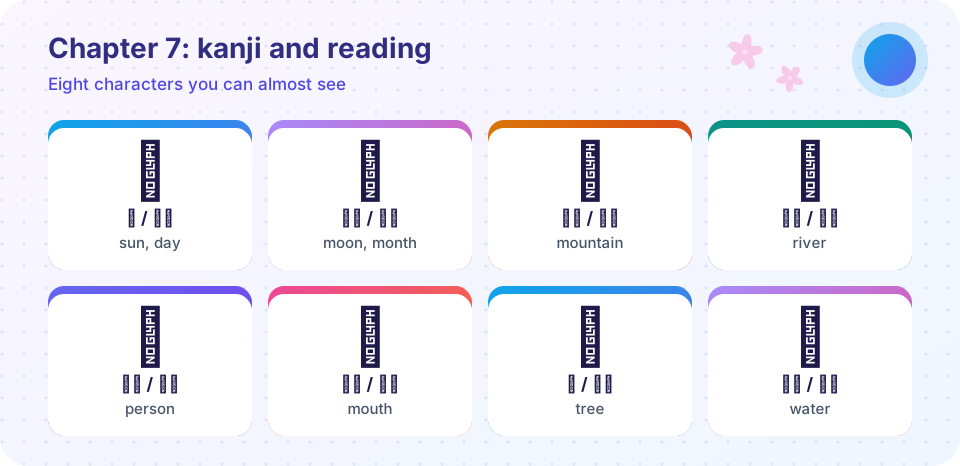
The big picture
Kanji sound intimidating because there are so many of them, but a few ideas make the task manageable.
- You do not need all of them. The official list of everyday characters, the jōyō kanji, has 2,136 entries. Children learn 1,026 of them in elementary school. A beginner who knows around a hundred characters can already read a surprising amount of signs, menus and calendar text, and a few hundred opens up simple books.
- Kanji are built from parts. Most characters are combinations of simpler pieces, so the 25th character you learn is easier than the first.
- Readings follow patterns. Each kanji has an "on" reading (borrowed from Chinese) and often a "kun" reading (native Japanese). Compound words usually use on readings; single characters with kana endings usually use kun readings.
- Kana still do the grammar. Particles and verb endings stay in hiragana, so the kana you already know are the frame in which kanji sit.
Chapter 7 at a glance
Three scripts
Kanji basics
Readings
Everyday kanji
What each lesson covers
- What kanji are and how they work introduces the three scripts, the four kinds of characters, stroke order, and your first twenty kanji.
- Readings, compounds and okurigana explains on and kun readings, how kana endings are attached, sound changes in compounds, and a routine for reading a sentence.
- Everyday kanji for verbs, places and directions adds more than thirty practical characters, organized by use, with sample sentences.
- Chapter 7 review summarizes everything and tests you with ten questions.
How to study kanji
Many learners start kanji with enthusiasm and quit after a few weeks. These habits reduce the risk.
- Learn kanji inside words, not in isolation. 学 (study) is more useful as a part of 学校 (school, がっこう) and 学生 (student, がくせい) than as a flashcard on its own.
- Write the character by hand. Stroke order matters for legibility and also for memory. The next lesson gives the basic rules.
- Use furigana as training wheels. Small kana above kanji (ふりがな) tell you how to read them. Textbooks and children's books use them; remove them gradually.
- Review a little every day. Five minutes daily beats one hour weekly. The lessons contain flashcard tools and drills for this.
- Do not expect speed. Even native speakers continue to learn new kanji throughout their lives.
A course cannot replace speaking with people, and kanji are no exception: reading aloud to a tutor, or having someone correct your handwriting, speeds things up. Stroke order in particular is much easier to absorb by watching than by reading a description.
Check your understanding
Quick check · 3 questions
of 3 answered You scored / 3 · perfect!
-
1. Which script is normally used for grammatical endings and particles?
Hiragana carry the grammar: particles like は and を and verb endings like ます. -
2. How many kanji are in the official jōyō list (2010 revision)?
The jōyō kanji list contains 2,136 characters. -
3. What is the best way to learn a kanji?
Words give context; handwriting and short daily reviews build memory.
Summary
- Japanese uses kanji for content words, hiragana for grammar and katakana for loanwords.
- You can read a lot with 100 to 200 kanji; the official everyday list has 2,136.
- Readings (on and kun) follow patterns you will learn in the second lesson of the chapter.
- Learn kanji in words, write them, and review a little every day.
Track your progress
Create a free account to tick off lessons and pick up where you left off on any device.
of Japanese for Beginners lessons completed