


















Lesson 1 of 50 · Getting Started
Course map
Plan your Japanese journey: who this course is for, how the nine chapters fit together, how to study each week and why speaking with people still matters.
Welcome to Japanese for Beginners. This course takes you from "I cannot read a single character" to simple conversations, a working knowledge of both kana scripts, your first kanji and a toolbox of everyday grammar. You do not need any earlier knowledge of Japanese or of another Asian language. If you can read English, you can start today.
Japanese looks hard from the outside because the writing is unfamiliar. In practice the spoken language is friendly to beginners: it has only five vowel sounds, almost no irregular verbs, no grammatical gender, no articles and no plurals to memorize. The mountain you climb first is the script, and it is a smaller mountain than it looks. The two kana alphabets contain 46 basic characters each, and most learners can read the first one in a couple of weeks.
What you will learn
- who this course is written for and what you need before you begin
- how the nine chapters build on each other
- a weekly routine that works for busy people
- how this course writes Japanese: native script first, romaji as a helper
- what a text course cannot do, and how to fill the gap
Key terms
Kana are the two syllable alphabets, hiragana and katakana.
Kanji are the Chinese-origin characters that carry meaning, such as 日 (sun, day).
Romaji means Japanese written in the Latin alphabet, for example arigatō.
Mora is the unit of sound length in Japanese, similar to a beat.
Particle is a tiny word such as は or を that marks the job of the word before it.
Who this course is for
This course is for teenagers and adults, anywhere in the world, who want to start Japanese properly. It works for travelers, anime and game fans, people with Japanese friends or colleagues, students preparing for school exams, and anyone who simply likes languages. The explanations are written in plain English and every Japanese word comes with a pronunciation guide.
The course follows the standard path that most beginner classrooms use. That means polite Japanese first (the ます and です style that is safe with everyone), the two kana scripts before kanji, and a small set of grammar patterns practiced until they feel natural. It lines up roughly with the first level of the Japanese-Language Proficiency Test (the N5 level), although the course is not an exam-prep book and does not promise a score.
How the nine chapters fit together
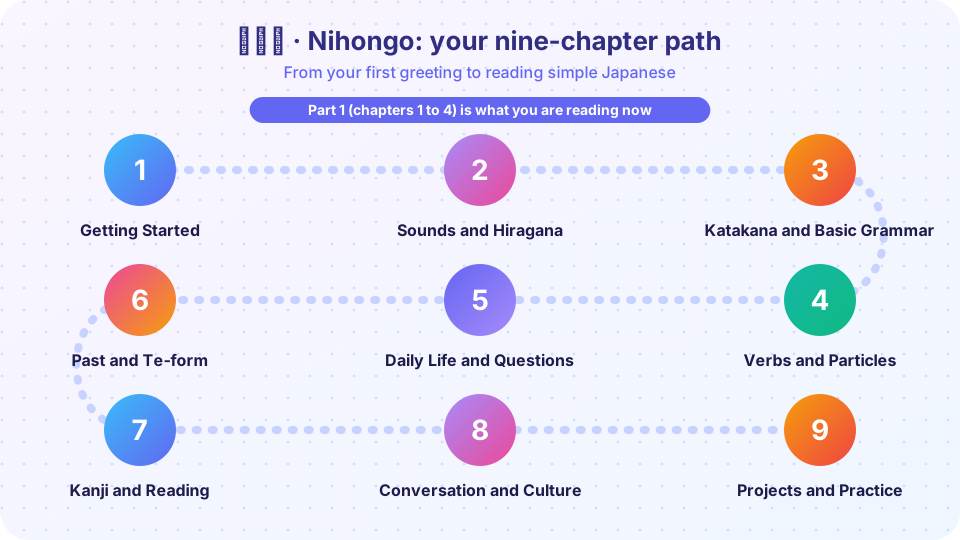
The course has nine chapters. You are reading the first part, chapters 1 to 4, which gives you the scripts and the sentence skeleton.
Part 1: first steps
- Getting Started
- Sounds and Hiragana
Part 1: grammar begins
- Katakana and Basic Grammar
- Verbs and Particles
Part 2: everyday Japanese
- Daily Life and Questions
- Past and Te-form
Part 2: reading and culture
- Kanji and Reading
- Conversation and Culture
Put it all together
- Projects and Practice
Each chapter opens with an overview lesson, has three or four content lessons and ends with a review lesson. In a content lesson you will always see the same rhythm: what you will learn, key terms, an explanation with examples, common mistakes, interactive practice, a short quiz and a summary.
How to study: the 20-minute rule
Language learning rewards frequency more than length. Twenty focused minutes every day beat two hours on Sunday. Here is a routine that fits that idea:
- Warm up (3 minutes). Review yesterday's flashcards or kana. Say each answer aloud before you reveal it.
- Learn (10 minutes). Read one section of a lesson and say every example aloud. Write the new kana by hand a few times. Handwriting builds memory in a way that typing does not.
- Use (5 minutes). Do the interactive exercises and the quiz. Mistakes are useful: each one shows you what to review.
- Review (2 minutes). Say three sentences you can make with the new material. Make them silly if that helps you remember.
A lesson is built for roughly 40 to 60 minutes of study, so most people spend two or three days on each. Use the planner below to see how long Part 1 will take at your pace. It is an estimate for planning, not a promise, because people learn at different speeds.
How this course writes Japanese
Every Japanese example appears in native script first, followed by romaji in italics so you can pronounce it before you can read the characters. The romaji follows the common Hepburn system, with a bar over long vowels (ō, ū). In chapter 2 you will learn hiragana, and from then on the kana carry the lesson while romaji fades into a helper. A rule worth following from day one: do not read romaji aloud like English. The romaji sushi is pronounced "soo-shee", not "soo-shy".
Sentences are spaced in this course for readability (for example わたしは パンを たべます), because beginners find word boundaries hard to see. Real Japanese is normally written without spaces, and children's books and games use spaces only for the youngest readers.
The dialogues in the chapters use short names: Lisa (a visiting student) and Tanaka (a local friend). They keep to polite speech throughout so you can safely imitate them.
A course cannot replace speaking with people. This course has no audio files. It teaches pronunciation with IPA symbols and careful descriptions, and some interactive pages can use your browser's built-in speech voice if your device has one, but synthetic voices are not a substitute for real ones. Listen to native speakers whenever you can (podcasts, shows, language exchange partners, a class), and speak aloud from the very first day, even to an empty room. Mistakes made out loud teach faster than mistakes in your head.
Common misconceptions
"Japanese is the hardest language in the world." It is hard in a few specific ways (the amount of kanji, the number of politeness levels) and surprisingly easy in others (a small sound system, regular grammar). Difficulty depends on your own language, and difficulty is not the same as impossible.
"I must master kanji before I can speak." No. Speaking and reading develop in parallel. Kanji come in chapter 7, after you already have hundreds of words in kana.
"Romaji is enough." Romaji is a fine bridge in the first days, but it hides the real sounds and makes learning more difficult over time. Learn the kana early.
Try it
A quick calculation shows how reachable the first goal really is. In the console below, change perDay and see how many days each kana alphabet needs.
Press Run (or Ctrl + Enter) to see the console output here.
No output.
Check your understanding
Quick check · 4 questions
of 4 answered You scored / 4 · perfect!
-
1. What do the two kana alphabets have in common?
Hiragana and katakana both have 46 basic characters and both are sound-based. Kanji carry meaning. -
2. Which routine does this course recommend?
Frequent short sessions build memory better than rare long ones, and speaking aloud is part of the routine. -
3. How should you treat romaji in this course?
Romaji is a bridge. Read it with Japanese sounds, then replace it with kana as soon as you can. -
4. Why does the course repeat that it cannot replace speaking with people?
Text and IPA teach a lot, but you also need real voices and real conversations.
Summary
- The course covers nine chapters; you are starting with chapters 1 to 4: first steps, hiragana, katakana, basic grammar and verbs.
- The hardest part of the beginning is the script, and it is more manageable than it looks.
- Study little and often: about 20 minutes a day, saying everything aloud.
- Examples use native script plus Hepburn romaji; kana replaces romaji as you learn.
- A text course cannot replace listening to and speaking with real people.
Next: How Japanese works
Track your progress
Create a free account to tick off lessons and pick up where you left off on any device.
of Japanese for Beginners lessons completed