


















Lesson 36 of 50 · Kanji and Reading
What kanji are and how they work
Understand what kanji are, how they were built, how to write them with correct stroke order, and learn 22 essential beginner characters with readings.
Look at any page of Japanese and you will see three kinds of symbols mixed together. The curved, simple shapes are hiragana. The sharper, angular shapes are katakana. And the dense, square characters, some with two strokes and some with twenty, are kanji. Each kanji represents an idea: 山 is "mountain," 水 is "water," 日 is "sun" or "day." That makes kanji different from kana, which stand only for sounds. This lesson explains how kanji work, how they are built, how to write them, and which twenty-two to learn first.
What you will learn
- Explain the roles of kanji, hiragana and katakana in a sentence.
- Recognize the four kinds of kanji and the idea of radicals.
- Apply the basic stroke-order rules.
- Read and write 22 beginner kanji with meanings and readings.
Key terms
Kanji (漢字): "Han characters"; symbols that came from Chinese writing and stand for meanings.
Radical (部首, bushu): a repeating component that often hints at the meaning, such as 氵 for water.
Stroke (画, kaku): one continuous pen movement; every kanji has a fixed number of strokes.
Jōyō kanji (常用漢字): the 2,136 characters on Japan's official list for everyday use.
Furigana (ふりがな): small kana printed above or beside kanji to show their reading.
Three scripts working together
Kanji have a division of labor with the kana:
- Kanji write the main content words: nouns, the stems of verbs and adjectives (食べる, 大きい).
- Hiragana write grammar: particles (は, を, に), verb and adjective endings (いる, ません), and words that do not have a common kanji.
- Katakana write foreign loanwords (コーヒー, テレビ), emphasis and some names.
Take the sentence 私は毎日学校で日本語を勉強します (Watashi wa mainichi gakkou de nihongo o benkyou shimasu), "I study Japanese at school every day." The kanji (私, 毎日, 学校, 日本語, 勉強) carry the content, while the hiragana は, で, を and します are the grammar scaffold. Spaces are not used between words, and the change from kanji to kana helps your eye find word boundaries. That is a main reason for mixing scripts: a long run of only kana is hard to read.
Kanji arrived in Japan from China more than a thousand years ago, when Japan had no writing of its own. Japanese scribes used Chinese characters to write both Chinese and Japanese. Over time they simplified some characters into hiragana and katakana. Today's kanji are mostly the same characters as in Chinese, but some have simplified shapes (the 1946 and later reforms) that differ from both traditional Chinese and mainland China's simplified forms. For example, 学 in Japan was 學 in the older form.
How kanji are built
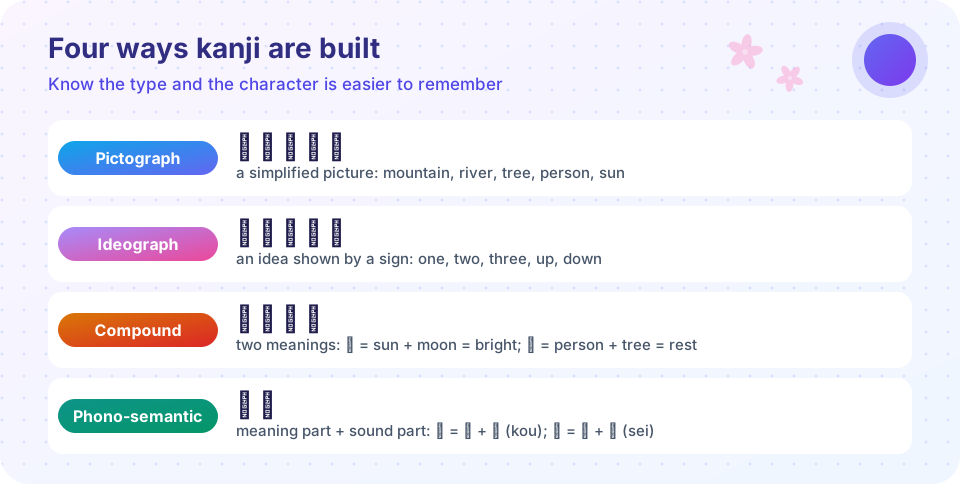
The characters were created in several ways. It helps to know the main types, because patterns make memory easier.
| Type | Idea | Examples |
|---|---|---|
| Pictograph | a simplified picture | 日 (sun), 月 (moon), 山 (mountain), 川 (river), 木 (tree), 人 (person), 口 (mouth), 目 (eye), 手 (hand) |
| Simple ideograph | an abstract idea shown by a sign | 一, 二, 三 (one, two, three), 上 (up), 下 (down) |
| Compound ideograph | two meanings combine | 明 (sun + moon = bright), 休 (person + tree = rest), 林 (two trees = woods), 森 (three trees = forest) |
| Phono-semantic | one part gives the meaning, another the sound | 校 (tree radical + 交 kou = school, こう), 晴 (sun + 青 sei = fine weather, せい) |
The last type is by far the most common in the whole script, which is good news: a large number of kanji contain a part that tells you how to say them. Learning that 交 is read こう helps you read 校 and many other characters that contain it.
A radical is a recurring component. 氵 (three drops) means water: 海 (umi, sea), 池 (ike, pond). 亻 (person) appears in 休 (rest) and 体 (karada, body). 言 (speech) appears in 話 (hanashi, talk), 語 (go, language) and 読 (yomu, read). Dictionaries are organized by radical, and spotting radicals gives you clues for the meaning of an unfamiliar character.
Writing kanji: strokes and order
A kanji with the wrong stroke order is not just old-fashioned. Following the standard order helps you write quickly and legibly, and it is how handwriting recognition and dictionaries count strokes. A few simple rules cover most characters.
- Top to bottom. 三 is written from the top line down.
- Left to right. 川 is three vertical strokes written left to right.
- Horizontal before vertical when they cross. 十: the horizontal stroke first, then the vertical one; 土 follows the same rule.
- Center before the sides. In 小 the center vertical is first, then the left and right dots.
- Outside before inside. In 国, the box (left, top, right sides) comes first, then the contents, and the bottom line closes the box last.
- Left-falling stroke before right-falling. 人 starts with the left stroke.
- A vertical stroke through the middle goes last. In 中 the box comes first, then the stroke through it.
Beginners often count strokes incorrectly, so check the numbers: 日 (4), 月 (4), 火 (4), 水 (4), 木 (4), 金 (8), 土 (3), 人 (2), 山 (3), 川 (3), 口 (3), 目 (5), 手 (4), 大 (3), 小 (3), 中 (4), 本 (5), 学 (8), 生 (5), 先 (6), 年 (6), 国 (8).
Your first 22 kanji
The table gives the meaning, the on reading (in katakana, as dictionaries do), the kun reading (in hiragana), and a sample word. Do not try to memorize every reading at once: learn the meaning and the first reading you meet in a word.
| Kanji | Meaning | On | Kun | Word |
|---|---|---|---|---|
| 日 | sun, day | ニチ, ジツ | ひ, か | 日本 (にほん, Japan), 日曜日 (にちようび, Sunday) |
| 月 | moon, month | ゲツ, ガツ | つき | 月曜日 (げつようび, Monday), 一月 (いちがつ, January) |
| 火 | fire | カ | ひ | 火曜日 (かようび, Tuesday) |
| 水 | water | スイ | みず | 水 (みず, water), 水曜日 (すいようび, Wednesday) |
| 木 | tree, wood | モク, ボク | き | 木 (き, tree), 木曜日 (もくようび, Thursday) |
| 金 | gold, money | キン | かね | お金 (おかね, money), 金曜日 (きんようび, Friday) |
| 土 | earth | ド, ト | つち | 土曜日 (どようび, Saturday) |
| 人 | person | ジン, ニン | ひと | 人 (ひと, person), 日本人 (にほんじん, Japanese person) |
| 山 | mountain | サン | やま | 山 (やま, mountain) |
| 川 | river | セン | かわ | 川 (かわ, river) |
| 口 | mouth | コウ, ク | くち | 口 (くち, mouth) |
| 目 | eye | モク | め | 目 (め, eye) |
| 手 | hand | シュ | て | 手 (て, hand) |
| 大 | big | ダイ, タイ | おお(きい) | 大きい (おおきい, big), 大学 (だいがく, university) |
| 小 | small | ショウ | ちい(さい) | 小さい (ちいさい, small) |
| 中 | middle, inside | チュウ | なか | 中 (なか, inside), 中国 (ちゅうごく, China) |
| 本 | book, origin | ホン | もと | 本 (ほん, book), 日本 (にほん, Japan) |
| 学 | study | ガク | まな(ぶ) | 学校 (がっこう, school), 学生 (がくせい, student) |
| 生 | life, birth | セイ, ショウ | い(きる), う(まれる), なま | 先生 (せんせい, teacher), 生まれる (うまれる, be born) |
| 先 | ahead, previous | セン | さき | 先生 (せんせい, teacher), 先週 (せんしゅう, last week) |
| 年 | year | ネン | とし | 今年 (ことし, this year), 一年 (いちねん, one year) |
| 国 | country | コク | くに | 国 (くに, country), 中国 (ちゅうごく, China) |
Look at 日本. The two characters 日 (sun) and 本 (origin) literally say "origin of the sun," which is the source of the English phrase "Land of the Rising Sun." And notice the reading: 日本 can be にほん (nihon) or にっぽん (nippon); both are correct, and にほん is the usual everyday reading.
Common misconceptions
"Kanji are just pictures." Only a small group began as pictures. Most characters combine meaning and sound parts, which is why reading them is easier than it looks.
"You must learn every kanji before reading." Start reading with the few hundred common ones and add with use. Furigana exist exactly for that.
"Stroke order is only for art." It affects the shape of your handwriting and how fast you can write, and it makes dictionary lookup by stroke count work.
"Each kanji has one reading." Most have two or more. The next lesson shows the system behind them.
Try it
Use these flashcards to practice. Tap Show to reveal the meaning and readings, then Next for a new character.
The second tool plots the stroke counts of the 22 kanji. Characters with more strokes usually take longer to learn, so this shows where to expect extra effort.
Press Run (or Ctrl + Enter) to see the result here.
Program input · what you'd type while the program runs
Type the answers before you press Run, one per line. Each time the program reads a line (with input()), it gets the next line from this box.
Check your understanding
Quick check · 5 questions
of 5 answered You scored / 5 · perfect!
-
1. Which type of kanji is 山 (mountain)?
山 began as a picture of three peaks, so it is a pictograph. -
2. What does the character 休 combine?
休 (rest) shows a person (亻) leaning on a tree (木). -
3. In which order do you write 十?
When a horizontal and a vertical stroke cross, the horizontal comes first. -
4. How is 日本 read in everyday speech?
にほん is usual; にっぽん is also correct, especially in formal or sports contexts. -
5. Which script writes grammatical particles such as は and を?
Particles and verb endings are written in hiragana.
Summary
- Kanji stand for meanings; hiragana write grammar; katakana write loanwords.
- Kanji types: pictographs, simple ideographs, compound ideographs, and (most common) phono-semantic characters.
- Radicals are recurring parts that hint at meaning; follow the stroke-order rules.
- 22 starter kanji: 日 月 火 水 木 金 土 人 山 川 口 目 手 大 小 中 本 学 生 先 年 国.
- Learn kanji inside words and expect more than one reading.
Track your progress
Create a free account to tick off lessons and pick up where you left off on any device.
of Japanese for Beginners lessons completed