


















Lesson 32 of 50 · Past and Te-form
Forming the te-form
Learn to build the Japanese te-form for every verb group: Group 1 ending rules, Group 2 and Group 3 patterns, the exception いく, and a runnable conjugator.
The te-form (て形) is a verb form that cannot stand alone as a sentence ending in polite speech, but that is used inside almost every other verb pattern: "please do", "is doing", "may I do", "did this and then that". It has no tense and no politeness level of its own. Those come from what follows it, or from the final verb in the sentence. Making the te-form correctly and quickly is the single most useful mechanical skill of the first year of Japanese, so this lesson focuses on the rules.
What you will learn
- Identify the three verb groups from the dictionary form.
- Form the te-form of Group 1, Group 2 and Group 3 verbs.
- Remember the one exception, いく (iku) to いって (itte).
- Turn any te-form into the casual past (ta-form).
Key terms
Dictionary form (辞書形, jishokei): the plain form that ends in a u-sound and is listed in dictionaries (たべる, かく, のむ).
Group 1 (五段, godan): verbs whose final kana changes through the five rows (a, i, u, e, o); also called u-verbs.
Group 2 (一段, ichidan): verbs that drop る; also called ru-verbs.
Group 3: the two irregular verbs する (to do) and くる (to come), plus compounds such as べんきょうする.
Te-form (て形): the connecting form of a verb, ending in て or で.
Step one: find the group
You need the dictionary form first. The ます-form of the verb helps you recover it. The most helpful rule is this:
- Group 3 has just two verbs, する (suru) and くる (kuru). Verbs made of a noun plus する (べんきょうする, to study; しょくじする, to dine) follow する.
- Group 2 verbs end in る, and the kana before る is an い-row sound (い, き, し, ち, に, ひ, み, り) or an え-row sound (え, け, せ, て, ね, へ, め, れ). Examples: たべる (taberu, eat), みる (miru, see), おきる (okiru, get up), ねる (neru, sleep).
- Group 1 includes everything else: all verbs that do not end in る, and all verbs ending in る with あ, う or お before it (ある, のる, とる).
There is a handful of tricky exceptions: verbs that look like Group 2 but belong to Group 1. The common ones are かえる (kaeru, return), はいる (hairu, enter), はしる (hashiru, run), しる (shiru, get to know), きる (kiru, cut) and いる (iru, need). Note that きる (wear, 着る) and いる (to be, 居る) really are Group 2, which is why the same spellings with different kanji belong to different groups. Dictionaries tell you the group of every verb; when you learn a new verb that ends in いる or える, look it up.
Step two: apply the rule
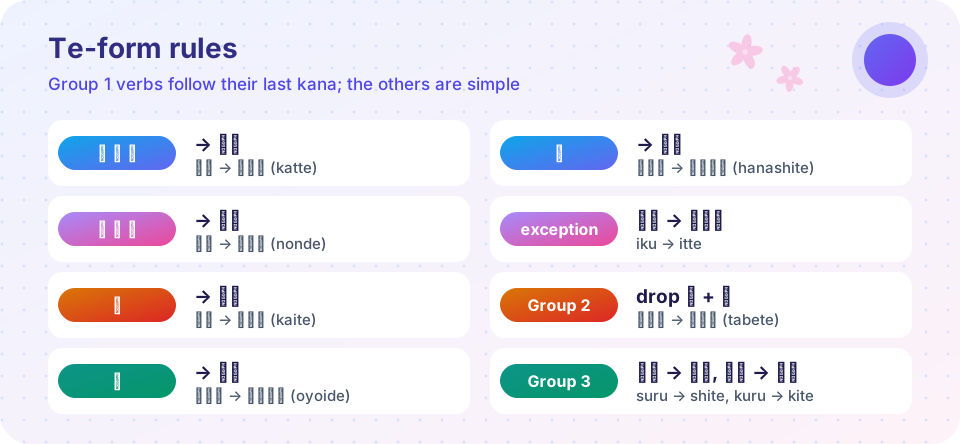
Group 2: drop る, add て
| Dictionary | Te-form | Romaji | Meaning |
|---|---|---|---|
| たべる | たべて | tabete | eat |
| みる | みて | mite | see |
| おきる | おきて | okite | get up |
| ねる | ねて | nete | sleep |
| あける | あけて | akete | open |
Group 3: two irregular forms
| Dictionary | Te-form | Romaji |
|---|---|---|
| する | して | shite |
| くる | きて | kite |
| べんきょうする | べんきょうして | benkyou shite |
Group 1: look at the last kana
| Last kana | Becomes | Example | Romaji |
|---|---|---|---|
| う, つ, る | って | かう → かって, まつ → まって, かえる → かえって | katte, matte, kaette |
| む, ぶ, ぬ | んで | のむ → のんで, あそぶ → あそんで, しぬ → しんで | nonde, asonde, shinde |
| く | いて | かく → かいて, きく → きいて | kaite, kiite |
| ぐ | いで | およぐ → およいで, いそぐ → いそいで | oyoide, isoide |
| す | して | はなす → はなして, だす → だして | hanashite, dashite |
There is exactly one exception: いく (iku, go) becomes いって (itte), not いいて. Compounds that end in いく, such as でていく (to go out), follow it too: でていって.
A handy memory trick: sing the endings in three chunks. "U-tsu-ru, tte. Mu-bu-nu, nde. Ku, ite. Gu, ide. Su, shite." The sounds "tte" and "nde" are short consonant stops, because the っ is a silent beat, and the ん is a full beat.
From te-form to ta-form
The casual past (ta-form) uses the same rules, with た instead of て and だ instead of で:
| Dictionary | Te-form | Ta-form (casual past) |
|---|---|---|
| かう | かって | かった (katta) |
| のむ | のんで | のんだ (nonda) |
| かく | かいて | かいた (kaita) |
| およぐ | およいで | およいだ (oyoida) |
| はなす | はなして | はなした (hanashita) |
| たべる | たべて | たべた (tabeta) |
| する | して | した (shita) |
| くる | きて | きた (kita) |
| いく | いって | いった (itta) |
The casual past is how friends talk about the past: きのう えいがを みた (Kinou eiga o mita), "I saw a movie yesterday." In polite speech you keep ました.
Why the sound changes
The te-form looks odd because it records old sound changes. Roughly speaking, Group 1 verbs ending in く and ぐ lost their consonant (kaku became kaite), and those ending in む, ぶ, ぬ merged into んで. You do not need the history to use the rules. The reason that the rules are worth learning is that you need each of them dozens of times a day.
Reading the te-form in a sentence
Look at these short sentences, each using a te-form followed by a helper (you will study the patterns in the next lesson):
- ちょっと まって ください。 (Chotto matte kudasai.) Please wait a moment.
- いま ほんを よんで います。 (Ima hon o yonde imasu.) I am reading a book now.
- ここで はなしても いいですか。 (Koko de hanashite mo ii desu ka.) May I speak here?
- あさ おきて、かおを あらいます。 (Asa okite, kao o araimasu.) I get up in the morning and wash my face.
In each of them the te-form is the verb that sits right before the helper, and every sentence has its tense and politeness from the last element only.
Common misconceptions
"Every verb ending in る is Group 2." No: かえる, はいる, はしる, しる and others belong to Group 1 and give かえって, はいって, はしって, しって.
"くる is regular, like Group 2." くる becomes きて (kite) and not くて. It is also irregular in the ます-form (きます) and in the negative.
"いく follows the く rule." The exception: いって (itte), not いいて.
"The te-form means 'and'." It can link verbs, but the meaning depends on the pattern. On its own, it is neither past nor present.
Try it
The conjugator below uses the rules from this lesson. It guesses the group from the dictionary form, with the list of known Group 1 exceptions, builds the te-form and ta-form and prints a romanization. Add your own verbs to the list (use hiragana).
Press Run (or Ctrl + Enter) to see the result here.
Program input · what you'd type while the program runs
Type the answers before you press Run, one per line. Each time the program reads a line (with input()), it gets the next line from this box.
The second tool lets you test yourself. A dictionary form appears, you type the te-form (using your keyboard's Japanese input, or copy it from above), and the page checks it.
Check your understanding
Quick check · 6 questions
of 6 answered You scored / 6 · perfect!
-
1. What is the te-form of のむ (to drink)?
む, ぶ and ぬ verbs end in んで: のんで (nonde). -
2. What is the te-form of かく (to write)?
Verbs ending in く change to いて: かいて (kaite). -
3. Which verb is the exception to the く rule?
いく becomes いって (itte), not いいて. -
4. What is the te-form of くる (to come)?
くる is irregular: きて (kite). -
5. Which verb belongs to Group 1 even though it ends in える?
かえる (return home) is a Group 1 verb: かえって (kaette). たべる, ねる and あける are Group 2. -
6. What is the ta-form (casual past) of みる?
Group 2: drop る and add た: みた (mita).
Summary
- Find the group first: する and くる are Group 3; ru-verbs with い/え-row before る are Group 2; everything else is Group 1.
- Group 2: drop る, add て. Group 3: して and きて.
- Group 1: う/つ/る becomes って; む/ぶ/ぬ becomes んで; く becomes いて; ぐ becomes いで; す becomes して; いく becomes いって.
- Watch for かえる, はいる, はしる, しる and いる (need), which look like Group 2 but are Group 1.
- Replace て with た (and で with だ) for the casual past.
Next: Using the te-form
Track your progress
Create a free account to tick off lessons and pick up where you left off on any device.
of Japanese for Beginners lessons completed