


















Lesson 11 of 50 · Sounds and Hiragana
Chapter 2 review: Sounds and Hiragana
Review chapter 2: the full 46-character hiragana chart, dakuten, small kana, double consonants and long vowels, with a speed round and a ten-question quiz.
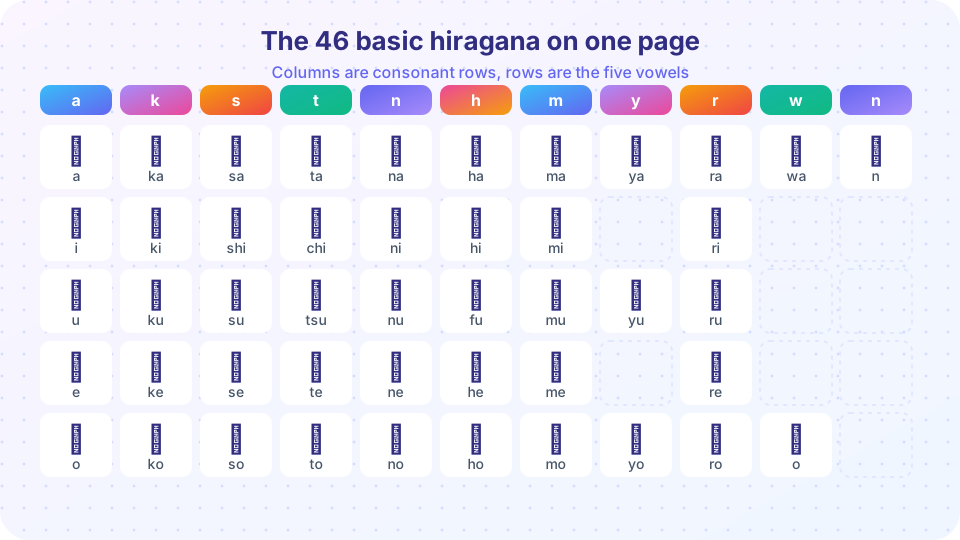
You have reached the end of chapter 2, and that is a real milestone: you know the whole hiragana system. The chart below shows the 46 basic characters in one place. Read it row by row, then column by column, and try to say every sound before looking at the romaji. If a cell feels slow, mark it in your mind and make it the first thing you review tomorrow.
What you will learn
- how well you remember the whole table
- the four rules that extend the table to every sound
- which characters and rules need more practice
Key terms
Gojūon: the 46 basic kana arranged in a grid.
Dakuten and handakuten: the marks ゛ and ゜ that voice a consonant or turn h into p.
Yōon: a combination such as きゃ made with a small ゃ, ゅ or ょ.
Sokuon: the small っ that doubles a consonant.
Chōon: a long vowel that lasts two beats.
The recap table
| Topic | Rule to remember | Example |
|---|---|---|
| Vowels | あ い う え お are short, pure and steady | あさ (asa) |
| Irregular sounds | し shi, ち chi, つ tsu, ふ fu | つき (tsuki) |
| Particle sounds | は is wa, へ is e, を is o only as particles | わたしは (watashi wa) |
| ん | A full beat; apostrophe before a vowel or y | ほんや (hon'ya) |
| Dakuten | ゛ voices k, s, t, h (g, z, d, b); ゜ makes p | がくせい (gakusei) |
| Small ゃ ゅ ょ | Fuse with the kana before them into one beat | ひゃく (hyaku) |
| Small っ | A silent beat that doubles the next consonant | きって (kitte) |
| Long vowels | Add あ, い, う, え or お (ō is お + う) | おかあさん (okāsan) |
| Mora rhythm | Each kana is one beat; small ゃ ゅ ょ add none | とうきょう = 4 beats |
| Pitch | High-low pattern, not stress | あめ (rain) and あめ (candy) |
How to keep the kana for good
Knowing a character today does not guarantee you will know it next month. Three habits keep the kana alive:
- Read every day. Even a short paragraph of hiragana a day is better than any flashcard deck. Children's picture books, short subtitle lines and the example sentences in this course are all good material.
- Space the reviews. Review new characters after one day, three days, a week and a month. If you get one wrong, move it back to tomorrow.
- Write with your hand. Copy out one of the dialogues from chapter 1 in hiragana. Your handwriting does not need to be pretty. You are building a motor memory.
If one group of characters keeps tripping you, build a mini chart of just those. A typical set of "trouble" pairs is さ and き, ぬ and め, る and ろ, わ and れ and ね, は and ほ. Put each pair together and say the difference aloud: "ぬ has a loop, め does not".
Self-check: I can ...
- I can say all five vowels with a short, steady sound.
- I can read all 46 basic hiragana without a chart.
- I can explain what dakuten and handakuten do, and read が, ぞ, ぷ and ぽ.
- I can read combinations such as きゃ, しゅ and ちょ as one beat.
- I can hear and say the difference between きて and きって.
- I can count the beats of とうきょう, ひゃく and にほん.
- I can write five words from memory: あさ, さかな, ともだち, がっこう and べんきょう.
If you are stuck
If a group of characters will not stay in your head, try one of these remedies. Draw it small: write each trouble character at the edge of a notebook page with its sound and a tiny picture you invent. Type it: use a Japanese keyboard to type a word, then check that the characters that appear are the ones you meant. Read something real: a short text, a children's book page or a sign, even if you only understand half of it. Say the whole table aloud once a day in order, then once in a random order. And do not skip rest days: sleep is when memory consolidates, and a short break can make you faster tomorrow than another hour of struggling today.
Common misconceptions
"I have learned hiragana, so I can read Japanese." You can read the sounds, which is a big step. But real texts mix kanji and katakana, so reading fluently comes with chapters 3 and 7.
"I only need to recognise kana, not write them." Recognition is faster to learn, but writing is the best way to remember. You do not need to write beautifully, and you do not need to write every day, but do write.
"Long vowels and small っ are details for later." They change meaning (きて and きって, おばさん and おばあさん), so practise them from the start.
Try it
First, a speed round. A random kana appears and you must type its sound before the 30-second timer runs out. Press Start to begin. It mixes basic kana, voiced kana and combinations.
Second, a self-check in the console. It lists ten words in romaji and the hiragana you should be able to write for each. Cover the answers, write each word on paper, then run the code to check yourself.
Press Run (or Ctrl + Enter) to see the console output here.
No output.
Check your understanding
Quick check · 10 questions
of 10 answered You scored / 10 · perfect!
-
1. How many basic hiragana characters are there?
There are 46 basic hiragana. The marks and small kana create the rest of the sounds. -
2. How do you read は in わたしは?
As the topic particle, は is wa. -
3. Which character is only ever used as the object particle?
を is read o and appears only as the object particle. -
4. What does the small っ do in きって?
The small っ is a silent beat that doubles the next consonant: kitte. -
5. How many beats does りょこう have?
りょ is one beat, then こ and う: three beats (ryo-ko-u). -
6. Which pair of kana is read ji?
じ and ぢ are both ji. し and ち are shi and chi; ず is zu. -
7. What does a dakuten (゛) do to か?
か + dakuten makes が. Only the H row takes a handakuten (ぱ). -
8. How is おかあさん (mother) romanized with a macron?
あ + あ makes a long ā: okāsan. -
9. Why is ほんや written hon'ya in romaji?
The apostrophe shows that ん is a separate beat before や. -
10. Which statement about pitch accent in Japanese is correct?
Japanese uses pitch, not loudness; the pattern depends on region, and this course uses Tokyo.
Summary
- The 46 basic hiragana are laid out in 11 columns of five vowels.
- Four extensions cover every other sound: dakuten and handakuten, small ゃ ゅ ょ, small っ and long vowels.
- は, へ and を change their sound only as particles.
- The mora is the unit of rhythm; length can change meaning.
- Daily reading, spaced review and handwriting keep the kana alive.
Track your progress
Create a free account to tick off lessons and pick up where you left off on any device.
of Japanese for Beginners lessons completed