


















Lesson 45 of 50 · Projects and Practice
Project: your self-introduction
Write and rehearse a one-minute Japanese self-introduction: structure, vocabulary for countries, jobs and hobbies, grammar checks and a builder tool.
The self-introduction (自己紹介, jikoshoukai) is the most useful speech you will ever learn in Japanese. You will give it in a classroom, at a language exchange, at a company, at a party and in many other places, and it is exactly the kind of text that a beginner can memorize and deliver smoothly. In this project you will write your own one-minute introduction, check it against the grammar of the course, and rehearse it. By the end, you will have a speech that is yours and that you can say without looking at notes.
What you will learn
- Plan a self-introduction in five parts.
- Choose vocabulary for your country, work or study, and hobbies.
- Check your draft for the common grammar mistakes.
- Rehearse it and ask polite questions in return.
Key terms
自己紹介 (jikoshoukai): a self-introduction.
〜じん (jin): a suffix meaning "person of ...": アメリカじん (an American).
しゅみ (shumi): hobby.
〜から (kara): "because" when it follows a reason; "from" when it follows a place.
もうします (moushimasu): "my name is...", the humble business form.
Step 1: the structure
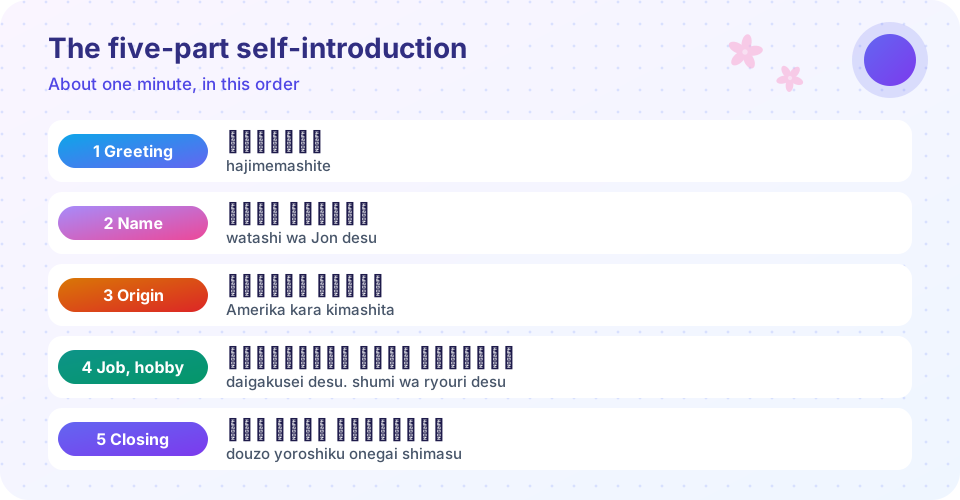
A self-introduction is short, and it follows a standard order. Learn the order, and you can say it in your sleep:
- Greeting: はじめまして。 (Hajimemashite.)
- Name: わたしは ジョンです。 (Watashi wa Jon desu.)
- Origin: アメリカから きました。 (Amerika kara kimashita.)
- Job or study, and hobbies: だいがくせいです。 しゅみは りょうりです。 (Daigakusei desu. Shumi wa ryouri desu.)
- Closing: どうぞ よろしく おねがいします。 (Douzo yoroshiku onegai shimasu.)
An optional extra sentence about why you are learning Japanese makes your introduction more personal and gives the other person something to talk about.
Step 2: choose your words
Countries and nationalities
To say where you are from, use the country name plus から きました (kara kimashita, "I came from"), or the country plus の しゅっしんです (no shusshin desu, "I am from"). For "I am a (nationality)," add じん after the country name.
| Country | Reading | Romaji | Person |
|---|---|---|---|
| アメリカ | アメリカ | Amerika | アメリカじん |
| イギリス | イギリス | Igirisu | イギリスじん |
| カナダ | カナダ | Kanada | カナダじん |
| オーストラリア | オーストラリア | Oosutoraria | オーストラリアじん |
| インド | インド | Indo | インドじん |
| ブラジル | ブラジル | Burajiru | ブラジルじん |
| 中国 | ちゅうごく | Chuugoku | ちゅうごくじん |
| 韓国 | かんこく | Kankoku | かんこくじん |
| ドイツ | ドイツ | Doitsu | ドイツじん |
| フランス | フランス | Furansu | フランスじん |
| スペイン | スペイン | Supein | スペインじん |
Work and study
| Japanese | Romaji | Meaning |
|---|---|---|
| がくせい | gakusei | student |
| だいがくせい | daigakusei | university student |
| かいしゃいん | kaishain | company employee |
| せんせい | sensei | teacher |
| いしゃ | isha | doctor |
| かんごし | kangoshi | nurse |
| エンジニア | enjinia | engineer |
| プログラマー | puroguramaa | programmer |
Use です after the job: エンジニアです (Enjinia desu), "I am an engineer." To say where you work or study, add で はたらいて います (de hataraite imasu, "I work at") or の がくせいです (no gakusei desu).
Hobbies
The pattern is しゅみは ___です (Shumi wa ___ desu).
| Japanese | Romaji | Meaning |
|---|---|---|
| どくしょ | dokusho | reading |
| りょうり | ryouri | cooking |
| りょこう | ryokou | travel |
| えいが | eiga | movies |
| おんがく | ongaku | music |
| スポーツ | supootsu | sports |
| さんぽ | sanpo | walking |
| しゃしん | shashin | photography |
You can list two hobbies with と (to, "and"): しゅみは りょうりと えいがです (Shumi wa ryouri to eiga desu), "My hobbies are cooking and movies." To say you like something, use が すきです (ga suki desu): おんがくが すきです (Ongaku ga suki desu), "I like music"; the stronger form is だいすきです (daisuki desu), "I really like it."
Step 3: a full model
はじめまして。 わたしは ジョンです。 アメリカから きました。 だいがくせいです。 しゅみは りょうりと えいがです。 にほんの えいがが すきですから、にほんごを べんきょうして います。 まいにち さんじゅっぷん べんきょうします。 どうぞ よろしく おねがいします。 (Hajimemashite. Watashi wa Jon desu. Amerika kara kimashita. Daigakusei desu. Shumi wa ryouri to eiga desu. Nihon no eiga ga suki desu kara, nihongo o benkyou shite imasu. Mainichi sanjuppun benkyou shimasu. Douzo yoroshiku onegai shimasu.) Nice to meet you. I am John. I came from America. I am a university student. My hobbies are cooking and movies. Because I like Japanese movies, I am studying Japanese. I study thirty minutes every day. Please treat me well.
The sentence "Nihon no eiga ga suki desu kara, ..." shows the reason pattern: a full polite sentence plus から (kara, "because"), and then the result. The time words connect to chapter 5 (まいにち, さんじゅっぷん) and the studying-in-progress sentence connects to chapter 6 (べんきょうして います).
Business version
At work or in a formal situation, say はじめまして。 ジョンと もうします。 (Hajimemashite. Jon to moushimasu.), a humble phrase that means "I am called John." Then add the company and role: ABCかいしゃの エンジニアです。 (ABC kaisha no enjinia desu), "I am an engineer at ABC company," and close with よろしく おねがいします.
Variations for different situations
The same five parts can be shortened or expanded. For a fifteen-second version (a quick round of introductions in class), say only the greeting, your name, your country and the closing phrase: はじめまして。 ジョンです。 アメリカから きました。 よろしく おねがいします。 With friends you can relax the style: ジョンです。 よろしくね (Jon desu. Yoroshiku ne), where the casual ね softens the sentence. For an interview or a business meeting, use the humble name phrase, mention the company or school you belong to, and keep every verb in the polite style. For an online profile, write short sentences that give the same information, adding one personal detail, for example a favorite food or place.
Whichever version you use, adjust the speed to the listener. Speak a little more slowly than you think necessary, pause between sentences, and look at the person you are speaking to. A clear, calm introduction is far more impressive than a fast one that you do not fully control.
Step 4: ask back
A good introduction invites a reply. Add one or two questions after you finish, in polite style:
- おなまえは なんですか。 (Onamae wa nan desu ka.) What is your name?
- どこから きましたか。 (Doko kara kimashita ka.) Where did you come from?
- しゅみは なんですか。 (Shumi wa nan desu ka.) What is your hobby?
- にほんごは どのくらい べんきょうして いますか。 (Nihongo wa dono kurai benkyou shite imasu ka.) How long have you been studying Japanese?
Step 5: check, polish and rehearse
Use this checklist before you rehearse:
- Particles. は after the topic, を before the verb, が before すき, から after the origin.
- Style. Everything ends in です or ます (no casual forms).
- Counting and time. Check any numbers or times against chapter 5.
- te-form. べんきょうして います, はたらいて います.
- Pronunciation. Say the long vowels (ですから, べんきょう) and the small っ (ちょっと) clearly.
To rehearse, record yourself on a phone and listen to it. First read from the page, then repeat with only the romaji, and finally with no notes. Aim for a calm pace: Japanese is spoken evenly, and each syllable is about the same length.
Common misconceptions
"I should say わたしは everywhere." In Japanese you can leave out わたしは when it is obvious. Using it in every sentence sounds unnatural; say it once at the start.
"A longer introduction is better." One minute is fine. Short sentences and clear pronunciation matter more than length.
"I can use my name with さん." Never add さん to your own name.
"から always means from." After a place it means "from"; after a full sentence it means "because."
Try it
The first tool builds an introduction from the details you fill in. Edit the variables at the top (use katakana or hiragana for your name) and run it.
Press Run (or Ctrl + Enter) to see the result here.
Program input · what you'd type while the program runs
Type the answers before you press Run, one per line. Each time the program reads a line (with input()), it gets the next line from this box.
The second tool builds the same text in the browser with menus, so you can try different countries, jobs and hobbies quickly.
Check your understanding
Quick check · 5 questions
of 5 answered You scored / 5 · perfect!
-
1. Which sentence correctly says 'I came from America'?
から marks the starting point: アメリカから きました. -
2. How do you say 'My hobby is cooking'?
The pattern is しゅみは ___です. -
3. What does から mean in 'すきですから、べんきょうして います'?
After a full sentence, から means because. -
4. Which closing phrase finishes a self-introduction?
どうぞ よろしく おねがいします is the standard closing. -
5. What is the humble business form of 'I am called John'?
〜と もうします is the humble, formal way to give your name.
Summary
- A self-introduction has five parts: greeting, name, origin, job/hobbies, closing.
- Use から for origin, しゅみは ___です for hobbies, が すきです for likes, and から after a sentence for because.
- Business style: ジョンと もうします.
- Check particles and style, then rehearse aloud and finish with a question to the listener.
Track your progress
Create a free account to tick off lessons and pick up where you left off on any device.
of Japanese for Beginners lessons completed