


















Lesson 37 of 50 · Kanji and Reading
Readings, compounds and okurigana
Learn why kanji have several readings, how on'yomi and kun'yomi differ, what okurigana do, how compounds change sounds, and how to read a sentence step by step.
The first surprise of kanji is that one character can be read in several ways. 日 is read ひ in "sun," にち in 日曜日 (Sunday) and か in 二日 (the second day of the month). This is not random. The readings come from two sources, and once you know the rule of thumb, you will guess most words correctly. This lesson explains the two reading types, the little kana tails called okurigana, the sound changes that happen in compounds, and a routine for reading a Japanese sentence that you have never seen.
What you will learn
- Tell on'yomi from kun'yomi and predict which a word uses.
- Use okurigana to read verbs and adjectives.
- Recognize common sound changes in compounds.
- Read a sentence by splitting it at the kana.
Key terms
On'yomi (音読み): the reading that came with the character from Chinese; written in katakana in dictionaries.
Kun'yomi (訓読み): the native Japanese word assigned to the character; written in hiragana in dictionaries.
Okurigana (送り仮名): kana written after a kanji to show the verb or adjective ending (食べる, 大きい).
Jukujikun (熟字訓): special readings of whole compounds that do not follow the characters one by one (今日 きょう).
Rendaku (連濁): a sound change that voices the first consonant of the second part of a compound (手 + 紙 becomes てがみ).
Two reading families
Japanese already had spoken words before it adopted kanji. When a Chinese character meaning "mountain" arrived, Japanese people attached their own word やま to it: that is the kun reading. They also borrowed the Chinese pronunciation (roughly "san"): that is the on reading. Both stayed. So 山 is やま (a native word, used alone) and さん (as in 富士山, ふじさん, Mt. Fuji).
The practical rule of thumb has three parts:
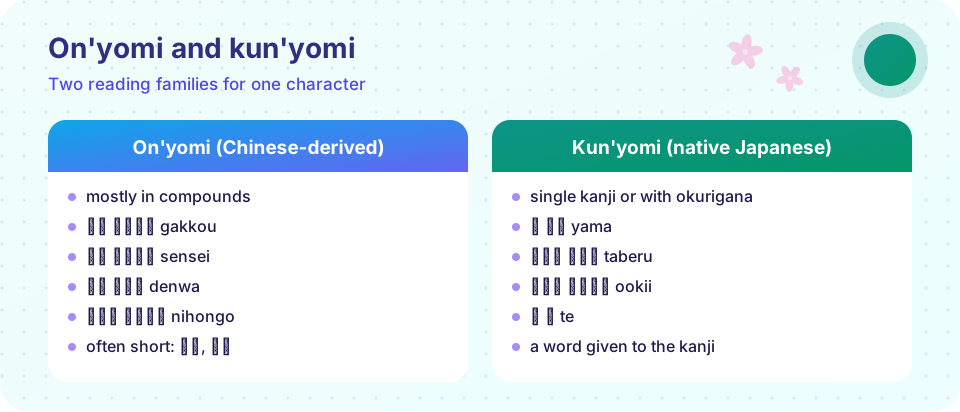
- A single kanji standing alone, or with okurigana, is usually kun: 山 (やま), 川 (かわ), 手 (て), 食べる (たべる), 大きい (おおきい), 行く (いく).
- A compound of two or more kanji is usually on: 学校 (がっこう), 先生 (せんせい), 電話 (でんわ), 電車 (でんしゃ), 大学 (だいがく), 日本語 (にほんご).
- Exceptions exist. Some compounds use kun readings (手紙 てがみ, 夜空 よぞら) and many everyday words use irregular readings (jukujikun).
On readings are often short, one or two syllables (ガク, セン, ジン), and many different kanji share the same on reading, which is why the same sound appears in many words. Kun readings are often longer and distinct for each character.
| Kanji | Alone / with okurigana (kun) | In compounds (on) |
|---|---|---|
| 山 | やま (mountain) | 富士山 ふじさん |
| 人 | ひと (person) | 日本人 にほんじん, 三人 さんにん |
| 学 | まなぶ 学ぶ (to learn) | 学校 がっこう, 学生 がくせい |
| 水 | みず (water) | 水曜日 すいようび |
| 大 | おおきい 大きい (big) | 大学 だいがく |
| 本 | もと (origin) | 本 ほん, 日本 にほん |
Okurigana: the grammar tail
Verbs and adjectives change their endings (たべる, たべます, たべた), so the changing part is written in hiragana after the kanji. The kanji holds the stable meaning and the kana show the grammar:
| Dictionary | Polite | Te-form | Romaji (dictionary) |
|---|---|---|---|
| 食べる | 食べます | 食べて | taberu |
| 見る | 見ます | 見て | miru |
| 行く | 行きます | 行って | iku |
| 読む | 読みます | 読んで | yomu |
| 書く | 書きます | 書いて | kaku |
| 大きい | 大きいです | 大きくて | ookii |
| 新しい | 新しいです | 新しくて | atarashii |
Notice that the okurigana start at the point where the word changes. 食べる (taberu) has the kanji 食 for たべ and the kana る; 食べます keeps 食べ and changes only the end. For い-adjectives, 大きい has きい in kana, and 新しい has しい. When you learn a new word, learn its okurigana together with the kanji; they tell you the verb's form and prevent misreadings (行く is いく, but 行う with different okurigana is おこなう, "to carry out").
Sound changes in compounds
When two kanji combine, the sounds often change for ease of pronunciation. A few patterns appear again and again:
- Doubling (gemination). 学 (ガク) + 校 (コウ) becomes がっこう (gakkou), not がくこう. Likewise 日 + 記 becomes にっき (nikki), 一 + 本 becomes いっぽん (ippon).
- Voicing (rendaku). 手 (て) + 紙 (かみ) becomes てがみ (tegami), 時 + 時 repeated becomes ときどき (tokidoki, "sometimes"), 人 + 人 becomes ひとびと (hitobito, "people").
- Long vowels. 先生 is せんせい (sensei); the い after え is pronounced as a long え sound in many speakers. In romaji we write sensei.
There are also jukujikun, compounds with a reading of their own. These common words are best learned as units: 今日 きょう (today), 明日 あした (tomorrow), 昨日 きのう (yesterday), 今年 ことし (this year), 大人 おとな (adult), 友達 ともだち (friend), 一人 ひとり (one person), 二人 ふたり (two people).
A routine for reading a sentence
Unknown text is much less frightening when you follow a simple routine. Take 私は毎日学校で日本語を勉強します (Watashi wa mainichi gakkou de nihongo o benkyou shimasu).
- Find the kana. は, で, を and します are hiragana: particles and endings. They split the sentence into chunks.
- Read each chunk. 私 (わたし, I), 毎日 (まいにち, every day), 学校 (がっこう, school), 日本語 (にほんご, the Japanese language), 勉強 (べんきょう, study).
- Apply the rule of thumb. The compounds (毎日, 学校, 日本語, 勉強) use on readings; 私 is a single kanji with its kun reading.
- Check the meaning. Does the sentence make sense? "I study Japanese at school every day." Yes.
- Look up what is left. An app or dictionary answers questions such as "what is 毎?" Use it for words you cannot guess.
More practice sentences, each broken into chunks:
- 今日は水曜日です。 (Kyou wa suiyoubi desu.) Today is Wednesday. 今日 きょう / は / 水曜日 すいようび / です.
- 先週、友達と日本へ行きました。 (Senshuu, tomodachi to nihon e ikimashita.) Last week I went to Japan with a friend. 先週 せんしゅう / 友達 ともだち と / 日本 にほん へ / 行きました.
Common misconceptions
"On readings are Chinese, so I need to know Chinese." On readings are Japanese-adapted versions of old Chinese sounds. You do not need Chinese to learn them.
"Compounds always use on readings." Mostly, yes; but 手紙 (てがみ), 夜空 (よぞら) and many everyday words mix or use irregular readings.
"Okurigana are optional." They are part of the spelling. 行く and 行う are different words.
"Rendaku always happens." It is common but not automatic: 手紙 is てがみ (voiced), but 手首 (wrist) is てくび. Learn the word, not the rule alone.
Try it
The first tool breaks a sentence into words, gives each word's reading, and prints a romanization. Edit the sentence list with the words in the lexicon (it is small, so unknown characters show a question mark).
Press Run (or Ctrl + Enter) to see the result here.
Program input · what you'd type while the program runs
Type the answers before you press Run, one per line. Each time the program reads a line (with input()), it gets the next line from this box.
The second tool lets you switch furigana on and off, like a reading book for learners. Try reading the sentences with the readings hidden first.
Check your understanding
Quick check · 5 questions
of 5 answered You scored / 5 · perfect!
-
1. Which reading type does 山 use when it stands alone as 'mountain'?
A single kanji standing alone usually takes its kun reading: やま. -
2. How is 学校 read?
ガク + コウ doubles into がっこう (gakkou). -
3. What are okurigana?
Okurigana (食べる: る, 大きい: きい) are the kana tail of an inflecting word. The small kana above kanji are furigana. -
4. How is 今日 read?
今日 (きょう, today) is a jukujikun: its reading belongs to the whole word. -
5. Which sentence part tells you where words begin and end in 私は毎日学校で日本語を勉強します?
は, で, を and します are hiragana that split the sentence into chunks.
Summary
- Kanji have on'yomi (from Chinese) and kun'yomi (native Japanese); compounds usually take on, single kanji with okurigana usually take kun.
- Okurigana are the hiragana tail of verbs and adjectives and are part of the spelling.
- Compounds change sounds: doubling (がっこう), voicing (てがみ) and special readings (きょう).
- Read a sentence by finding the kana, reading each chunk, applying the rule of thumb and checking the meaning.
Track your progress
Create a free account to tick off lessons and pick up where you left off on any device.
of Japanese for Beginners lessons completed