


















Lesson 31 of 50 · Past and Te-form
The polite past tense
Learn the polite past tense in Japanese for verbs, nouns, い-adjectives and な-adjectives, with negative forms, time words and a runnable conjugator.
Japanese verbs distinguish two tenses: non-past (present and future) and past. The polite past is one of the easiest things in the language, because it changes only the ending of the sentence. Yesterday you ate; last week you went; the movie was interesting. In this lesson you will learn the endings for verbs, nouns, い-adjectives and な-adjectives, in both positive and negative form, and you will see that a single pattern covers each family.
What you will learn
- Form the polite past and negative past of verbs (ました, ませんでした).
- Form the past of nouns and な-adjectives (でした, じゃありませんでした).
- Form the past of い-adjectives (かったです, くなかったです), including いい.
- Use time words such as きのう and せんしゅう with the past tense.
Key terms
Non-past: the form used for habits, facts, present and future events (たべます).
Past: the form for completed events (たべました).
い-adjective: an adjective ending in い that conjugates by itself (おいしい, delicious).
な-adjective: an adjective that needs な before a noun and です after it (きれい, pretty; しずか, quiet).
Ending swap: changing the last part of a word to make a new form.
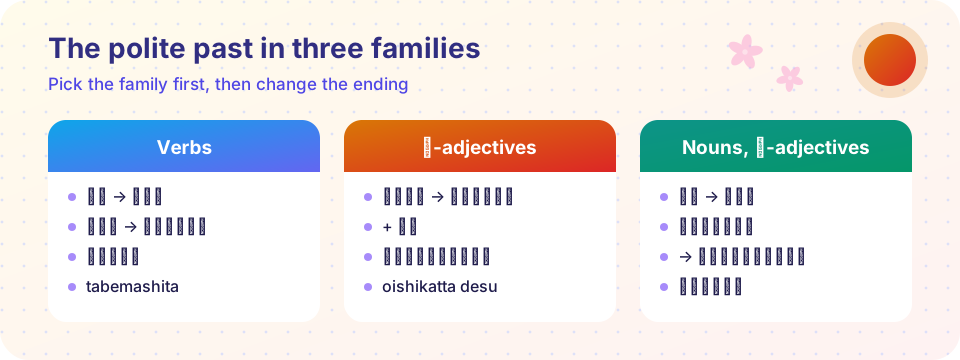
Verbs: ます becomes ました
Take the polite verb you already know and replace ます (masu) with ました (mashita):
| Meaning | Non-past | Past | Romaji |
|---|---|---|---|
| eat | たべます | たべました | tabemashita |
| go | いきます | いきました | ikimashita |
| see, watch | みます | みました | mimashita |
| drink | のみます | のみました | nomimashita |
| buy | かいます | かいました | kaimashita |
| do | します | しました | shimashita |
| come | きます | きました | kimashita |
The negative past replaces ません (masen) with ませんでした (masen deshita): たべませんでした (tabemasen deshita), いきませんでした (ikimasen deshita). Notice that the polite forms do not care about the verb group. Every verb follows the same four-step pattern:
| Positive | Negative |
|---|---|
| ます | ません |
| ました | ませんでした |
The same pattern works for ある (to exist, for things) and いる (to exist, for living things): ありました (arimashita), ありませんでした (arimasen deshita), いました (imashita), いませんでした (imasen deshita).
Here are the past forms in sentences:
- きのう えいがを みました。 (Kinou eiga o mimashita.) I watched a movie yesterday.
- けさ コーヒーを のみませんでした。 (Kesa koohii o nomimasen deshita.) I did not drink coffee this morning.
- せんしゅう ともだちに あいました。 (Senshuu tomodachi ni aimashita.) I met a friend last week.
- ゆうべ ほんを よみました。 (Yuube hon o yomimashita.) I read a book last night.
Time words such as きのう (yesterday), ゆうべ (last night), けさ (this morning), せんしゅう (last week), せんげつ (last month) and きょねん (last year) do not take に, just like あした. Words with a specific point in time, such as にちようびに (on Sunday), do take に.
Nouns and な-adjectives: です becomes でした
The past of です is でした (deshita), and its negative is じゃありませんでした (ja arimasen deshita). In formal writing you will see ではありませんでした (dewa arimasen deshita); the two are equal in meaning.
| Non-past | Past | Meaning |
|---|---|---|
| がくせいです | がくせいでした | I am / was a student |
| がくせいじゃ ありません | がくせいじゃ ありませんでした | I am not / was not a student |
| しずかです | しずかでした | it is / was quiet |
| しずかじゃ ありません | しずかじゃ ありませんでした | it is not / was not quiet |
Nouns and な-adjectives share these forms, which is why they can be learned together. For example: きのうは あめでした (Kinou wa ame deshita), "Yesterday was rainy" (あめ, rain is a noun here), and へやは きれいでした (Heya wa kirei deshita), "The room was clean."
い-adjectives: change the ending
い-adjectives are different because they change themselves, not です. Drop the final い and add かった (katta) for the past. The です that follows is polite, and it stays the same.
| Form | Pattern | Example | Romaji |
|---|---|---|---|
| present | word + です | おいしいです | oishii desu |
| negative | stem + くないです | おいしくないです | oishikunai desu |
| past | stem + かったです | おいしかったです | oishikatta desu |
| negative past | stem + くなかったです | おいしくなかったです | oishikunakatta desu |
"Stem" means the adjective without its final い. For おいしい the stem is おいし. The same works for たかい (takai, high or expensive): たかかったです (takakatta desu), たかくなかったです (takakunakatta desu); and for たのしい (tanoshii, fun): たのしかったです (tanoshikatta desu).
The word いい (ii, good) is irregular. Its stem is よ (yo), so いい becomes よくないです (yokunai desu), よかったです (yokatta desu) and よくなかったです (yokunakatta desu). The same is true of compounds such as かっこいい (kakkoii, cool), which becomes かっこよかった. A common example of the past with いい is the dialogue question きのうは どうでしたか (Kinou wa dou deshita ka), "How was yesterday?" with the answer よかったです (Yokatta desu), "It was good."
A polite alternative is くありません (kuarimasen) for the negative present and くありませんでした (kuarimasen deshita) for the negative past: おいしくありません, おいしくありませんでした. They mean the same as くないです and くなかったです, and are a bit more formal.
All three families side by side
| Present | Negative | Past | Negative past | |
|---|---|---|---|---|
| verb (たべる) | たべます | たべません | たべました | たべませんでした |
| い-adjective (おいしい) | おいしいです | おいしくないです | おいしかったです | おいしくなかったです |
| な-adjective (しずか) | しずかです | しずかじゃありません | しずかでした | しずかじゃありませんでした |
| noun (がくせい) | がくせいです | がくせいじゃありません | がくせいでした | がくせいじゃありませんでした |
A conversation about yesterday
A: きのう なにを しましたか。 (Kinou nani o shimashita ka.) What did you do yesterday? B: ともだちと えいがを みました。 そして、ラーメンを たべました。 (Tomodachi to eiga o mimashita. Soshite, raamen o tabemashita.) I watched a movie with a friend. And then we ate ramen. A: えいがは どうでしたか。 (Eiga wa dou deshita ka.) How was the movie? B: とても おもしろかったです。 ラーメンも おいしかったです。 (Totemo omoshirokatta desu. Raamen mo oishikatta desu.) It was very interesting. The ramen was delicious too.
Asking and answering about the past
Past questions use the same recipe as present questions: add か at the end. きのう なにを たべましたか (Kinou nani o tabemashita ka), "What did you eat yesterday?" The answer simply repeats the structure in the past: ラーメンを たべました (Raamen o tabemashita). A yes/no question gets はい or いいえ plus the verb: えいがを みましたか (Eiga o mimashita ka), "Did you see the movie?" The answers are はい、みました (Hai, mimashita), "Yes, I did," or いいえ、みませんでした (Iie, mimasen deshita), "No, I didn't." Answer a past question with a past verb.
To ask about a state or an impression, use どうでしたか (dou deshita ka), "How was it?" りょこうは どうでしたか (Ryokou wa dou deshita ka), "How was the trip?" A natural answer uses an い-adjective in the past: たのしかったです (Tanoshikatta desu), "It was fun." To ask when something happened, use いつ: いつ いきましたか (Itsu ikimashita ka), "When did you go?" and answer with a time word: せんしゅうの にちようびに いきました (Senshuu no nichiyoubi ni ikimashita), "I went last Sunday."
Two small words help with the past. もう (mou) means "already": もう たべましたか (Mou tabemashita ka), "Have you eaten already?" And まだ (mada) means "not yet", which in the next lessons you will learn to pair with the te-form: まだ たべて いません (Mada tabete imasen), "I haven't eaten yet." Japanese does not have a separate "present perfect" tense like English, so the simple past covers many things that English says with "have done." For events that took place, such as a meeting, a class or a test, use ありました (arimashita): きのう じゅぎょうが ありました (Kinou jugyou ga arimashita), "There was a class yesterday."
Finally, notice that past forms and the casual past are related. The casual past of たべます is たべた (tabeta). You will learn how to make it for every verb in the te-form lesson, where the same rules apply. For now, remember the polite forms, because they are the safe choice with teachers, shopkeepers and anyone you have just met.
Common misconceptions
"おいしいでした is the past of おいしいです." This is the most common error. You cannot attach でした to an い-adjective. The past is おいしかったです.
"Past negative means adding ませんでした to everything." ませんでした belongs to verbs only. For adjectives and nouns use くなかったです or じゃありませんでした.
"The past tense also changes the particles." It does not. Particles stay the same in all tenses: えいがを みます, えいがを みました.
Try it
The first tool builds the four polite forms of any word. Add your own words to the lists to test them, but note that it only knows the three families of this lesson.
Press Run (or Ctrl + Enter) to see the result here.
Program input · what you'd type while the program runs
Type the answers before you press Run, one per line. Each time the program reads a line (with input()), it gets the next line from this box.
In the second tool, choose a word and see all four polite forms with romaji, then try to say them before you read them.
Check your understanding
Quick check · 5 questions
of 5 answered You scored / 5 · perfect!
-
1. What is the polite past of のみます?
Replace ます with ました: のみました (nomimashita). -
2. Which is the correct past of おいしいです?
い-adjectives change their own ending to かった, then です: おいしかったです. -
3. What is the negative past of たべます?
Verbs use ませんでした: たべませんでした (tabemasen deshita). -
4. How do you say 'It was not good' about a movie (いい)?
いい is irregular: its stem is よ, so よくなかったです (yokunakatta desu). -
5. How do you say 'It was quiet' about a room (しずか)?
な-adjectives and nouns use でした: しずかでした (shizuka deshita).
Summary
- Verbs: ます to ました; ません to ませんでした.
- Nouns and な-adjectives: です to でした; じゃありません to じゃありませんでした.
- い-adjectives: change the ending to かったです and くなかったです; いい becomes よかったです.
- Time words like きのう and せんしゅう take no に.
- Never say おいしいでした; say おいしかったです.
Next: Forming the te-form
Track your progress
Create a free account to tick off lessons and pick up where you left off on any device.
of Japanese for Beginners lessons completed