


















Lesson 18 of 50 · Katakana and Basic Grammar
Chapter 3 review: Katakana and Basic Grammar
Review chapter 3: the 46 katakana, loanword rules, X は Y です with か, じゃありません, も and の, and the こ・そ・あ・ど pointing words, with a ten-question quiz.
Chapter 3 gave you a second alphabet and your first working grammar. Together, they turn a pile of kana into real communication: you can read a menu, introduce yourself, ask a question and point at things. This review gathers the key rules in one place and gives you practice with the parts that learners most often forget.
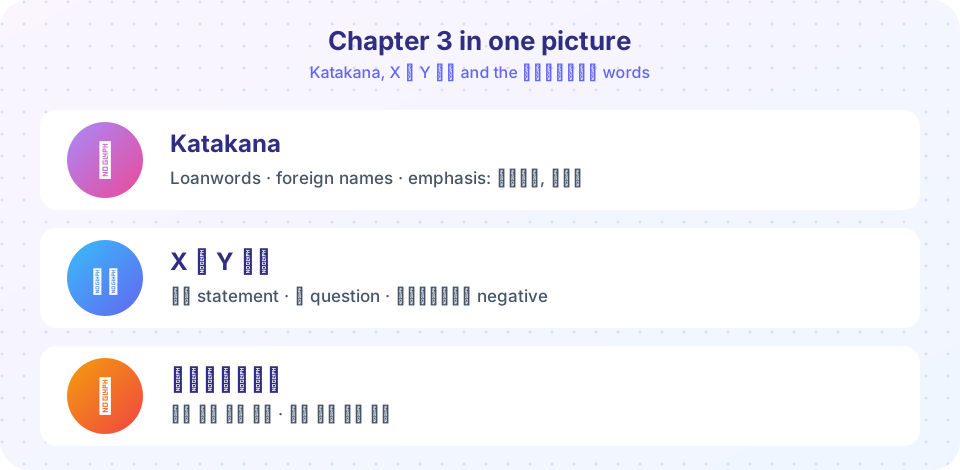
What you will learn
- how well you have mastered katakana and the loanword rules
- whether you can build and transform X は Y です sentences
- where you still mix up こ, そ and あ
Key terms
Katakana: the angular script for loanwords, foreign names and emphasis.
Gairaigo: a loanword; wasei-eigo is made-in-Japan English.
X は Y です: the basic polite sentence.
こ・そ・あ・ど: the four demonstrative series.
の: links nouns (A の B) and can replace a noun.
The recap table
| Topic | Rule to remember | Example |
|---|---|---|
| Katakana shapes | Angular; シ and ン sweep up, ツ and ソ fall down | シ / ツ, ソ / ン |
| Long vowel | ー adds one beat | ケーキ (kēki) |
| Double consonant | A small ッ doubles the next consonant | カップ (kappu) |
| Extended sounds | A kana plus a small vowel | ティ, ファ, フォ, ウィ |
| Loanwords | A vowel after every consonant; L and R merge | ストライク (sutoraiku) |
| Statement | X は Y です | わたしは がくせいです |
| Question | add か | がくせいですか |
| Negative | じゃ ありません | せんせいじゃ ありません |
| Also / of | も replaces は; A の B | リサさんも; わたしの ともだち |
| Pointing | こ near me, そ near you, あ far; ど asks | これ, それ, あれ, どれ |
| Before a noun | この, その, あの, どの | この ほん |
| Places | ここ, そこ, あそこ, どこ | えきは どこですか |
Patterns to practise out loud
Say each of these aloud. For each, change one word (the topic, the noun or the pointing word) and say the new sentence.
- わたしは がくせいです。 → たなかさんは せんせいです。
- たなかさんは せんせいですか。 → リサさんは アメリカじんですか。
- わたしは かいしゃいんじゃ ありません。 → ともだちは いしゃじゃ ありません。
- これは ほんです。 → あれは ホテルです。
- この かばんは だれのですか。 → その かさは わたしのです。
Changing a single piece at a time is a powerful way to turn a memorized sentence into a sentence you can create.
Mistakes to watch for
- Dropping the long-vowel bar. ケキ is not ケーキ. The bar is a beat.
- Swapping シ and ツ. If your handwriting is unclear, slow down and compare the stroke direction.
- Using これ before a noun. Always この before a noun.
- Choosing そ for a far object. そ is for the listener's zone. Far from both is あ.
- Forgetting that です does not change for person. わたしは, たなかさんは and リサさんは all take です.
Self-check: I can ...
- I can read all 46 katakana, including シ, ツ, ソ and ン.
- I can read ー, small ッ and the extended sounds such as ティ and ファ.
- I can turn a simple English word into likely katakana.
- I can say "I am a student", "Are you a student?" and "I am not a student".
- I can use も for "also" and の for "of".
- I can point with これ, それ, あれ and ask what, who and where.
A mini-conversation to practise
Read this conversation aloud. Then cover the English and check that you could say every sentence yourself.
リサ: すみません。これは なんですか。 Sumimasen. Kore wa nan desu ka. "Excuse me. What is this?"
たなか: それは ケーキです。 Sore wa kēki desu. "That is a cake."
リサ: この ケーキは チーズケーキですか。 Kono kēki wa chīzukēki desu ka. "Is this cake a cheesecake?"
たなか: いいえ、チーズケーキじゃ ありません。ココアケーキです。 Iie, chīzukēki ja arimasen. Kokoa kēki desu. "No, it is not a cheesecake. It is a cocoa cake."
A ten-sentence challenge
Write ten sentences about the things around you. Use at least three katakana words, two questions, one negative and one sentence with も. For example: これは コーヒーです。それは ノートですか。あれは テレビじゃ ありません。わたしの ともだちも がくせいです。Ask a friend or a teacher to check your sentences, or read them aloud and listen for anything that sounds odd. Pay particular attention to the long-vowel bar and the small ッ in your katakana words: those two details are where most spelling mistakes hide.
Using the chapter this week
Knowledge sticks when you use it outside the course. This week, try four small tasks. Label ten objects in your home with sticky notes in Japanese, using これ, それ and あれ when you speak about them. Read every katakana word you meet on packaging, apps and menus, even if you only guess the meaning. Introduce yourself aloud three times using X は Y です. And send yourself one message a day in Japanese, however short, using a loanword and a negative or a question. A week of this will do more than an hour of rereading.
Common misconceptions
"Katakana is only for English words." It writes loanwords from any language, names, sound effects and emphasis.
"じゃありません is the opposite of です in every situation." It negates です in noun sentences. For other kinds of sentences, other negatives exist, and you will learn ません for verbs in chapter 4.
"I can leave out は and です to sound casual." Dropping です makes the sentence abrupt and changes the register. Keep the polite frame while you are learning.
Try it
First, a loanword reading quiz. A katakana word appears and you pick its reading from four choices.
Second, a checker for the pointing words. It decides ko, so or a from the object's distances and prints a test table. Change the numbers to see how the rule behaves.
Press Run (or Ctrl + Enter) to see the console output here.
No output.
Check your understanding
Quick check · 10 questions
of 10 answered You scored / 10 · perfect!
-
1. Which katakana word means "cake"?
ケーキ has the long-vowel bar: kēki. -
2. What does the small ッ do in サッカー?
The small ッ is a silent beat before the k: sakkā. -
3. How do you say "Is Mr. Tanaka a teacher?"?
Add か to the statement to make a question. -
4. Which sentence means "Lisa is a student too"?
も replaces は for "also". -
5. Which is correct?
Use この before a noun. -
6. Something is next to your friend, far from you. You say:
そ points to things near the listener. -
7. What is the polite way to introduce a person: "This is Mr. Tanaka"?
こちら is the polite word for a person or direction. -
8. What does あれは ホテルです mean?
あれ points to something far from both; ホテル is hotel. -
9. Which katakana pair is easiest to confuse?
シ (shi) and ツ (tsu) differ only in the direction and angle of their strokes. -
10. Why does マンション not mean "mansion"?
Made-in-Japan English can have a different meaning from the English original.
Summary
- Katakana adds loanwords, foreign names and emphasis to what you can read.
- ー, small ッ and extended kana (ティ, ファ) handle foreign sounds.
- X は Y です, か, じゃ ありません, も and の make a full beginner grammar.
- こ・そ・あ・ど point by distance, and perspective can flip between question and answer.
- Practise by changing one word at a time in sentences you already know.
Track your progress
Create a free account to tick off lessons and pick up where you left off on any device.
of Japanese for Beginners lessons completed