


















Lesson 15 of 50 · Katakana and Basic Grammar
Loanwords and foreign sounds
See how English words become Japanese: vowel insertion, doubled consonants, extra katakana like ティ and ファ, made-in-Japan English and how to write your name.
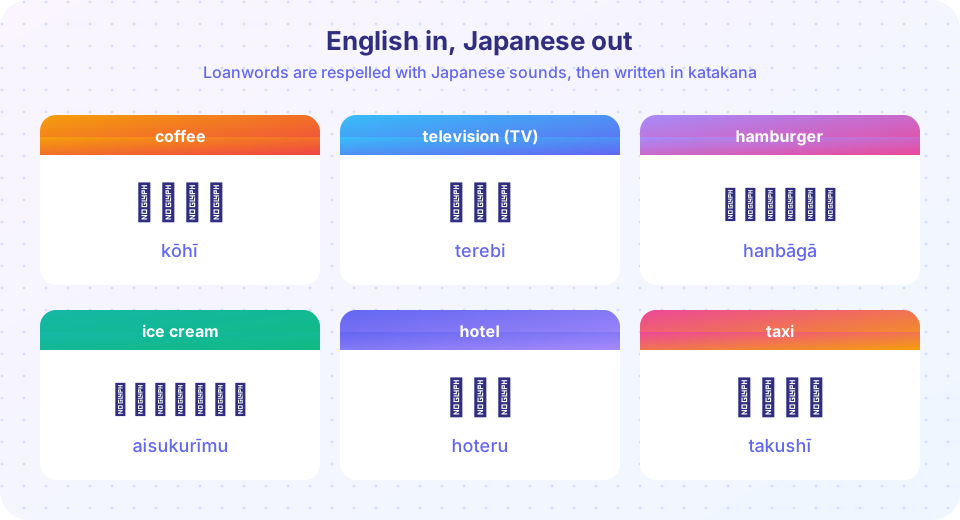
You can now read all 46 katakana. This lesson shows you how to use them. Katakana is the Japanese way to bring foreign words into the language, and the process follows rules you can learn. Once you know the rules, you can guess what an unknown katakana word means just by sounding it out, and you can write foreign names and new words correctly.
The central idea is that Japanese has fewer sounds than English and a much stricter syllable shape. Nearly every beat is a consonant plus a vowel. So when a word such as strike arrives, it has to be reshaped to fit: ストライク (sutoraiku). Three beats become six. Reading loanwords is a game of hearing the English word hidden inside the Japanese one.
What you will learn
- the main rules for turning foreign words into katakana
- the extra katakana combinations for sounds such as ti, fa and wi
- what wasei-eigo (made-in-Japan English) is
- how to write your own name and some country names
- why the ・ dot appears in foreign names
Key terms
Gairaigo (外来語): a loanword, usually written in katakana.
Wasei-eigo (和製英語): words that look English but were made in Japan.
Nakaguro (中黒, ・): the middle dot used between parts of a foreign name or between listed items.
Extended katakana: combinations such as ティ and ファ that write foreign sounds.
The rules of adaptation
Every borrowed word is filtered through the Japanese sound system. These rules explain most of what you see.
- Every consonant gets a vowel. Japanese words do not end in consonants (except ん) and do not have clusters. English street becomes ストリート (sutorīto). The default vowel is u (ス, ク, ブ, ド, グ), but after t and d it is o (ト, ド), and after ch and j it is i (チ, ジ).
- A short vowel before a final stop gets a small ッ. Cup is カップ (kappu), bed is ベッド (beddo), bag is バッグ (baggu), bus is バス (basu), with a plain sound because the final s is not a stop.
- L and R merge. Both become the ラ row. Light and right are both ライト (raito). The Japanese ラ row is a tap, so English speakers hear a mix of l, r and d.
- V is usually B. Video is ビデオ (bideo), violin is バイオリン (baiorin). A rare ヴ exists, but it is mostly decorative.
- TH becomes S or Z. Think resembles シンク and three is スリー (surī).
- Long vowels come from stressed English vowels. Stressed ee, oo and ar sounds get a ー: ビール (bīru, beer), スーパー (sūpā, supermarket), パーティー (pātī, party).
- Short words are often shortened further. パソコン (pasokon) is personal computer; コンビニ (konbini) is convenience store; スマホ (sumaho) is smartphone. Japanese loves four-beat abbreviations.
Reading with these rules in mind: テーブル becomes tēburu, table; ドア doa, door; アパート apāto, apartment; ノート nōto, notebook; ストライク sutoraiku, strike.
Extra katakana for foreign sounds
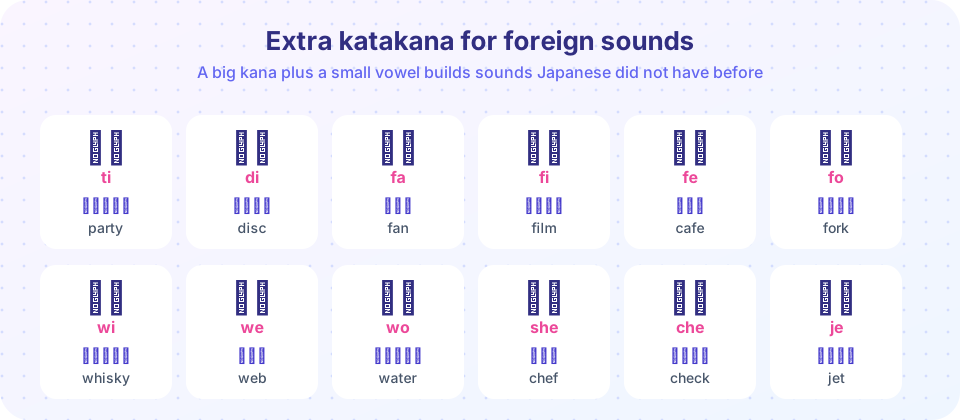
Traditional Japanese has no ti, di, fa or wi, so katakana invented combinations of a normal kana plus a small vowel. They are not part of the basic 46, but you will read them every day.
| Kana | Sound | Example | Meaning |
|---|---|---|---|
| ティ | ti | パーティー (pātī) | party |
| ディ | di | ディスク (disuku) | disc |
| ファ | fa | ファン (fan) | fan (supporter) |
| フィ | fi | フィルム (firumu) | film |
| フェ | fe | カフェ (kafe) | café |
| フォ | fo | フォーク (fōku) | fork |
| ウィ | wi | ウィスキー (wisukī) | whisky |
| ウェ | we | ウェブ (webu) | the web |
| ウォ | wo | ウォーター (wōtā) | water |
| シェ | she | シェフ (shefu) | chef |
| チェ | che | チェック (chekku) | check |
| ジェ | je | ジェット (jetto) | jet |
Spelling is not always settled. The word Disney is written ディズニー, but video is ビデオ, and some older speakers say パーティ with a shorter vowel. When in doubt, check how a native writer spells the word in a dictionary.
Made-in-Japan English (wasei-eigo)
Some Japanese katakana words look English but are not used that way in English. Learning them will save you embarrassment.
| Katakana | Romaji | Means in Japanese | English word |
|---|---|---|---|
| サラリーマン | sararīman | office worker (usually male) | salaried employee |
| マンション | manshon | a condominium or apartment | not a mansion |
| コンセント | konsento | electrical outlet | outlet or socket |
| ガソリンスタンド | gasorin sutando | gas station | gas stand |
| ノートパソコン | nōto pasokon | laptop | notebook PC |
| クーラー | kūrā | air conditioner | cooler |
| ホッチキス | hotchikisu | stapler | from a brand name, Hotchkiss |
| アルバイト | arubaito | part-time job | from German Arbeit |
Not every loanword is English. ビール (beer) came from Dutch, パン (bread) from Portuguese, アルバイト from German and ズボン (zubon, trousers) from French jupon. Katakana is the universal door for words from anywhere.
Names and countries
Foreign personal names are written in katakana by sound: マイク (Maiku, Mike), リサ (Risa, Lisa), ジョン (Jon, John), エマ (Ema, Emma), サラ (Sara, Sarah), トム (Tomu, Tom), アレックス (Arekkusu, Alex), デビッド (Debiddo, David). When both given and family names appear, a middle dot (・) separates them: ジョン・スミス (Jon Sumisu, John Smith). Choose the spelling that matches the sound of your name in your own language, not its English spelling, and ask a Japanese speaker to check it.
Country names follow the same rule: アメリカ (Amerika, USA), イギリス (Igirisu, UK), カナダ (Kanada), オーストラリア (Ōsutoraria, Australia), ブラジル (Burajiru), インド (Indo, India), ドイツ (Doitsu, Germany), フランス (Furansu, France), スペイン (Supein), イタリア (Itaria), メキシコ (Mekishiko), ロシア (Roshia). A few countries, such as 日本 (Nihon, Japan) and 中国 (Chūgoku, China), use kanji, and you will meet those in chapter 7.
Decoding an unknown katakana word
Faced with a word you have never seen, apply these four steps:
- Say it quickly, with the beats running together. ストレス becomes sutoresu.
- Undo the added vowels. Strip out the extra u and o: s-t-r-e-s-s.
- Think of English (and of other languages). The word "stress" appears.
- Check the context. A sentence about work and tiredness confirms it.
Try the method on インターネット (intānetto) and コンピューター (konpyūtā). Remove the extra vowels and the long-vowel stretches and you hear "internet" and "computer". Practice a few a day and you will recognise whole words at a glance.
Shortened words
Japanese loves to clip long loanwords to four beats. パソコン is personal computer, コンビニ is convenience store, スマホ is smartphone, エアコン is air conditioner, リモコン is remote control and デパート is department store. Some abbreviations are not even recognisable as English: アニメ (anime, from "animation") and マスコミ (masukomi, "mass communication") became Japanese words in their own right. Do not guess meanings from the English alone; when a katakana word looks odd, check it in a dictionary.
Pronouncing loanwords like a native
Resist the urge to pronounce katakana words with English stress. ホテル is ho-te-ru with three even beats and a slight rise on the first beat, not HO-tel. Give every beat the same length and keep vowels pure, and do not reduce an unstressed vowel to a weak "uh". Short, clear beats are the heart of Japanese rhythm. Native speakers will understand an English-style stress, but a Japanese-style pronunciation of a loanword will sound far more natural.
Katakana for animals and plants
Katakana has another, quieter use: the names of animals, plants and foods in scientific or technical writing. The everyday word for "cat" is ねこ in hiragana or 猫 in kanji, but a biology book may write ネコ, and a field guide may write サクラ for cherry trees, to mark the word as a species name rather than an everyday word. You do not need to memorize this convention. Simply remember that if you see an ordinary word suddenly written in katakana, it is probably being used for emphasis, for a technical label or as a brand name.
Common misconceptions
"Japanese loanwords are mispronounced English." They are English words adapted to Japanese phonology. Japanese speakers pronounce them as Japanese words.
"If it is in katakana, it means the same as the English word." Many do, but wasei-eigo such as マンション and コンセント do not.
"You can spell a name any way you like." Names have conventions (ティ, ファ and ー), and a name spelled by sound looks natural to Japanese readers.
Try it
First, a tool that converts romaji (in Japanese-style spelling) into katakana. It applies the rules above: doubled consonants become ッ, repeated vowels become ー, and the extended sounds are included. Try typing koohii, paatii, chekku or your own name written as Japanese sounds (for example maiku).
Press Run (or Ctrl + Enter) to see the console output here.
No output.
Second, a matching game. An English word appears; choose its katakana form from three choices.
Check your understanding
Quick check · 5 questions
of 5 answered You scored / 5 · perfect!
-
1. Why does the English word "strike" become ストライク?
Japanese syllables are consonant plus vowel, so extra vowels fill the clusters: su-to-ra-i-ku. -
2. Which katakana writes the sound "fa"?
フ plus a small ァ makes ファ, as in ファン (fan). -
3. What does マンション mean in Japanese?
マンション is wasei-eigo: it means a condo or apartment, not a mansion. -
4. What does the small ッ do in カップ?
The small ッ is a silent beat before the p: kappu. -
5. Which dot separates John and Smith in ジョン・スミス?
The middle dot (nakaguro) separates the parts of a foreign name.
Summary
- Loanwords get a vowel after every consonant (u by default, o after t and d, i after ch and j).
- A small ッ doubles a consonant after a short vowel (カップ), and ー lengthens stressed vowels (パーティー).
- L and R merge into the ラ row, v is usually b, and th becomes s.
- Extended katakana (ティ, ファ, フォ, ウィ, シェ, チェ, ジェ) write foreign sounds.
- Wasei-eigo looks like English but means something else (マンション, コンセント).
- Names are written by sound, with ・ between name parts.
Track your progress
Create a free account to tick off lessons and pick up where you left off on any device.
of Japanese for Beginners lessons completed