


















Lesson 7 of 50 · Sounds and Hiragana
Hiragana 1: vowels and the K, S, T rows
Learn the first 20 hiragana: the vowels and the K, S and T rows. Charts, stroke-order rules, lookalikes, real words and practice quizzes for beginners.
Now you start reading. In this lesson you learn the first 20 hiragana: the five vowels and the three consonant rows K, S and T. That is already enough for words such as あさ (asa, morning), さくら (sakura, cherry blossom) and くつ (kutsu, shoes). Hiragana is the foundation of written Japanese. Every other script rests on it, since grammar words and word endings are written in hiragana, and learners of all ages use hiragana to look up kanji.
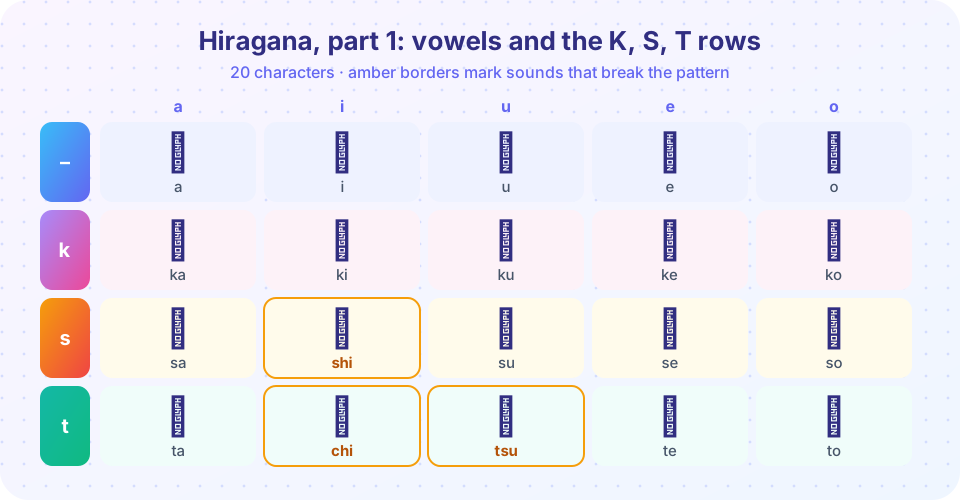
Hiragana has a logic that makes it easier than it looks. The table is a grid. Down the left are consonants, across the top are the five vowels (a, i, u, e, o), and every cell is a consonant plus a vowel. Learn a row's pattern and the five characters follow one sound rule.
What you will learn
- the five vowel characters and the K, S and T rows
- the three irregular sounds し, ち and つ
- the basic rules of stroke order
- how to avoid the most common lookalike mistakes
- how to read about 15 real words
Key terms
Gojūon (五十音): the "fifty sounds" table, the traditional grid of kana.
Stroke order (書き順, kakijun): the standard sequence and direction for drawing a character.
Row (行, gyō): one consonant group, such as the K row か き く け こ.
Man'yōgana: the old practice of using kanji for their sound, from which the kana evolved.
The vowels あいうえお
The five vowels start the table. Here they are with their stroke counts and the kanji each one grew from. If a shape does not stick, invent your own picture for it: odd, personal images are remembered best.
| Kana | Sound | Strokes | Comes from |
|---|---|---|---|
| あ | a | 3 | 安 |
| い | i | 2 | 以 |
| う | u | 2 | 宇 |
| え | e | 2 | 衣 |
| お | o | 3 | 於 |
The K, S and T rows
Each row follows the same pattern, with the consonant before each vowel.
K row: か ka, き ki, く ku, け ke, こ ko. S row: さ sa, し shi, す su, せ se, そ so. T row: た ta, ち chi, つ tsu, て te, と to.
The three amber cells are irregular because they follow the historical Japanese sound change, not the pattern: し is shi, not si, ち is chi, not ti, and つ is tsu, not tu. The kana table was designed around ancient pronunciation, and in modern speech those three sounds shifted. Romaji written the Japanese Kunrei way uses si, ti and tu, but the Hepburn system, which this course uses, writes what you hear: shi, chi, tsu.
Here is where each character comes from, which also explains its shape. Hiragana evolved from fast, cursive handwriting of kanji used for their sound.
| Kana | From kanji | Kana | From kanji | Kana | From kanji | Kana | From kanji |
|---|---|---|---|---|---|---|---|
| あ | 安 | か | 加 | さ | 左 | た | 太 |
| い | 以 | き | 幾 | し | 之 | ち | 知 |
| う | 宇 | く | 久 | す | 寸 | つ | 川 |
| え | 衣 | け | 計 | せ | 世 | て | 天 |
| お | 於 | こ | 己 | そ | 曽 | と | 止 |
You do not need to memorize this table. But it shows that kana are not random scribbles: し, for example, is a smoothed-out 之. Looking up the source kanji sometimes helps a stubborn character stick.
How to write them: stroke order
Hiragana has a standard stroke order and direction for every character. The conventions are the same ones used for kanji, and they are worth learning now because they apply to every character you will ever write.
- Top to bottom. Draw higher strokes before lower ones.
- Left to right. Draw left strokes before right ones.
- Horizontal before vertical when strokes cross.
- Outside before inside for enclosed shapes, and the closing stroke last.
- A long, smooth curve is one stroke. Lifting the pen is a new stroke.
Some counts are worth knowing so your characters look right: あ, お, か, け and せ use 3 strokes; い, う, え, こ, す, ち and と use 2; く, し, そ, つ and て use 1. Some characters, notably き and さ, are printed with their strokes joined in some fonts and separated in others, so you may see both a connected and a separate form. Textbooks teach the separated handwriting form. In a connected form the character is the same; only the pen lifts change.
Write each new kana ten times, saying the sound aloud, then write it once from memory. Do not worry about beauty. Clean proportions and the right stroke order matter more.
Real words with these 20 kana
Reading real words keeps motivation high. Say each word aloud, then check it against the romaji.
| Word | Romaji | Meaning |
|---|---|---|
| あさ | asa | morning |
| いえ | ie | house |
| うえ | ue | above, up |
| あおい | aoi | blue |
| かお | kao | face |
| こえ | koe | voice |
| さけ | sake | rice wine |
| すし | sushi | sushi |
| せかい | sekai | world |
| たこ | tako | octopus |
| ちかい | chikai | near |
| つき | tsuki | moon |
| とけい | tokei | clock, watch |
| くつ | kutsu | shoes |
| さくら | sakura | cherry blossom |
| あいさつ | aisatsu | greeting |
Note that け followed by い, as in せかい and とけい, is simply two beats: ke then i. Long vowels and small kana appear later. Do not be surprised that こえ is read ko-e and not "koy": every vowel is its own beat.
Lookalikes and how to tell them apart
Some pairs trip up almost every learner. Compare them side by side while practising.
- さ and き: both have a crossbar. さ has one crossbar; き has two.
- こ and に: こ is two horizontal lines; に has a vertical stroke on the left, which comes later in lesson 4.
- く and し: く is a sharp angle that points left; し is a smooth hook that curls to the right.
- い and こ: い has two vertical strokes, こ has two horizontal ones.
- つ and て: つ is one wide curve that ends open, て has a flat top bar.
A three-day plan for the first 20
Learning 20 characters in one day is neither realistic nor necessary. Spreading them over three days, with built-in repetition, is what turns short-term recognition into long-term memory.
Day 1: the vowels and the K row (10 characters). Spend the first ten minutes on あ, い, う, え, お: look at each one, say it aloud and write it five times. Then do the same for か, き, く, け, こ. Finish by reading the words あい (ai, love), いえ and かお, and by taking the quiz above in the "random" order. Do not stop until you reach about 80 percent correct.
Day 2: the S and T rows (10 characters). Begin with five minutes of review of day 1 before you add anything. Then learn さ, し, す, せ, そ and た, ち, つ, て, と, paying special attention to the three irregular sounds. Read すし, せかい, つき, とけい and くつ aloud.
Day 3: consolidate. Mix all 20 characters. Write five words from memory (あさ, さけ, たこ, つき, くつ), then check them. Any character you hesitate on goes onto your "tomorrow" list, along with the next lesson's new characters.
How to practise a single character
A short routine works better than copying a character twenty times mindlessly:
- Look at the model for a few seconds. Notice where strokes start and end and how long each one is.
- Trace the stroke order in the air with your finger while saying the sound.
- Write it large, once or twice, slowly and carefully.
- Write it small, five times in a row, at normal speed.
- Cover the model and write it from memory. Compare, then fix any difference.
Step 5 is the one that matters most. Recalling a character from nothing is much harder than copying it, and that effort is exactly what makes memory stick. If you cannot recall it, look again and repeat from step 1.
Kana in the wild
Once you know these 20 characters, you start to see them everywhere. The word さけ (sake) appears on bottles of rice wine, すし on restaurant signs and とけい on watch shop windows. The sound of the first line of the K, S and T rows also underlies many names: Kaori, Sakura, Takeshi and Tsukasa all begin with sounds from today's rows. Do not worry that you cannot read every character on a sign yet. Finding the ones you can read is a powerful motivator, and each real-world sighting is a free review session.
Common misconceptions
"し is si." It is shi. Writing si in romaji will make learners pronounce it wrongly.
"The final vowel of ち is a long ee." It is the same short vowel as any other. ち is "chi" with a short i.
"I can learn all 20 in one sitting." Most people forget most of them by the next day. Spread them across three or four days with repetition.
Try it
First, a quiz. A kana appears and you type its romaji. Typing (and not just choosing) forces recall, which builds memory better than recognition alone.
Second, a reading drill in the console. A tiny reader turns hiragana words into romaji using only the 20 characters from this lesson, which shows you that reading is simply looking up each beat. Add your own words to the list (for example ここ, そこ or あそこ).
Press Run (or Ctrl + Enter) to see the console output here.
No output.
Check your understanding
Quick check · 5 questions
of 5 answered You scored / 5 · perfect!
-
1. How is し read in Hepburn romaji?
し is shi, with a clear sh sound. The same applies to ち (chi) and つ (tsu). -
2. Which character is read tsu?
つ is tsu. て is te and と is to. -
3. What does さくら mean?
さくら (sakura) is the cherry blossom. くつ is shoes and あさ is morning. -
4. Which stroke-order rule is correct?
Strokes generally go from top to bottom and from left to right. -
5. How many beats does あいさつ have?
あ, い, さ, つ: four kana, four beats.
Summary
- The first 20 hiragana are the vowels あ い う え お and the K, S and T rows.
- し, ち and つ are read shi, chi and tsu: the three irregular sounds.
- Draw strokes top to bottom and left to right, and crossing horizontals before verticals.
- Lookalikes such as さ and き need side-by-side practice.
- Reading real words (あさ, さくら, とけい) shows that kana are beats, one by one.
Track your progress
Create a free account to tick off lessons and pick up where you left off on any device.
of Japanese for Beginners lessons completed