


















Lesson 30 of 50 · Past and Te-form
Chapter 6 overview: the past tense and the te-form
A map of chapter 6: talk about yesterday with the polite past tense, then learn the te-form, the most useful verb form for requests, ongoing actions and sequences.
So far almost everything you have said has been in the present or the future, which Japanese treats as one tense (the "non-past"). In this chapter you add two big tools. The first is the past tense: talking about yesterday, last weekend and what you ate for lunch. The second is the te-form (て形, te-kei), a verb form with no tense of its own that works like a connector. If the polite ます form is the foundation of beginner Japanese, the te-form is the first floor, because with it you can make requests, describe what is happening right now, ask permission, forbid things and chain actions into a story.
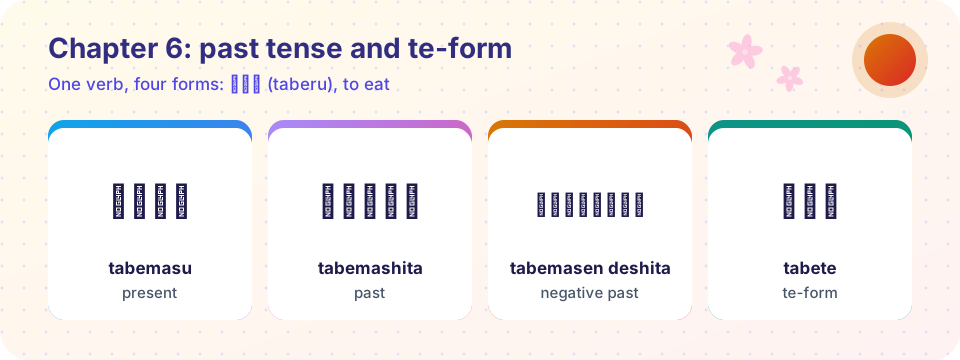
The big picture
The chapter has two parts that fit together neatly.
- Past tense. Verbs, nouns and adjectives each have a polite past form. Verbs are simple (ます becomes ました), nouns use でした, and い-adjectives change their ending to かったです. Negatives work in the same pattern.
- Te-form. Every verb has a te-form, but the way you make it depends on the verb group. You will learn the three groups, a set of ending rules (such as う, つ, る becoming って), and then the six most important patterns that use it.
Chapter 6 at a glance
Polite past
Verb groups
What te-form does
What each lesson covers
- The polite past tense: verbs, nouns, い-adjectives and な-adjectives, positive and negative, with time words like きのう (yesterday) and せんしゅう (last week).
- Forming the te-form: the three verb groups, the ending rules and a conjugator you can run.
- Using the te-form: requests, ongoing actions, permission, prohibition, sequences and joining adjectives.
- Chapter 6 review: a recap table, a practice text and ten mixed questions.
Why the te-form matters
You can say a lot with just the polite present and past. But as soon as you want to be polite and natural, you will need to ask people to do something ("Please wait"), say that something is in progress ("I am studying"), or describe a sequence ("I woke up, ate breakfast and left"). Each of these uses the te-form. Japanese learners often say that learning to make the te-form fluently, without stopping to think, is the moment when conversation starts to flow, because the form appears in so many patterns that you cannot avoid it.
The te-form also opens the door to later grammar. The casual past form (ta-form, たべた) is built the same way, so if you can make the te-form you already know the casual past. Plain-form patterns like "I have eaten" and "while eating" build on the same endings. Time spent on this chapter pays back for a long time.
A course cannot replace speaking with people. The te-form changes (って, んで, いて) are easier to hear than to read, so listen to a native speaker saying かって, よんで and かいて and repeat them until your mouth stops hesitating.
How to study this chapter
- Learn the past tense in one sitting. The patterns are regular, and the polite past is short. Turn the dialogue answers into past tense yourself.
- Memorize the te-form by ending. Write the six Group 1 endings on a card: う/つ/る, む/ぶ/ぬ, く, ぐ, す, and the special case いく. Run the conjugator with your own verbs.
- Build sentences, not tables. For each pattern, write three personal sentences (for example, a request to a friend, something you are doing now, and a rule at your school).
Check your understanding
Quick check · 3 questions
of 3 answered You scored / 3 · perfect!
-
1. Which form do you use to talk about yesterday politely?
ました is the polite past ending. -
2. Which of these is NOT a use of the te-form?
Topics are marked by the particle は. The te-form handles requests, ongoing actions, permission and sequences. -
3. How many verb groups does Japanese have in this course?
Group 1 (u-verbs), Group 2 (ru-verbs) and Group 3 (する and くる).
Summary
- Chapter 6 adds the polite past tense and the te-form.
- The te-form makes requests, ongoing actions, permission, prohibition and sequences.
- Group 1, Group 2 and Group 3 verbs form the te-form differently.
- The casual past (ta-form) is built the same way, so these rules pay back later.
Next: The polite past tense
Track your progress
Create a free account to tick off lessons and pick up where you left off on any device.
of Japanese for Beginners lessons completed