


















Lesson 48 of 50 · Projects and Practice
Glossary: words, phrases and terms from chapters 5 to 8
A glossary of the Japanese words, counters, question words, phrases, kanji and grammar terms from chapters 5 to 8, with readings, romaji and meanings.
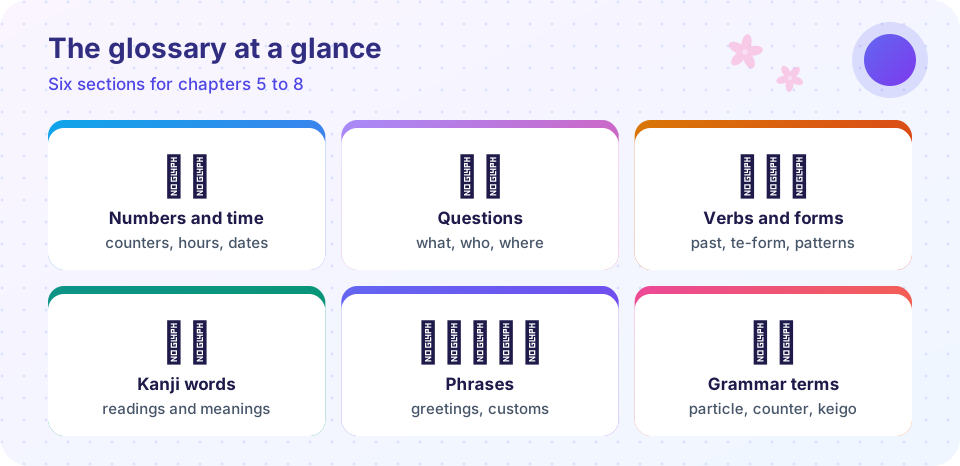
This glossary collects the vocabulary and terms from chapters 5 to 8, organized by topic so that you can find a word when you forget it, and so that you can review a whole topic at once. Each entry gives the Japanese, the reading in romaji, and the meaning. Use it with the flashcards at the end of the page, and remember that a glossary is for checking and revising: new words stick best when you meet them in sentences.
What you will learn
- Find the reading and meaning of the key words of chapters 5 to 8.
- Review vocabulary by topic.
- Recognize the Japanese and English names of the grammar terms.
- Use flashcards to review a random selection.
Key terms
Glossary: an alphabetical or topical list of terms with short definitions.
Romaji (ローマじ): the Latin-letter spelling of Japanese, used here in the Hepburn style.
Reading (よみ): how a word is pronounced; important for kanji.
Entry: one word with its meaning.
Lesson cluster: a group of words taught together.
Numbers and counting
| Japanese | Romaji | Meaning |
|---|---|---|
| ゼロ / れい | zero / rei | zero |
| いち, に, さん | ichi, ni, san | one, two, three |
| よん / し | yon / shi | four |
| ご, ろく | go, roku | five, six |
| なな / しち | nana / shichi | seven |
| はち | hachi | eight |
| きゅう / く | kyuu / ku | nine |
| じゅう | juu | ten |
| ひゃく | hyaku | hundred |
| せん | sen | thousand |
| まん | man | ten thousand |
| えん | en | yen |
| ひとつ, ふたつ, みっつ | hitotsu, futatsu, mittsu | one, two, three (things) |
| よっつ, いつつ | yottsu, itsutsu | four, five (things) |
| むっつ, ななつ, やっつ | muttsu, nanatsu, yattsu | six, seven, eight (things) |
| ここのつ, とお | kokonotsu, too | nine, ten (things) |
| ひとり, ふたり | hitori, futari | one person, two people |
| 〜にん | nin | counter for people |
| 〜まい | mai | counter for flat things |
| 〜ほん | hon | counter for long things |
| 〜ひき | hiki | counter for small animals |
| 〜こ | ko | counter for small objects |
| 〜さつ | satsu | counter for books |
| 〜さい | sai | years of age |
| はたち | hatachi | twenty years old |
Time and dates
| Japanese | Romaji | Meaning |
|---|---|---|
| 〜じ | ji | o'clock |
| よじ, しちじ, くじ | yoji, shichiji, kuji | 4:00, 7:00, 9:00 |
| 〜ふん / 〜ぷん | fun / pun | minutes |
| はん | han | half past |
| ごぜん / ごご | gozen / gogo | a.m. / p.m. |
| 〜ようび | youbi | day of the week |
| げつ, か, すい, もく, きん, ど, にち | getsu, ka, sui, moku, kin, do, nichi | Monday to Sunday (before ようび) |
| 〜がつ | gatsu | month |
| 〜にち | nichi | day of the month |
| ついたち | tsuitachi | the 1st |
| ふつか, みっか, よっか | futsuka, mikka, yokka | the 2nd, 3rd, 4th |
| はつか | hatsuka | the 20th |
| きょう | kyou | today |
| あした | ashita | tomorrow |
| きのう | kinou | yesterday |
| まいにち | mainichi | every day |
| こんしゅう, らいしゅう, せんしゅう | konshuu, raishuu, senshuu | this, next, last week |
| ことし | kotoshi | this year |
| いま | ima | now |
| 〜ごろ | goro | around (a time) |
| 〜から 〜まで | kara made | from ... until ... |
Question words
| Japanese | Romaji | Meaning |
|---|---|---|
| なに / なん | nani / nan | what |
| だれ | dare | who |
| どこ | doko | where |
| いつ | itsu | when |
| どれ | dore | which one (of three or more) |
| どの + noun | dono | which (noun) |
| どう | dou | how |
| どんな + noun | donna | what kind of |
| どうして / なぜ | doushite / naze | why |
| いくら | ikura | how much |
| いくつ | ikutsu | how many (things), how old |
| か | ka | question particle |
| ね | ne | sentence-final: isn't it? |
| よ | yo | sentence-final: you know |
| はい / いいえ | hai / iie | yes / no |
Verbs, forms and linking words
| Japanese | Romaji | Meaning |
|---|---|---|
| 〜ました | mashita | polite past (verb) |
| 〜ませんでした | masen deshita | polite negative past (verb) |
| 〜でした | deshita | past of です |
| 〜じゃありませんでした | ja arimasen deshita | negative past of です |
| 〜かったです | katta desu | past of an い-adjective |
| 〜くなかったです | kunakatta desu | negative past of an い-adjective |
| 〜て | te | te-form, linking form |
| 〜てください | te kudasai | please do ... |
| 〜ています | te imasu | is doing; state |
| 〜てもいいです | te mo ii desu | it is okay to ... |
| 〜てはいけません | te wa ikemasen | must not ... |
| 〜てから | te kara | after doing ... |
| 〜たいです | tai desu | want to ... |
| 〜から | kara | because; from |
| そして | soshite | and, and then |
| それから | sorekara | after that |
| でも | demo | but |
| だから | dakara | so |
| まだ | mada | not yet; still |
| ください | kudasai | please give me |
| おねがいします | onegai shimasu | I would like ... please |
Everyday verbs (dictionary form)
| Japanese | Romaji | Meaning |
|---|---|---|
| たべる (食べる) | taberu | eat |
| のむ (飲む) | nomu | drink |
| みる (見る) | miru | see, watch |
| いく (行く) | iku | go |
| くる (来る) | kuru | come |
| でる (出る) | deru | go out |
| はいる (入る) | hairu | enter |
| はなす (話す) | hanasu | speak |
| きく (聞く) | kiku | listen, ask |
| よむ (読む) | yomu | read |
| かく (書く) | kaku | write |
| かう (買う) | kau | buy |
| あう (会う) | au | meet |
| やすむ (休む) | yasumu | rest |
| まつ | matsu | wait |
| かえる | kaeru | return home |
| おきる | okiru | get up |
| ねる | neru | sleep |
| する | suru | do |
Kanji words
| Japanese | Reading | Meaning |
|---|---|---|
| 日本 | にほん (nihon) | Japan |
| 日本語 | にほんご (nihongo) | Japanese language |
| 学校 | がっこう (gakkou) | school |
| 学生 | がくせい (gakusei) | student |
| 先生 | せんせい (sensei) | teacher |
| 友達 | ともだち (tomodachi) | friend |
| 毎日 | まいにち (mainichi) | every day |
| 今日 | きょう (kyou) | today |
| 駅 | えき (eki) | station |
| 電車 | でんしゃ (densha) | train |
| 電話 | でんわ (denwa) | telephone |
| 出口 | でぐち (deguchi) | exit |
| 入口 | いりぐち (iriguchi) | entrance |
| 水曜日 | すいようび (suiyoubi) | Wednesday |
| 新聞 | しんぶん (shinbun) | newspaper |
| 会社 | かいしゃ (kaisha) | company |
| 右 / 左 | みぎ / ひだり (migi / hidari) | right / left |
| 上 / 下 | うえ / した (ue / shita) | above / below |
| 前 / 後 | まえ / うしろ (mae / ushiro) | front / behind |
Phrases and customs
| Japanese | Romaji | Meaning |
|---|---|---|
| おはようございます | ohayou gozaimasu | good morning |
| こんにちは | konnichiwa | hello |
| こんばんは | konbanwa | good evening |
| おやすみなさい | oyasumi nasai | good night |
| ありがとうございます | arigatou gozaimasu | thank you |
| どういたしまして | dou itashimashite | you are welcome |
| すみません | sumimasen | excuse me; sorry; thanks |
| ごめんなさい | gomen nasai | I am sorry |
| はじめまして | hajimemashite | nice to meet you |
| よろしくおねがいします | yoroshiku onegai shimasu | please treat me well |
| いただきます | itadakimasu | before eating |
| ごちそうさまでした | gochisousama deshita | after eating |
| いってきます / いってらっしゃい | itte kimasu / itterasshai | leaving home / reply |
| ただいま / おかえりなさい | tadaima / okaeri nasai | back home / reply |
| おじゃまします | ojama shimasu | excuse me for entering |
| おつかれさまです | otsukaresama desu | thanks for your work |
| いらっしゃいませ | irasshaimase | welcome (shops) |
| かんぱい | kanpai | cheers |
| おみやげ | omiyage | souvenir |
| げんかん | genkan | entrance hall |
Grammar terms
| Term | Japanese | Meaning |
|---|---|---|
| particle | 助詞 (joshi) | small word marking a role: は, を, に, で |
| counter | 助数詞 (josuushi) | word used to count: 人, 本, 枚 |
| dictionary form | 辞書形 (jishokei) | basic form of a verb: たべる |
| te-form | て形 (te-kei) | linking form: たべて |
| ta-form | た形 (ta-kei) | casual past: たべた |
| polite style | 丁寧語 (teineigo) | です/ます style |
| honorific language | 敬語 (keigo) | respectful and humble speech |
| okurigana | 送り仮名 | kana tail after a kanji |
| on'yomi | 音読み | Chinese-derived reading |
| kun'yomi | 訓読み | native Japanese reading |
| furigana | ふりがな | small kana above kanji |
| aizuchi | あいづち | listening responses |
How to study this vocabulary
A list of words is only a starting point. Memory works best when each word is connected to something: a sentence, a picture, a sound, or another word you already know. These five habits turn a glossary into knowledge.
Learn in word families. Many Japanese words share a kanji, and once you know the kanji, the family is easier to remember. The table groups some of the words in this glossary by the character they share.
| Shared kanji | Words |
|---|---|
| 学 (study) | 学校 がっこう (school), 学生 がくせい (student), 大学 だいがく (university) |
| 日 (sun, day) | 日本 にほん (Japan), 日曜日 にちようび (Sunday), 毎日 まいにち (every day), 今日 きょう (today) |
| 電 (electricity) | 電車 でんしゃ (train), 電話 でんわ (telephone) |
| 口 (mouth, opening) | 出口 でぐち (exit), 入口 いりぐち (entrance) |
| 先 (ahead, previous) | 先生 せんせい (teacher), 先週 せんしゅう (last week) |
Use the words in sentences. After you meet a word in the glossary, write a short sentence of your own with it. A sentence such as 学校で ともだちに あいました (Gakkou de tomodachi ni aimashita), "I met a friend at school," practices the word, a particle and the past tense at once. Write the sentence about something that really happened to you, because personal sentences are easier to remember.
Review at growing intervals. Look at a new word again after a day, then after three days, then after a week, and then after a month. If you forget a word, move it back to the daily pile. A flashcard app can do the scheduling for you, but a stack of paper cards in a box works as well.
Say it aloud. Read the Japanese and the romaji aloud, then cover the meaning and say it in English, and then cover the Japanese and say it from the English. Because the language has even rhythm, try to give every kana the same length, and pause for the small っ as one silent beat: ろっぴゃく (rop-pya-ku), いっぽん (ip-pon).
Keep a personal glossary. The lists here come from the lessons, but your needs are your own. Add the words you actually need: the name of your job, your city, your favorite food. A personal word list with sentences that belong to you is worth more than any ready-made list.
Finally, remember the difference between recognizing a word and producing it. You may recognize みぎ when you read it and still fail to remember it when you need to say "right." Practice both directions, and test production often, because that is the skill you need in a conversation.
Try it
The first tool is a searchable glossary: type part of a word, reading, or English meaning to filter the list.
The second tool prints a random review set from the glossary, so you can test yourself in the console. Change the seed or the size.
Press Run (or Ctrl + Enter) to see the result here.
Program input · what you'd type while the program runs
Type the answers before you press Run, one per line. Each time the program reads a line (with input()), it gets the next line from this box.
Check your understanding
Quick check · 4 questions
of 4 answered You scored / 4 · perfect!
-
1. What does おじゃまします mean?
It is said when entering someone's home. -
2. What is the meaning of 〜てください?
The te-form plus ください is a polite request. -
3. How is 出口 read?
出口 is でぐち (exit); 入口 is いりぐち. -
4. What does はつか mean?
はつか is the 20th day of the month. Twenty years old is はたち.
Summary
- The glossary groups the words of chapters 5 to 8 by topic.
- Learn words in sentences and use the glossary to check and revise.
- Use the search tool and the random review set for quick review.
- Keep growing your own list; add each new word with a sample sentence.
Next: Cheat sheet
Track your progress
Create a free account to tick off lessons and pick up where you left off on any device.
of Japanese for Beginners lessons completed