


















Lesson 21 of 50 · Verbs and Particles
Particles は, が and を
Learn the three core Japanese particles: は for the topic, が for the subject and を for the object, plus も for also, with verbs, dialogues, drills and common mistakes.
If verbs are the engines of Japanese sentences, particles are the road signs. A particle is a short word, usually one kana, that follows a noun and tells you what job that noun does in the sentence. English has nothing quite like it, because English assigns jobs by word order: in "The dog bites the man", position tells you who bites whom. In Japanese, あのいぬは ひとを かみます and ひとを あのいぬは かみます mean the same thing, because the particles は and を keep the roles clear.
In this lesson you meet the three particles that carry most of the weight, は (topic), が (subject) and を (object), and also も (also), which replaces them when you want to say "too". Mastering these four lets you say who does what, which is the core of nearly every sentence.
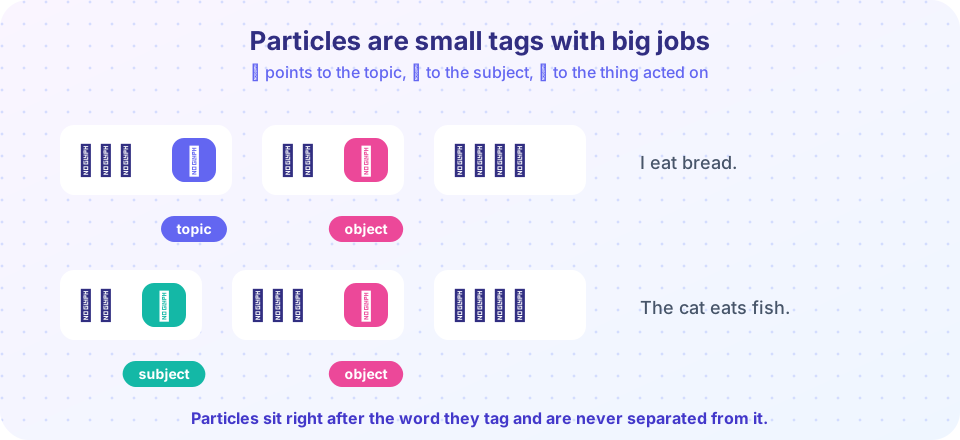
What you will learn
- what は, が and を do and how they differ
- when が is required (question words and new information)
- how to use を with ten everyday verbs
- how も replaces は, が and を
- how to ask "What do you eat?" and answer
Key terms
Topic (は): what the sentence is about, "as for X".
Subject (が): who or what does the action or has the state, especially as new or specific information.
Object (を): the thing the verb acts on.
も: "also, too", used in place of は, が or を.
Question word: なに (what), だれ (who), どこ (where), いつ (when).
は: the topic
You met は in the last chapter: わたしは がくせいです。 It does not mark "the one who does something"; it marks "what we are talking about". After you set a topic, you can say anything about it: the sentence わたしは パンを たべます (Watashi wa pan o tabemasu) is "As for me, (I) eat bread."
Topics are usually things the listener already knows: you, a person both of you know, something just mentioned. That is why は suits introductions and statements of fact. A topic can also be contrasted: パンは たべますが、ごはんは たべません (Pan wa tabemasu ga, gohan wa tabemasen), "Bread, I eat, but rice, I don't." The contrasting は implies "as for this one, but maybe not that one".
Remember: は is pronounced wa as a particle.
を: the object
を marks the thing the verb acts on, the direct object. It follows the noun directly and is read o:
- パンを たべます。 (Pan o tabemasu.) "I eat bread."
- コーヒーを のみます。 (Kōhī o nomimasu.) "I drink coffee."
- テレビを みます。 (Terebi o mimasu.) "I watch TV."
- おんがくを ききます。 (Ongaku o kikimasu.) "I listen to music."
- ほんを よみます。 (Hon o yomimasu.) "I read a book."
- てがみを かきます。 (Tegami o kakimasu.) "I write a letter."
- しんぶんを かいます。 (Shinbun o kaimasu.) "I buy a newspaper."
- にほんごを べんきょうします。 (Nihongo o benkyō shimasu.) "I study Japanese."
- にほんごを はなします。 (Nihongo o hanashimasu.) "I speak Japanese."
- えいがを みます。 (Eiga o mimasu.) "I watch a movie."
When you want to know what the object is, use なに and a question: なにを たべますか。 (Nani o tabemasu ka?) "What do you eat?". Note: なに here, not なん, because を follows. The answer is パンを たべます.
Notice that the subject often disappears: all the sentences above leave out "I". It is understood from context.
が: the subject
が marks the subject of a sentence: the one doing the action or being described. At first it looks like は, and the two do overlap, but they serve different purposes. Three situations call for が:
- After question words. When who, what or which is the subject, が is required: だれが きますか。 (Dare ga kimasu ka?) "Who is coming?" The answer also takes が: たなかさんが きます。 (Tanaka-san ga kimasu.) "Mr. Tanaka is coming." The answer says who, which is the new information.
- New information. When you introduce something new, が fits: ねこが さかなを たべます。 (Neko ga sakana o tabemasu.) "A cat is eating fish." (We were not talking about the cat before.)
- Natural events and states. あめが ふります。 (Ame ga furimasu.) "It rains." (ふる is a Group 2 verb: ふります.) And the verbs and adjectives of liking and ability take が for what is liked: わたしは ねこが すきです。 (Watashi wa neko ga suki desu.) "I like cats."
A handy summary: は = "talking about X", が = "it is X (and not something else)". Compare:
- たなかさんは きます。 "Tanaka comes." (About Tanaka: he is coming.)
- たなかさんが きます。 "Tanaka comes." (It is Tanaka who comes, not someone else.)
Both sentences are about the same event; the emphasis differs. The distinction takes time to feel, so do not worry about perfection now. Start with these rules of thumb and let reading and listening make it natural.
も: "also"
The particle も replaces は, が or を and adds "also". It is a very small word with a big job:
- わたしも がくせいです。 "I am a student too."
- コーヒーも のみます。 "(I) drink coffee as well." (replacing を)
- たなかさんも きます。 "Mr. Tanaka is coming too." (replacing が)
If you would write を, you can write も instead, never both: コーヒーをも is not a normal sentence.
A dialogue
たなか: リサさんは なにを たべますか。 Risa-san wa nani o tabemasu ka. "What are you going to eat, Lisa?"
リサ: わたしは さかなを たべます。たなかさんは? Watashi wa sakana o tabemasu. Tanaka-san wa? "I will eat fish. And you, Mr. Tanaka?"
たなか: わたしも さかなを たべます。おちゃも のみます。 Watashi mo sakana o tabemasu. Ocha mo nomimasu. "I will eat fish too. I will drink tea as well."
Notice that たなか uses も twice: once for the topic ("me too") and once for the object ("tea as well").
Putting it together
A Japanese sentence builds up piece by piece:
- Topic with は (optional).
- Object with を (if the verb takes one).
- Verb in ます form at the end.
The order of the first two can swap, and the topic is often dropped, as in the dialogue.
| Pattern | Example | Meaning |
|---|---|---|
| N は V ます | たなかさんは きます | Tanaka comes |
| N を V ます | パンを たべます | (I) eat bread |
| N は N を V ます | わたしは パンを たべます | I eat bread |
| N が V ます | ねこが たべます | The cat eats |
| N も V ます | リサさんも のみます | Lisa also drinks |
Building a sentence step by step
Suppose you want to say "Lisa drinks coffee." Build it in four moves.
- Pick the verb. Drinking is のむ, a Group 2 verb: のみます.
- Find the object. What is drunk? コーヒー, so it takes を: コーヒーを のみます.
- Add the topic. Who is the sentence about? Lisa, so リサさんは: リサさんは コーヒーを のみます。
- Check the order. Topic, object, verb. The verb is last. Done.
If you want the sentence to say "Lisa also drinks coffee", change は to も. If you want to ask who drinks it, change the topic into a question word with が: だれが コーヒーを のみますか。 Practise this build-and-change routine until it feels automatic, because it is how you will construct almost every sentence for the rest of the course.
は and が in a tiny story
The difference between は and が shows up clearly in a short story where a new character appears and then becomes the topic.
あそこに おんなの ひとが います。 Asoko ni onna no hito ga imasu. "There is a woman over there."
その ひとは リサさんです。 Sono hito wa Risa-san desu. "That person is Lisa."
リサさんは がくせいです。 Risa-san wa gakusei desu. "Lisa is a student."
The first sentence introduces the woman as new information with が. Once she is on stage, she is the topic of the conversation and gets は in the next two sentences. This pattern, new thing with が, known thing with は, appears over and over in stories, news and conversation. If you notice it, you are already reading like a Japanese speaker.
Common misconceptions
"は is the subject marker." は marks the topic. The topic is often the subject too, but not always: パンは わたしが たべます, "As for the bread, I will eat it", has the topic パン and the subject わたし.
"A sentence has one particle." A sentence usually has several, each after its own noun.
"You can use を with たべます only." を goes with any verb that has a direct object.
"I should always use が for the person who acts." In everyday speech は is much more common for people already known in the conversation. が is for new information and question words.
Try it
First, a gap-fill drill. Each sentence has a blank. Choose the correct particle.
Second, a console program that tags the particles in a sentence. It splits a spaced sentence into words and reports the role marked by the final particle. It is a very simple model of how your brain can read Japanese: spot the particle, know the role.
Press Run (or Ctrl + Enter) to see the console output here.
No output.
Check your understanding
Quick check · 6 questions
of 6 answered You scored / 6 · perfect!
-
1. Which particle marks the object of the verb?
を marks the direct object (the thing the verb acts on), pronounced o. -
2. Which sentence is correct for "Who is coming?"?
A question word that is the subject takes が. -
3. What does おちゃも のみます mean?
も replaces を and adds "also": I drink tea too. -
4. Which sentence means "I read a book"?
ほん is the object of よみます, marked by を. -
5. How do you ask "What do you eat?"?
なに is the "what" word before を; なん is used before です, の and counters. -
6. What is the best summary of the difference between は and が?
は sets the topic; が identifies the subject and is required after question words.
Summary
- は marks the topic (read wa), を marks the object (read o), が marks the subject, and も adds "also".
- が is required when a question word is the subject and for new or specific information.
- A sentence builds up as topic, object, verb, with the verb last.
- Use なにを for "what" as an object and だれが for "who" as a subject.
Track your progress
Create a free account to tick off lessons and pick up where you left off on any device.
of Japanese for Beginners lessons completed