


















Lesson 49 of 50 · Projects and Practice
Cheat sheet: chapters 5 to 8 on one page
A one-page Japanese cheat sheet for chapters 5 to 8: irregular numbers and time words, question words, past tense, te-form rules, kanji readings and key phrases.
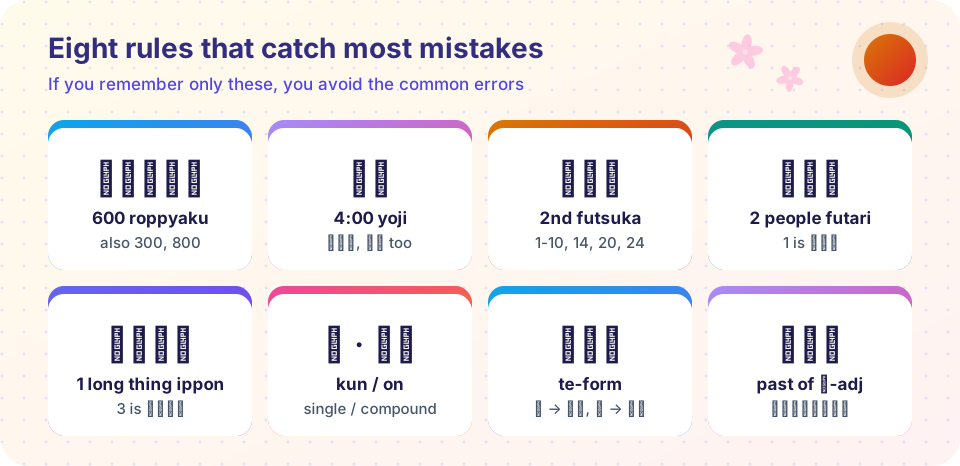
A cheat sheet is not a substitute for learning, but it is a good way to hold the whole structure in your head at once. This page gathers the rules and the irregular items from chapters 5 to 8 into compact tables. Print it, put it next to your desk, and use it for quick checks while you write or practice. Everything here was taught in detail in the earlier lessons, so follow the links if a line is unclear.
What you will learn
- Recall the irregular numbers, times and counters.
- Apply the past and te-form rules from a single table.
- Use the kanji rule of thumb and the key phrases.
- Find the right lesson to review for any error.
Key terms
Irregular: an item that does not follow the general pattern and must be memorized.
Sound change: a change in the first sound of a word after another word: ひゃく to びゃく or ぴゃく.
Ending rule: a rule that tells you what to do with the last kana of a verb.
Rule of thumb: a guide that works most of the time.
Cheat sheet: a short summary for quick reference.
Numbers and counters
| Item | Rule | Memorize |
|---|---|---|
| Hundreds | change after 3, 6, 8 | さんびゃく, ろっぴゃく, はっぴゃく |
| Thousands | change after 3, 8 | さんぜん, はっせん |
| Ten thousand | needs いち | いちまん, じゅうまん, ひゃくまん |
| 4, 7, 9 | defaults | よん, なな, きゅう |
| People | 1 and 2 irregular | ひとり, ふたり; さんにん, よにん |
| Long things 本 | 1, 6, 8, 10 → っぽん; 3 → ぼん | いっぽん, さんぼん, ろっぽん, はっぽん, じゅっぽん |
| Small animals 匹 | same as 本 | いっぴき, さんびき, ろっぴき |
| Objects 個, books 冊 | 1, 6, 8, 10 shorten (冊: 1, 8, 10) | いっこ, ろっこ; いっさつ, はっさつ |
| Native series | one to ten | ひとつ ... とお |
| Counter position | after the noun and its particle | ねこが にひき います |
Time and dates
| Item | Rule | Memorize |
|---|---|---|
| Hours | add じ; 4, 7, 9 irregular | よじ, しちじ, くじ |
| Minutes | ふん / ぷん; shortening for 1, 6, 8, 10 | いっぷん, ろっぷん, はっぷん, じゅっぷん |
| Half | add はん | さんじはん |
| a.m. / p.m. | before the time | ごぜん, ごご |
| Months | number + がつ; 4, 7, 9 irregular | しがつ, しちがつ, くがつ |
| Days 1-10 | special words | ついたち, ふつか, みっか, よっか, いつか, むいか, なのか, ようか, ここのか, とおか |
| Days 14, 20, 24 | special | じゅうよっか, はつか, にじゅうよっか |
| Other days | number + にち | じゅういちにち |
| Particle に | clock time, date, weekday | しちじに, にちようびに |
| No に | relative words | きょう, あした, きのう, らいしゅう |
Questions
| Word | Meaning | Remember |
|---|---|---|
| なに / なん | what | なん before です and counters |
| だれ | who | だれが (not だれは) |
| どこ | where | どちら is polite |
| いつ | when | |
| どれ / どの | which | どの needs a noun |
| どう / どんな | how / what kind | |
| どうして / なぜ | why | |
| いくら | how much | |
| いくつ | how many | ages too |
Add か for any question, and answer with はい or いいえ.
Past tense
| Family | Present | Past | Negative past |
|---|---|---|---|
| verb | たべます | たべました | たべませんでした |
| noun / な-adj | しずかです | しずかでした | しずかじゃありませんでした |
| い-adj | おいしいです | おいしかったです | おいしくなかったです |
| いい | いいです | よかったです | よくなかったです |
Te-form
| Verb type | Rule | Example |
|---|---|---|
| Group 2 (ru-verbs) | drop る, add て | たべる → たべて |
| Group 3 | する → して; くる → きて | べんきょうして |
| Group 1: う つ る | って | かう → かって |
| Group 1: む ぶ ぬ | んで | のむ → のんで |
| Group 1: く | いて | かく → かいて |
| Group 1: ぐ | いで | およぐ → およいで |
| Group 1: す | して | はなす → はなして |
| Exception | いく → いって | itte |
| Look-alikes (Group 1) | かえる, はいる, はしる, しる | かえって |
Casual past: change て to た and で to だ (かった, のんだ, かいた).
Patterns: 〜てください (please), 〜ています (is doing; state), 〜てもいいですか (may I?), 〜てはいけません (must not), 〜て、〜て、〜ます (sequence), 〜てから (after), い-adj くて, な-adj and noun で.
Kanji
| Topic | Rule of thumb |
|---|---|
| Single kanji or kanji with okurigana | usually kun (山 やま, 食べる たべる) |
| Compounds | usually on (学校 がっこう) |
| Sound changes | doubling (がっこう), voicing (てがみ) |
| Special readings | 今日 きょう, 友達 ともだち |
| Numbers | 一万二千円 (digits before units) |
| Signs | 出口 でぐち, 入口 いりぐち, 駅 えき, 休み やすみ |
| Reading a sentence | find the kana, read chunks, apply the rule, check meaning |
Phrases and manners
| Situation | Say |
|---|---|
| first meeting | はじめまして。 〜です。 よろしくおねがいします。 |
| entering a home | ごめんください / おじゃまします |
| meals | いただきます / ごちそうさまでした |
| getting attention | すみません |
| ordering | 〜をください / 〜をおねがいします |
| asking | 〜はどこですか / 〜はいくらですか / 〜はありますか |
| wanting | 〜たいです |
| directions | まっすぐ, みぎ, ひだり, まがる, かど |
| soft refusal | ちょっと… |
| customs | shoes off, bow, no tipping, quiet trains, omiyage |
How to use this sheet
A cheat sheet works only if you use it actively. Here is a routine that takes about five minutes a day.
- Cover and recall. Cover the right-hand column of one table with a card and say the answers for the left-hand column aloud: "300? さんびゃく. 4:00? よじ." Uncover and check.
- Mark the misses. Put a pencil mark next to each item that you got wrong. After a week, the marks show which items need extra attention.
- Turn the misses into sentences. For each marked item, write one sentence of your own. If you keep missing ふつか, write "Kyou wa futsuka desu" in your own words: きょうは ふつかです (Kyou wa futsuka desu), "Today is the 2nd."
- Recheck after a few days. The point is the repeated effort of recalling, not the reading of the sheet.
You can also make your own version. Copy the tables by hand onto one sheet of paper, leave out what you know well, and add your personal weak points. Writing the table is itself a way of learning it.
Which lesson explains which rule?
When you find a mistake, go back to the lesson that teaches the rule:
| If you missed ... | Review |
|---|---|
| numbers, counters, prices | Numbers and counters |
| hours, minutes, dates | Time and dates |
| question words, か, ね, よ | Question words |
| polite past, adjective past | The polite past tense |
| te-form of a verb | Forming the te-form |
| てください, ています, てもいい | Using the te-form |
| kanji types and strokes | What kanji are |
| on and kun readings | Readings and okurigana |
| verbs, signs, directions in kanji | Everyday kanji |
| greetings and politeness | Greetings and politeness |
| restaurants, trains, directions | Restaurants, trains and directions |
| customs | Etiquette and everyday Japan |
If you made the same mistake twice, do not just re-read the lesson. Redo one of its TryIt exercises, because the doing reinforces what the reading only introduces. And if you are still stuck after that, ask a teacher or an exchange partner to explain the rule in their own words: a second explanation often makes the first one clear.
Common misconceptions
"The cheat sheet means I can skip the lessons." It only reminds you of rules; it cannot explain them. Go back to the lesson when something is unclear.
"I should memorize everything at once." Take one table per day and quiz yourself.
"The exceptions do not matter." They are exactly the words you will use every day (よじ, ひとり, ふつか, いって).
Try it
The first tool lists every special reading in one place, generated from the rules, so you can check your memory against it.
Press Run (or Ctrl + Enter) to see the result here.
Program input · what you'd type while the program runs
Type the answers before you press Run, one per line. Each time the program reads a line (with input()), it gets the next line from this box.
The second tool is a te-form lookup: pick the last kana of a Group 1 verb and see the rule and an example.
Check your understanding
Quick check · 4 questions
of 4 answered You scored / 4 · perfect!
-
1. Which of these is the correct reading of 9:00?
The special hours are よじ, しちじ and くじ. -
2. What is the te-form of はなす?
す verbs end in して. -
3. What is the past of たのしいです?
い-adjectives change to かったです. -
4. Which pair has a counter sound change?
本 changes to ぽん after 1, 6, 8, 10 and ぼん after 3: いっぽん, さんぼん.
Summary
- Learn the irregular numbers, hours, days and counters as a block.
- Questions: add か, put the question word in the answer's slot.
- Past: ました, でした, かったです; te-form by verb group and ending.
- Kanji: single with okurigana is usually kun; compounds are usually on.
- Phrases, politeness and customs complete the picture.
Next: Further study
Track your progress
Create a free account to tick off lessons and pick up where you left off on any device.
of Japanese for Beginners lessons completed