


















Lesson 19 of 50 · Verbs and Particles
Verbs and Particles: overview
Chapter 4 overview: how Japanese verbs work, the polite ます form, the particles は を に で へ と, existence with あります and います, and how a sentence is assembled.
So far your sentences have described things: "I am a student", "This is a book". Chapter 4 adds action. You will learn to say what people do, where they do it, with whom and by what means. Verbs are the engine of the language, and the particles are the small gears that connect them to everything else in the sentence.
Verbs in Japanese are friendlier than in many languages. A verb has one form for I, you, he, she, we and they. It has no gender and no plural. The polite present form ends in ます (masu), and it covers both the present and the future: たべます (tabemasu) can mean "I eat" (as a habit) or "I will eat", depending on context. To say what a verb's subject is doing to what, where, when and with whom, you add particles: は, を, に, で, へ and と.
What you will learn
- how the sentence "train" is assembled around a final verb
- what each lesson of the chapter covers
- the idea of the dictionary form and the polite form
- the particles you will use most
Key terms
Verb (動詞, dōshi): a word for an action or state.
Dictionary form (辞書形, jisho-kei): the plain form listed in dictionaries, ending in a u-sound, such as たべる.
ます form: the polite non-past form, such as たべます.
Particle (助詞): a small word that marks a role.
Object (目的語): the thing acted on, marked by を.
The chapter in one deck
A verb always ends the sentence
The polite ます form
The particle toolkit
Existence
What each lesson covers
| Lesson | What you get |
|---|---|
| The ます form | the three verb groups, how to form ます, ません and ましょう |
| Particles は, が and を | topic, subject and object |
| Particles に, で, と and more | time, goal, place of action, means, company, from and until |
| あります and います: existence | there is / there are, and position words |
| Chapter 4 review | recap, a project and a quiz |
Why the verb comes last
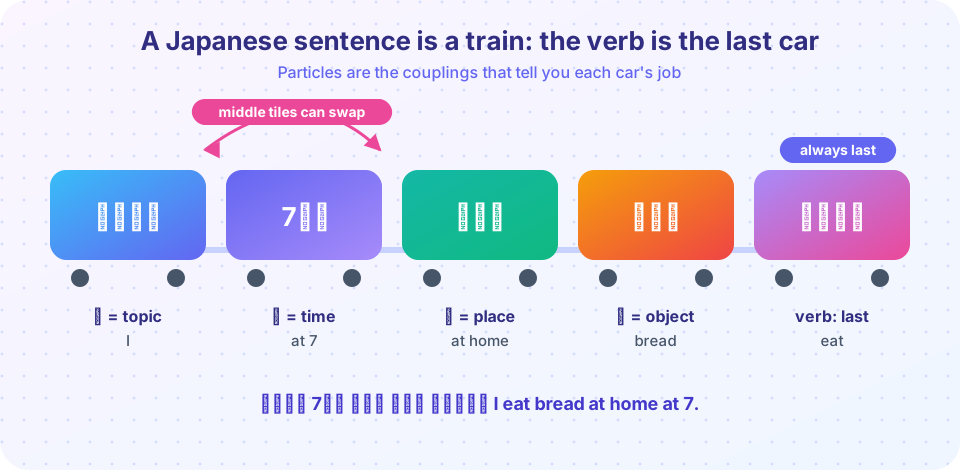
Japanese is a verb-final language, so every sentence in this chapter ends with the verb. A reader or listener builds the picture piece by piece: who (わたしは), when (7じに), where (うちで), what (パンを), and then, finally, what happens to it (たべます). The particle after each piece tells you its job, so the pieces before the verb can be reordered with little change in meaning, though the usual order is time, place, object, verb.
The tiles in the picture are the five slots you will fill most often:
- Topic, marked by は.
- Time, marked by に for clock times and dates.
- Place of action, marked by で.
- Object, marked by を.
- Verb, the last word.
You will not use all five in every sentence. Usually two or three are enough: パンを たべます, "(I) eat bread." Drop what the listener can already guess.
The dictionary form and the polite form
Every verb has a plain form in the dictionary. It always ends in a u-sound: たべる (taberu), のむ (nomu), いく (iku), する (suru). This is the form for friends, family and thoughts. The ます form is its polite twin: たべます, のみます, いきます, します. In this course you will learn to make the ます form from the dictionary form, since the dictionary form is the one you look up and the one that teaches you the group of the verb.
Verbs you already know
You have been using ます verbs since chapter 1 without noticing. ありがとうございます contains ございます, a polite form. いただきます is the ます form of いただく (to receive humbly). おねがいします is the ます form of おねがいする (to request). いってきます is the ます form of the phrase いってくる, with きます, the ます form of くる. Every one of these is a ます verb, which is why the form sounds so familiar. The chapter simply explains the machinery behind phrases you already say.
Try it
First, play with the sentence train. Press Shuffle to reorder the four middle tiles. The verb tile never moves. Every order is natural Japanese, though some orders put a different piece in the spotlight. Press Verb first to see what a wrong order looks like.
Second, count the orders. There are 5 tiles, so 120 possible orderings. How many keep the verb last? The code counts them.
Press Run (or Ctrl + Enter) to see the console output here.
No output.
Common misconceptions
"Japanese word order is completely free." Only the order of the pieces before the verb is flexible. The verb is last.
"ます means present tense only." It is the polite non-past form, covering present habits and the future.
"Every sentence needs all five parts." Most need two or three. Japanese drops what is obvious.
Check your understanding
Quick check · 4 questions
of 4 answered You scored / 4 · perfect!
-
1. Where does the verb go in a Japanese sentence?
Japanese is verb-final. -
2. Which form do dictionaries list?
Dictionaries list the plain form, such as たべる. -
3. What can たべます mean?
ます is a non-past polite form, so it covers present and future. -
4. Which particle marks the object?
を marks the thing acted on.
Summary
- A verb closes the sentence, and particles tag the earlier pieces.
- The ます form is the polite non-past form, covering present and future.
- The usual slot order is topic, time, place, object, verb.
- This chapter teaches the ます form, particles, and existence with あります and います.
Next: The ます form
Track your progress
Create a free account to tick off lessons and pick up where you left off on any device.
of Japanese for Beginners lessons completed