


















Lesson 13 of 50 · Katakana and Basic Grammar
Katakana 1: ア to ノ
Learn the first 25 katakana: vowels and the K, S, T and N rows. Origins, stroke counts, the シ/ツ and ソ/ン lookalikes, the long-vowel bar and real loanwords.
Katakana looks strange for about a day and then becomes easy. You already know the sound of every character, since each katakana is the twin of a hiragana you have learned. In this lesson you learn the first 25: the vowels and the K, S, T and N rows. By the end you will read words such as アイス (aisu, ice), テニス (tenisu, tennis) and ケーキ (kēki, cake) without help.
The only real difficulty in katakana is that a few characters look alike. You will meet the two famous pairs, シ with ツ and ソ with ン, in this lesson and a method for telling them apart that works every time.
What you will learn
- the katakana vowels and the K, S, T and N rows
- where katakana came from and why the shapes are angular
- how to tell シ from ツ and ソ from ン
- how the long-vowel bar ー works
- how to read about ten everyday loanwords
Key terms
Katakana (片仮名): "fragment kana", a script made from pieces of kanji.
Chōonpu (長音符, ー): the long-vowel bar, a horizontal line used in katakana to stretch a vowel by one beat.
Gairaigo (外来語): a loanword.
Lookalike: two characters that differ only by stroke direction or position.
Where katakana came from
Hiragana was formed from whole, cursive kanji. Katakana was built differently. Buddhist monks in the ninth century used parts of kanji as quick sound reminders while they studied texts, so the script is literally made of fragments, which is what its name means. That is why katakana consists of straight lines, sharp corners and few curves. For example, イ is the left part of 伊, and ア comes from the left part of 阿.
| Kana | From kanji | Kana | From kanji | Kana | From kanji |
|---|---|---|---|---|---|
| ア | 阿 | カ | 加 | サ | 散 |
| イ | 伊 | キ | 幾 | シ | 之 |
| ウ | 宇 | ク | 久 | ス | 須 |
| エ | 江 | ケ | 介 | セ | 世 |
| オ | 於 | コ | 己 | ソ | 曽 |
| Kana | From kanji | Kana | From kanji | Kana | From kanji |
|---|---|---|---|---|---|
| タ | 多 | ナ | 奈 | ネ | 祢 |
| チ | 千 | ニ | 二 | ノ | 乃 |
| ツ | 川 | ヌ | 奴 | ||
| テ | 天 | ||||
| ト | 止 |
The characters, row by row
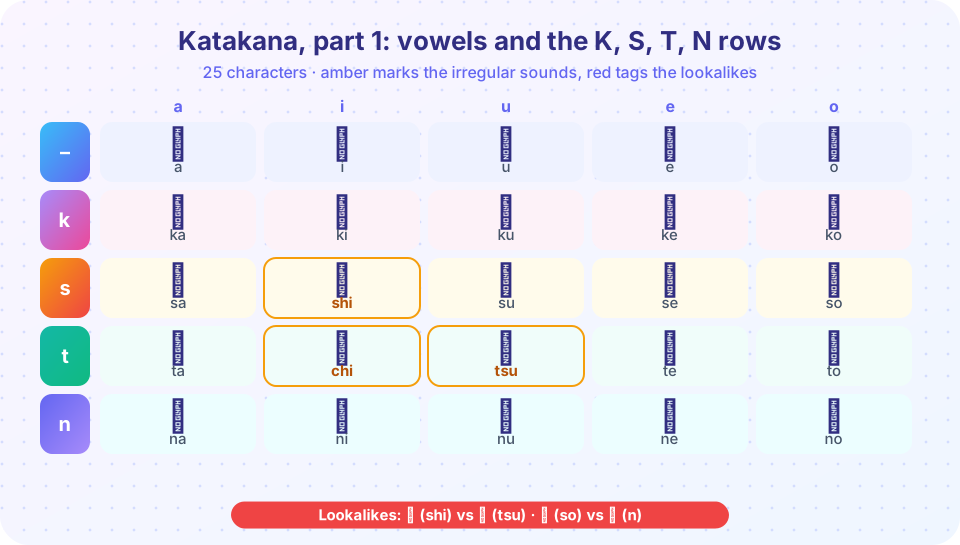
Vowels: ア a, イ i, ウ u, エ e, オ o K row: カ ka, キ ki, ク ku, ケ ke, コ ko S row: サ sa, シ shi, ス su, セ se, ソ so T row: タ ta, チ chi, ツ tsu, テ te, ト to N row: ナ na, ニ ni, ヌ nu, ネ ne, ノ no
The irregular sounds are the same as in hiragana: シ is shi, チ is chi and ツ is tsu.
Stroke counts, which help your handwriting look correct: ア 2, イ 2, ウ 3, エ 3, オ 3, カ 2, キ 3, ク 2, ケ 3, コ 2, サ 3, シ 3, ス 2, セ 2, ソ 2, タ 3, チ 3, ツ 3, テ 3, ト 2, ナ 2, ニ 2, ヌ 2, ネ 4 and ノ 1. The stroke-order rules are the same as for hiragana: top to bottom, left to right, and horizontals before verticals when they cross.
The lookalikes: シ, ツ, ソ and ン
These four characters look almost the same, and no learner escapes them. You will learn ン in the next lesson, but practise the whole set now.
The trick is the direction of the long stroke and where the short strokes sit.
- シ (shi) and ン (n): the two short strokes sit side by side on the left, and the long stroke starts at the lower left and sweeps upward to the right. Think of a smile or a rising wave.
- ツ (tsu) and ソ (so): the short strokes sit on top or at the upper left, and the long stroke starts at the top and falls downward to the left, like a falling arrow.
A second trick: シ has its first two strokes nearly horizontal; ツ has its first two strokes nearly vertical. Writing each of the four ten times, saying the sound aloud, will fix the difference.
Other lookalikes: ク (two strokes) and タ (three strokes: タ is ク with an extra stroke inside); ト and ナ (ナ has a horizontal bar that crosses); ニ (two flat strokes) and ヌ.
The long-vowel bar ー
Katakana lengthens a vowel with a short line, ー (chōonpu). In horizontal writing it is a horizontal line; in vertical writing it is a vertical one. It stands for one extra beat of the previous vowel.
- ケーキ: kēki (cake) = ke, ー, ki: three beats.
- スキー: sukī (ski) = su, ki, ー: three beats.
- タクシー: takushī (taxi) = ta, ku, shi, ー: four beats.
- セーター: sētā (sweater).
Hiragana lengthens by adding a vowel kana; katakana uses ー. Practise the beat rule: ー takes a full beat, just like a vowel kana would.
Real words to read
Read these aloud before checking the romaji:
| Word | Romaji | Meaning |
|---|---|---|
| アイス | aisu | ice, ice cream |
| テニス | tenisu | tennis |
| ケーキ | kēki | cake |
| スキー | sukī | skiing |
| タクシー | takushī | taxi |
| トースト | tōsuto | toast |
| ココア | kokoa | cocoa |
| セーター | sētā | sweater |
| ソース | sōsu | sauce |
| ネクタイ | nekutai | necktie |
| オーケー | ōkē | OK |
| コート | kōto | coat |
Notice the pattern: English words are heard through Japanese sounds. "Tennis" has two syllables in English but three in Japanese (te-ni-su), because every consonant needs a vowel. The next lesson and the loanword lesson will build on this.
Katakana in the wild
Even with only 25 characters you can read a surprising amount of everyday Japanese. A convenience store freezer says アイス (ice cream). A tennis club sign says テニス. Taxi stands, bakery windows and menus offer タクシー, ケーキ and ココア. In winter shops sell セーター and コート, and at a barbecue you might see ソース on the table. Katakana appears on packaging because it looks crisp and modern, and because brand and product names are often foreign.
Because the same words are written in the same way everywhere, reading them is a quick way to practise. Next time you see a katakana word, sound it out slowly beat by beat before you try to guess its meaning. The pattern "read first, understand second" is the fastest way to build both speed and vocabulary.
Hiragana twins that look alike
Several katakana are close cousins of their hiragana twins, which makes them easy to learn: カ and か, ト and と, ニ and に, ヘ and へ (the same shape in both scripts), and リ and り. If you know a hiragana twin, ask yourself what has been "straightened out": katakana usually keeps the skeleton of the character and removes the curves. Other pairs, such as ア and あ or ネ and ね, look quite different, so learn those by themselves.
A four-step method for the first 25
- Learn five at a time. Take a row (for example カ, キ, ク, ケ, コ), say each sound and write it five times.
- Link each to its twin. Say "ka: か and カ" so that your brain connects the new shape to an old one.
- Read short words immediately. After each row, read the words that use it: ケーキ after the K row, テニス after the T row.
- Review in mixed order. Use the quiz in this lesson and mix old rows with the new ones.
Most learners need about three study sessions for the 25 characters and a few more for the lookalikes. It is normal to feel slow at first, because you are retraining your eyes for a new set of shapes.
More words to read
Read these aloud, then check: テスト (tesuto, test), スタート (sutāto, start), ケース (kēsu, case), タイ (Tai, Thailand), スイス (Suisu, Switzerland), ニース (Nīsu, Nice, the French city) and ノート (nōto, notebook). Each word uses only the characters from this lesson and the bar ー. If you hesitate on シ and ツ, go back to the lookalike tricks above and try again.
Common misconceptions
"シ and ツ are the same thing." They are different letters, and swapping them changes the word: ツ in ツアー (tsuā, tour) cannot be シ.
"The bar ー is a dash and can be skipped." It is a full beat. ケーキ (kēki) is not ケキ.
"I can learn katakana without writing." The lookalikes especially need handwriting practice.
Try it
First, a quiz on the 25 characters you just learned. Type the romaji for each katakana.
Second, a console reader for katakana. It knows the long-vowel bar: when it sees ー, it replaces the last vowel with its long form (e becomes ē, and so on). Add your own words from this lesson to the list.
Press Run (or Ctrl + Enter) to see the console output here.
No output.
Check your understanding
Quick check · 5 questions
of 5 answered You scored / 5 · perfect!
-
1. Which character is read tsu?
ツ is tsu. シ is shi and ソ is so. -
2. What does the bar ー do in ケーキ?
ー adds one beat to the previous vowel: ke-e-ki, written ケーキ. -
3. How can you tell シ from ツ?
The direction of the long stroke and the angle of the short strokes separate them. -
4. What does タクシー mean?
タクシー (takushī) is a taxi. -
5. Where did the shapes of katakana come from?
Katakana is made from fragments of kanji; hiragana comes from whole cursive kanji.
Summary
- The first 25 katakana are the vowels and the K, S, T and N rows.
- Katakana was built from pieces of kanji, so it is angular.
- シ and ン sweep upward, ツ and ソ fall downward; practise them in pairs.
- ー is a full beat that stretches the previous vowel.
- Katakana loanwords such as ケーキ, スキー and タクシー are easy to read now.
Next: Katakana 2: ハ to ン
Track your progress
Create a free account to tick off lessons and pick up where you left off on any device.
of Japanese for Beginners lessons completed