


















Lesson 9 of 50 · Sounds and Hiragana
Hiragana 3: the Y, R, W rows and ん
Finish the 46 basic hiragana: ya, yu, yo, the R row, わ, を and ん. Learn the odd gaps in the table, the rules for を and ん, lookalikes and real words.
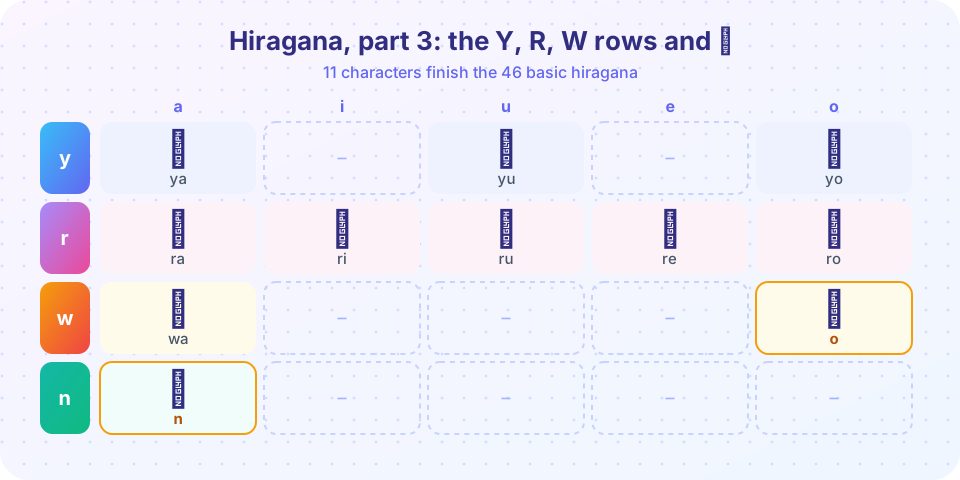
This is the last stretch of the basic hiragana table. You have 35 characters and need 11 more: や ゆ よ (the Y row), ら り る れ ろ (the R row), わ and を (the W row) and the lone character ん. When you finish, you will know all 46 basic hiragana, and nearly every simple sentence in this course will be readable without romaji.
The shape of today's table differs from the earlier ones. The Y row has only three members and the W row has only two. That is not a mistake in this course: the sounds yi, ye and wu do not exist in standard Japanese, and the old characters for wi and we (ゐ and ゑ) are no longer used. You do not need to learn the old ones, but you may spot ゐ and ゑ on old signs or as a brand-style decoration.
What you will learn
- the characters of the Y, R and W rows
- the special behaviour of を (only a particle) and ん (a full beat of its own)
- how to avoid the main lookalike traps (る and ろ, わ and れ and ね)
- how to read a dozen more words and three short sentences
Key terms
Moraic nasal (撥音, hatsuon): the sound ん, which takes one beat by itself.
Object particle (を): the particle that marks the thing acted on; it is read o.
Tap (/ɾ/): the quick tongue touch used for the Japanese r.
Apostrophe in romaji: a mark that separates ん from the vowel after it, as in hon'ya.
The Y row: や ゆ よ
| Kana | Sound | Strokes | Comes from |
|---|---|---|---|
| や | ya | 3 | 也 |
| ゆ | yu | 2 | 由 |
| よ | yo | 2 | 与 |
These three sounds also serve as the small ゃ ゅ ょ that you will use in the next lesson to build combinations such as きゃ (kya). Learning them well now pays off later.
The R row: ら り る れ ろ
| Kana | Sound | Strokes | Comes from |
|---|---|---|---|
| ら | ra | 2 | 良 |
| り | ri | 2 | 利 |
| る | ru | 1 | 留 |
| れ | re | 2 | 礼 |
| ろ | ro | 1 | 呂 |
Pronounce each with the quick tongue tap from lesson 2. Between l and d and r in English, the Japanese r takes some practice. A common trick: say "butter" quickly and stop on the middle sound, then add the vowel.
わ, を and ん
| Kana | Sound | Strokes | Comes from |
|---|---|---|---|
| わ | wa | 2 | 和 |
| を | o | 3 | 遠 |
| ん | n | 1 | 无 |
わ is a normal wa, as in わたし (watashi, I).
を is the odd one. It is pronounced exactly like お, o, but it is only used as a particle: the object marker. You never find を inside a word. In romaji, many textbooks write it o (as this course does) and some write wo. On a Japanese keyboard, you type wo to produce を and o for お.
ん is the only kana that is a consonant by itself. It is one full beat of rhythm (a "moraic nasal") and its sound shifts with what follows. In にほん (Nihon), it is a plain n at the end. Before p, b or m it sounds like m, as in さんぽ (sanpo, a walk). Before k or g it is closer to the ng of "sing". You do not need to think about it: say a nasal sound for one beat and your mouth will do the rest. When ん sits before a vowel or y, romaji separates it with an apostrophe to avoid confusion: ほんや is hon'ya (bookshop), not honya (which would be read ho-nya).
Real words and sentences
| Word | Romaji | Meaning |
|---|---|---|
| やま | yama | mountain |
| ゆき | yuki | snow |
| ゆめ | yume | dream |
| やすみ | yasumi | rest, holiday |
| よる | yoru | night |
| りす | risu | squirrel |
| くるま | kuruma | car |
| れきし | rekishi | history |
| ろく | roku | six |
| らいおん | raion | lion |
| わたし | watashi | I, me |
| ほん | hon | book |
| にほん | Nihon | Japan |
| さかな | sakana | fish |
| みなみ | minami | south |
| かんたん | kantan | easy |
| あります | arimasu | there is (for things) |
Now three whole sentences, using only the characters you know:
- ほんを よみます。 (Hon o yomimasu.) "I read a book." The particle を marks ほん as the object, and the verb よみます comes last.
- わたしは にほんに いきます。 (Watashi wa Nihon ni ikimasu.) "I will go to Japan." Here は is wa, and the particle に marks the destination.
- ねこは あそこに います。 (Neko wa asoko ni imasu.) "The cat is over there."
Congratulations: you have just read three real sentences. Do not worry about the grammar yet; chapters 3 and 4 explain every piece.
Lookalikes
- る and ろ: る ends in a small loop; ろ does not.
- わ, れ and ね: all three start with a vertical stroke on the left. ね ends in a loop, れ ends with an outward flick, and わ ends with a rounded curve that comes back toward the vertical stroke.
- り and い: the two strokes of い are about the same size; the second stroke of り is much longer and hooks at the bottom.
- ん and ろ: ん is a single angled stroke without a loop; ろ is a rounded 3-shape.
Reading a sentence slowly
Take the sentence ほんを よみます. A beginner reads it in four steps, and a fluent reader does the same steps so fast that they feel like one.
- Break at the spaces: ほんを / よみます. (Real texts have no spaces, but this course adds them to help you.)
- Spot the particle: the final を in ほんを is the object marker, so ほん is the object.
- Read the verb last: よみます is yo - mi - ma - su. The ます ending tells you it is a polite verb.
- Put it together: "(I) read a book."
The sentence わたしは にほんに いきます works the same way: わたしは is "as for me", にほんに is "to Japan" and いきます is "go". The meaning comes together at the end, when you read the verb.
Why does the table have gaps?
The Y and W rows are short because the gojūon table records the sounds of old Japanese. Over a thousand years, the sounds yi, ye and wu disappeared from the spoken language, and wi, we and wo merged into plain i, e and o. The kana for those sounds (ゐ, ゑ and in part を) either fell out of use or, in the case of を, were kept for a single grammatical job. So when you see を, you are seeing a fossil of a sound that no longer exists, kept alive because it makes the object particle easy to spot.
Typing を and ん
On a computer or phone with a Japanese keyboard, you type wo to get を and o to get お. For ん, type nn, or type n and then a consonant (kantan gives かんたん). If you need ん before a vowel, as in ほんや, type n'ya or nn then ya. These small typing rules are useful to learn now, because typing in Japanese is one of the best ways to practise reading and spelling.
A short passage to read
Here are four lines that use only the kana you know. Read them aloud, then check the meaning below each line.
ほしを みます。 Hoshi o mimasu. "I look at the stars."
ねこは ほんの うえに います。 Neko wa hon no ue ni imasu. "The cat is on top of the book."
わたしは よるに ほんを よみます。 Watashi wa yoru ni hon o yomimasu. "I read a book at night."
ちいさい ねこは ふねの なかに います。 Chiisai neko wa fune no naka ni imasu. "The small cat is in the boat."
Even partial success on a real sentence is a good sign. If a word such as よる or なか is new, look at its romaji, then read the whole line again without it.
Common misconceptions
"を is the wo sound." In modern standard Japanese it is just o, and it is only a particle.
"ん is just n and nothing more." It is a full beat, and its sound changes with the next consonant. Practising the beat helps with words such as にほん and ほんや.
"The R row is the same as English r." It is a tap, closer to a quick d or the Spanish single r.
Try it
First, a full quiz covering the last 11 characters, optionally mixed with the first 35.
Second, a full reader for all 46 basic hiragana. It knows the special rules from lessons 2 and 3: は, へ, を and に as particles (a simplification, since a real reader would need a dictionary to be sure), and the apostrophe after ん before a vowel or y. Try adding your own words.
Press Run (or Ctrl + Enter) to see the console output here.
No output.
Check your understanding
Quick check · 5 questions
of 5 answered You scored / 5 · perfect!
-
1. How is を read?
を is pronounced o, and it is only used as the object particle. -
2. How many beats is ん?
ん counts as one full mora, which is why にほん has three beats. -
3. Which character has a loop at the end: る or ろ?
る ends in a loop; ろ is a rounded 3 without one. -
4. What does ほんを よみます mean?
ほん is book, を marks the object and よみます is the verb read. -
5. Why does ほんや use an apostrophe in romaji (hon'ya)?
Without the apostrophe the word would look like ho-nya. The apostrophe signals ん then や.
Summary
- The Y, R and W rows add 11 characters: や ゆ よ; ら り る れ ろ; わ を ん. The basic table is now complete (46 characters).
- を is read o and is only a particle; ん is its own full beat.
- Y and W rows have gaps because sounds like yi, ye and wu do not exist.
- Lookalikes る / ろ, わ / れ / ね and り / い need side-by-side practice.
- You can now read complete simple sentences such as ほんを よみます.
Track your progress
Create a free account to tick off lessons and pick up where you left off on any device.
of Japanese for Beginners lessons completed