


















Lesson 2 of 50 · Getting Started
How Japanese works
A clear tour of Japanese for beginners: the three writing systems, verb-last word order, particles, dropped subjects and the levels of politeness.
Before you learn a single character it helps to see the whole machine. Japanese is built differently from English in four ways that you will meet in every lesson: it uses three scripts side by side, it puts the verb at the end of the sentence, it uses small marker words called particles to show who does what, and it adjusts its politeness to the person you are talking to. Once you understand these four ideas, the rest of the course is filling in the details.
Japanese is the national language of Japan and is spoken by well over 120 million people, almost all of them in Japan. It belongs to its own small language family, the Japonic languages, which also includes the Ryukyuan languages of Okinawa and the nearby islands. It is not a dialect of Chinese and is not related to Chinese by grammar. What Japanese borrowed from China, about fifteen centuries ago, was a writing system and a large number of words. The grammar stayed Japanese.
What you will learn
- the three scripts and the job each one does
- why the verb comes last and how particles keep sentences clear
- what "dropping the subject" means and why Japanese can do it
- the three broad levels of politeness and why this course uses the polite one
- how to order names and how to use the polite title さん
Key terms
Hiragana (ひらがな) is the rounded syllable script used for grammar words and endings.
Katakana (カタカナ) is the angular syllable script used mainly for foreign loanwords and names.
Kanji (漢字) are Chinese-origin characters that carry meaning.
SOV stands for subject, object, verb: the basic order of a Japanese sentence.
Particle (助詞, joshi) is a short word that marks the role of the word before it.
Three scripts, one sentence
English uses one alphabet. Japanese uses three scripts together, and a single ordinary sentence often contains all of them. Look at 私はコーヒーを飲みます (Watashi wa kōhī o nomimasu, "I drink coffee").
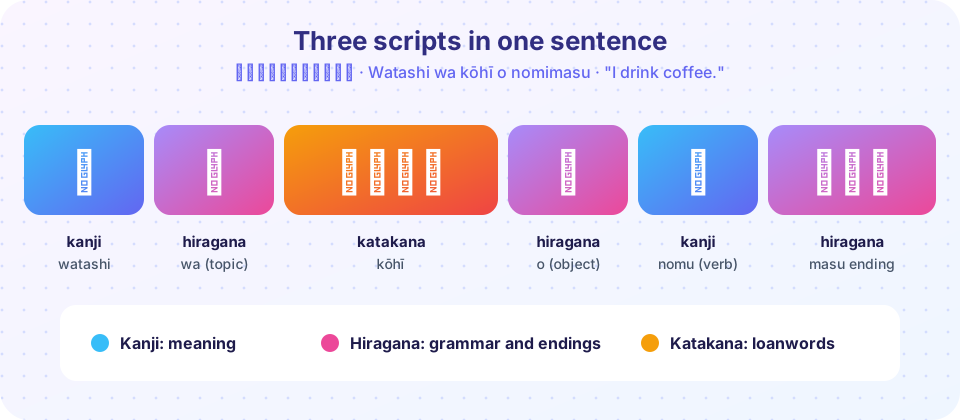
Each script has a different job:
- Kanji carry the core meaning of nouns, verb stems and adjectives: 私 (watashi, I) and 飲 (nomu, to drink). A reader's eye lands on kanji first, and that is why Japanese stays readable without spaces.
- Hiragana writes everything grammatical: the particles は and を, the ending ます, and verb and adjective endings. It also writes native words that have no kanji or whose kanji are too hard.
- Katakana writes words borrowed from other languages (コーヒー from English coffee), foreign names, and words that need emphasis, a bit like italics in English.
There are 46 basic hiragana, 46 basic katakana and 2,136 kanji on the government's list of everyday characters (the jōyō kanji). That last number sounds scary, and it is why this course introduces kanji slowly, in chapter 7. In chapters 1 to 6 nearly everything is written in kana, which is also how Japanese children's books start.
There is also romaji, Japanese in Latin letters. You see it on train station signs, in dictionaries for learners and on keyboards. Japanese people type using romaji and a computer converts it to kana and kanji.
Verb last: the SOV pattern
English says "I eat bread" (subject, verb, object). Japanese says, in word-for-word order, "I bread eat". The verb is always the last word of a sentence, with only small sentence-ending words (like the question marker か) allowed after it.
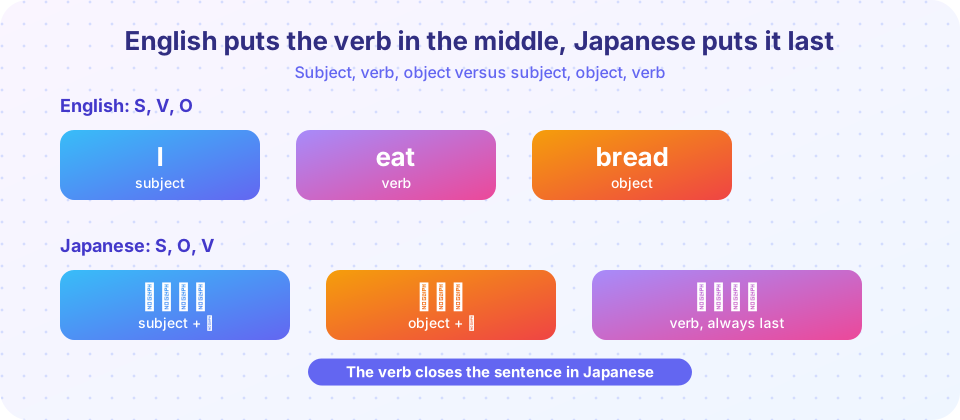
The Japanese version is わたしは パンを たべます (watashi wa pan o tabemasu). Notice the small words は and を. They are particles, and they are the secret of Japanese word order. Because the particle tags the job of each word, the order of the other parts can move around without confusion:
- わたしは パンを たべます (watashi wa pan o tabemasu), "I eat bread."
- パンを わたしは たべます (pan o watashi wa tabemasu), "Bread, I eat."
Both are correct. The second puts bread in the spotlight. The only fixed rule is that the verb ends the sentence. In English, word order does the work that particles do in Japanese, and that is why English word order is rigid.
A beginner's tip: when you listen to Japanese, wait for the end of the sentence. The verb arrives last and tells you the action, the tense and whether it is positive or negative. Skilled listeners follow along by recognising the particles as they go.
Dropping what is obvious
Japanese speakers leave out words that the listener can already work out. If you and a friend are talking about your friend's weekend, you do not say "you" again and again. The subject, the object and even the topic can disappear. This is normal, not sloppy.
- コーヒーを のみます。(Kōhī o nomimasu.) Literally: "Coffee drink." Depending on context: "I drink coffee", "She drinks coffee."
There are also no articles ("a", "the") and, in most cases, no plural endings. ねこ (neko) can mean "a cat", "the cat", "cats" or "the cats". Context supplies the answer. Verbs do not change for person either: たべます (tabemasu) is the same for I, you, he, she, we and they. Many beginners find this a relief.
Politeness levels
Japanese grammar encodes the relationship between speaker and listener. There are three broad levels, and each level changes verb endings and some vocabulary:
| Level | Name | Example for "eat" | When |
|---|---|---|---|
| Casual (plain) | 普通形, futsūkei | たべる (taberu) | friends, family, thoughts |
| Polite | 丁寧語, teineigo | たべます (tabemasu) | strangers, shops, work, class |
| Honorific / humble | 敬語, keigo | めしあがる, いただく (meshiagaru, itadaku) | customers, bosses, formal writing |
This course teaches the polite level. It is the safest choice: if you use polite speech with a friend it sounds a little formal, but never rude, whereas casual speech with a stranger can sound abrupt. We will meet plain forms in later chapters because you need them to understand shows and friends, and we will touch honorific language only lightly.
Names and titles
In Japan the family name comes first: 田中 花子 is Tanaka Hanako, where Tanaka is the family name. Foreign names are usually written in katakana: リサ・スミス (Risa Sumisu, Lisa Smith). When speaking about another person, add さん (-san) after the name: たなかさん. It works for any adult, male or female, married or not. Never add さん to your own name. It is a title of respect for others, so using it for yourself sounds odd, like calling yourself "Mr. Me" in English.
Common misconceptions
"Japanese has no grammar." It does, and it is quite regular. Verbs, for example, have very few irregular forms: you will meet only two irregular verbs (する and くる) in this course.
"Kanji are the same as Chinese characters." Many are shared, but meanings and readings differ, and Japanese kanji are only one of three scripts. Japanese and Chinese have different grammar and different spoken languages.
"The particle は is pronounced ha." As a particle it is pronounced wa. Everywhere else the character is ha. We return to this in lesson 4 of chapter 2.
Try it
The first demo sorts every character of a sentence into one of the three scripts, using the position of each character in Unicode (the standard numbering of characters). Type or paste any Japanese, and watch the colours.
The second demo shows that Japanese order is subject, object, verb. In the console, a small function builds a sentence from three parts and always puts the verb last, even if you list the parts in a different order.
Press Run (or Ctrl + Enter) to see the console output here.
No output.
Check your understanding
Quick check · 5 questions
of 5 answered You scored / 5 · perfect!
-
1. Which script is mainly used for foreign loanwords such as コーヒー?
Katakana writes loanwords, foreign names and emphasis. Hiragana writes grammar, kanji writes meaning. -
2. Where does the verb go in a basic Japanese sentence?
Japanese is a verb-last language: subject, object, then verb. -
3. What do particles such as は and を do?
Particles tag roles such as topic and object, which is why other word order can be flexible. -
4. Which politeness level does this course teach first?
Polite speech is the safest starting point because it is acceptable with nearly everyone. -
5. How do you refer politely to Ms. Tanaka?
さん follows the name. It is never used for yourself.
Summary
- Japanese combines kanji (meaning), hiragana (grammar) and katakana (loanwords) in one sentence.
- Word order is subject, object, verb: the verb always comes last.
- Particles mark roles, so the order of other parts is flexible.
- Subjects and objects are dropped when obvious; there are no articles, no gender and, usually, no plural forms.
- Politeness is built into the verb endings; this course teaches the polite level first.
- Family name comes first; add さん to other people's names, never to your own.
Track your progress
Create a free account to tick off lessons and pick up where you left off on any device.
of Japanese for Beginners lessons completed