


















Lesson 6 of 50 · Sounds and Hiragana
Mora, rhythm and pitch
Master the sounds of Japanese: five pure vowels, tricky consonants like r and f, the mora rhythm, long vowels, double consonants and a first look at pitch accent.
Pronunciation is the easiest part of Japanese to get almost right and the hardest to get exactly right. Almost right is enough to be understood: the language has few sounds, and Japanese listeners are patient with learners. But a few habits, once fixed, make you sound far more natural. Those habits are short pure vowels, a quick tapped r, an even rhythm in which every beat has the same length, and a small pitch pattern that tells apart a few common words.
This lesson explains each of these. It uses IPA (the International Phonetic Alphabet) in slashes such as /a/ for precision, and always gives an English comparison, but remember that English comparisons are approximate. When you can, copy a real speaker.
What you will learn
- the five Japanese vowels and how they differ from English vowels
- the consonants that look familiar but sound a bit different (r, f, tsu, ん)
- how the mora rhythm works, including long vowels and doubled consonants
- how vowels sometimes whisper in です and ます
- what pitch accent is and how it separates words such as 雨 and 飴
Key terms
IPA: symbols that write sounds exactly, for example /ɯ/ for the Japanese う.
Mora (拍): a unit of rhythm; each mora lasts about the same time.
Moraic nasal: the sound ん, which is a full beat of its own.
Devoiced vowel: a vowel that is whispered, as in the end of です (des).
Pitch accent: a high-low pattern in a word; Japanese uses pitch, not loudness, to mark it.
Five vowels
Japanese has five vowels, and each one is short, clear and steady. In English, vowels often glide: "go" slides from "o" to "w". Japanese vowels do not. Say each one and keep the mouth still.
| Kana | Romaji | IPA | Close English sound | Tip |
|---|---|---|---|---|
| あ | a | /a/ | "ah" in "father" | open the mouth wide, but make it short |
| い | i | /i/ | "ee" in "machine" | smile; do not glide into "y" |
| う | u | /ɯ/ | between "oo" and "ee" | lips relaxed and flat, not rounded |
| え | e | /e/ | "e" in "bed" | no glide into "ee" |
| お | o | /o/ | "o" in "or" | lips rounded, not "oh-oo" |
A good test: say "okay" in English and you hear "oh-kay-ee". The Japanese version ōkē (オーケー) holds a pure "o" then a pure "e". Every vowel is also the same length, no matter where in the word it stands. English reduces unstressed vowels to a weak "uh" (the first a in "banana"); Japanese does not.
Consonants that deserve attention
Most consonants are close to English. A few need care.
- r (ら, り, る, れ, ろ) is a quick tap, /ɾ/, like the middle sound of "butter" in American English or the Spanish single r. It sits between English r, l and d. Never roll it, and do not curl your tongue as for the English r.
- ふ (fu) is not an English "f". Make a soft breath through lips as if blowing out a candle, /ɸɯ/. English speakers saying "foo" with teeth on the lip are understood too, but the lip-only sound is native.
- つ (tsu) is a "ts" like the end of "cats", followed by /ɯ/. It can begin a word, which feels odd to English speakers: つき (tsuki, moon).
- し (shi) and ち (chi) are "sh" and "ch" before a very clear i, as in "sheep" and "cheap".
- ん (n) changes shape. Before p, b, m it is closer to m; before k and g it is closer to the ng of "sing"; at the end of a word it can be a nasal vowel. Japanese speakers do this without noticing. A beginner can safely say a plain "n" every time.
- g (が, ぎ, ぐ, げ, ご) is a hard g as in "go" at the start of words. In some Tokyo speech older speakers say it as ng in the middle of words, but it is not required.
The mora: a beat, not a syllable
English builds rhythm on stressed syllables. Japanese builds rhythm on mora, units of equal length. Each of the following counts as one beat:
- a plain kana: か (ka)
- a vowel by itself: あ
- the sound ん
- a small っ (a short silent pause that doubles the next consonant)
- the second half of a long vowel, written with an extra vowel kana or ー
A small や, ゆ or よ after a kana (きゃ, しゅ, ちょ) does not add a beat: the two kana blend into one. So きょう (kyō, today) has two beats, and とうきょう (Tōkyō) has four: と, う, きょ, う.
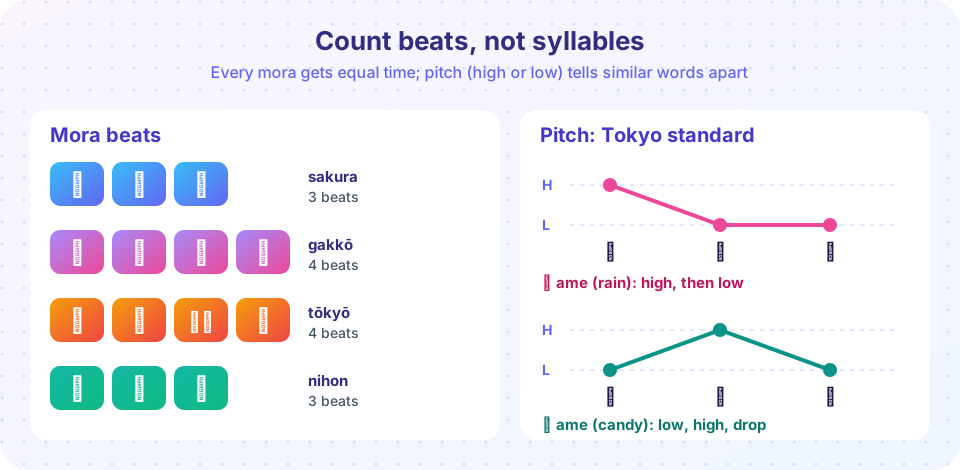
Why does this matter? Because beat length is meaning. Compare these pairs (you will learn the kana in the next lessons):
| Short | Meaning | Long or doubled | Meaning |
|---|---|---|---|
| おばさん (obasan) | aunt | おばあさん (obāsan) | grandmother |
| ゆき (yuki) | snow | ゆうき (yūki) | courage |
| きて (kite) | come (and) | きって (kitte) | stamp |
| おじさん (ojisan) | uncle | おじいさん (ojiisan) | grandfather |
If you shorten a long vowel or a double consonant, you say a different word. When you practise, tap the table with your finger for each beat and aim for an even tap.
Quiet vowels: です and ます
Japanese speakers often whisper the vowels /i/ and /ɯ/ when they sit between two voiceless consonants (such as k, s, t, h, p, sh) or at the end of a word after one. This is called devoicing. It explains why です is heard as des and ます as mas: the final vowel almost disappears. Likewise in すき (suki, "like"), the first u is nearly silent: ski. You do not need to practise devoicing deliberately, but if you hear it, you now know why.
Pitch accent
English marks one syllable in a word with stress (louder and longer). Japanese marks a pitch pattern: each beat is high (H) or low (L), and the point where the pitch drops, if any, is part of the word. The standard Tokyo pattern follows two rules: the first and second beats differ in pitch (one is low and the other high), and once the pitch drops in a word it does not rise again.
The famous example is 雨 (rain) and 飴 (candy), both pronounced ame:
- 雨: H-L. The pitch starts high and drops on the second beat. A following particle such as が stays low (あめが = H-L-L).
- 飴: L-H. The pitch starts low and rises to high. A following particle が drops back to low (あめが = L-H-L).
Another trio is はし: 箸 (chopsticks) is H-L, 橋 (bridge) is L-H with a drop on the following particle, and 端 (edge) is L-H and stays high with the particle. In writing in hiragana all three look the same: はし. Only pitch and context separate them.
Pitch accent differs by region. Everything here is the standard Tokyo pattern. In Kansai (Osaka and Kyoto), many accent patterns are different or even reversed, and native speakers understand one another anyway. Pitch rarely causes real confusion because context already tells you the meaning. For now, listen for the shape, then learn each word's accent from a dictionary or a teacher as your vocabulary grows.
Practising with shadowing
Reading about sounds only goes so far; you must hear and imitate them. The best-known method is shadowing: listen to a short Japanese sentence, then say it right after the speaker, as a shadow follows its owner. Use any short, clear recording of a native speaker, such as a news excerpt, a language-lesson dialogue or a children's show.
- Listen to a sentence once without speaking, and notice its rhythm and where the pitch falls.
- Play it again and repeat it a fraction of a second behind the speaker.
- Repeat the same sentence until your rhythm matches theirs.
- Record yourself and compare.
Do not aim to understand every word: focus on rhythm, on the length of long vowels and on keeping each beat even. Five minutes a day builds the "ear" that no explanation can give you.
Common misconceptions
"Japanese has tones like Chinese." It does not. Pitch accent is a pattern inside a word, and it never changes the meaning of every syllable the way a Mandarin tone does.
"Japanese is spoken in a flat monotone." The pitch moves; it simply does not carry stress. A rise-and-fall melody gives natural speech its sound.
"Syllables and mora are the same." They are not: とうきょう has two syllables (tō-kyō) but four mora, and the timing follows the mora.
"I can skip long vowels." Length can change meaning, as in おばさん (aunt) and おばあさん (grandmother).
Try it
The first demo is a chart of pitch contours. It plots the three はし words with the particle が, so you can see where the pitch falls. This is a simplified model: it draws high and low as two levels.
Press Run (or Ctrl + Enter) to see the result here.
Program input · what you'd type while the program runs
Type the answers before you press Run, one per line. Each time the program reads a line (with input()), it gets the next line from this box.
The second demo splits any hiragana word into beat boxes. Type a word (try きょう, がっこう, おばあさん, とうきょう) and count the boxes.
Check your understanding
Quick check · 5 questions
of 5 answered You scored / 5 · perfect!
-
1. Which description fits the Japanese vowel う?
Japanese う is /ɯ/, pronounced with unrounded lips. -
2. How many beats (mora) does とうきょう have?
と, う, きょ, う: the small ょ joins the previous kana, leaving four beats. -
3. How does the Japanese r sound compare with English r?
Japanese r is a tap, /ɾ/. It is quick and light. -
4. Why does it matter that おばさん and おばあさん have different lengths?
おばさん means aunt, おばあさん means grandmother. Long vowels are meaningful. -
5. What does pitch accent mean in Japanese?
Pitch accent is a high-low pattern in a word; it does not use loudness.
Summary
- Japanese has five short, pure vowels: a, i, u (flat lips), e and o.
- The r is a tap; ふ is a soft lip sound; ん is a full beat.
- Rhythm counts mora: each kana, ん, っ and long-vowel half is one beat, but small や ゆ よ do not add one.
- Length is meaningful: long vowels and double consonants change words.
- Pitch accent (Tokyo standard) gives a word a high-low pattern; regional differences exist.
Track your progress
Create a free account to tick off lessons and pick up where you left off on any device.
of Japanese for Beginners lessons completed